The Value of Christmas Trees

"...there is no reason why the joy associated with the Christmas evergreen may not be a means of arousing in the minds of children an appreciation of the beauty and usefulness of trees; and keen appreciation of the beauty and usefulness of trees is a long stop toward the will to plant and care for them (Arthur Sowder, US Forest Service, 1949)."

Friday, February 13, 2015

Changes to Safari Label

Honey bee in white clover

Many of you are no doubt following the news about bee decline in the US and worldwide. Due to concerns about neonicotinoids in particular, the US EPA is making changes to the labels of these products.

Many growers are using Safari (dinotefuran), a neonicotinoid, for the control of elongate hemlock scale in Fraser fir Christmas trees. This product has proven to be the most effective at controlling scale in western North Carolina. Safari can be sprayed on the foliage or it can be applied as a trunk application. Both have proven effective.

The previous label of Safari indicated that plants shouldn't be sprayed if bees are visiting the treated area. This allowed the product to be applied of an evening or at night when bees weren't active.

The new Safari label which came out in 2014, is far more restrictive. The label now states that this product is "toxic to bees exposed to residue for more than 38 hours following treatment. Do not apply this product to blooming, pollen-shedding or nectar-producing parts of plants if bees may forage on the plants during this time period." The label also indicates it can't be applied "while bees are foraging" or "to plants that are flowering. Only apply after all flower petals have fallen off."

In other words -- no flowers period.

So what's a grower to do? Ground covers in Christmas trees are an integral part of integrated pest management. Besides controlling erosion and making the soil cooler so tree roots are closer to the surface, ground covers keep problem weeds from coming into a field and they are habitat for natural predators such as lady beetles, hover flies and lacewings.

In 2013, Jeff Owen conducted several demonstrations to find ways to keep good ground covers while getting rid of flowers and therefore bees. What he found was that our typical chemical mowing with Roundup will burn back flowers in ground covers including white clover within one to two weeks depending on the weather. Therefore, it's important when applying Safari, to time applications after a herbicide treatment. It's also important to scout before making an application to see if bees are visiting the area any further.

Protecting bees from pesticides is important, but flowering ground covers are also important to provide forage for bees as well for natural predators as well. With a little forethought, Fraser fir Christmas tree growers can create a win-win situation for themselves and pollinators.


Monday, October 20, 2014

White Pines in the Loading Yard

It's not always easy to tell why trees start to decline
THE VALUE OF WHITE PINES IN LOADING YARDS: Many Fraser fir growers in the mountains are fortunate enough to have loading yards shaded by white pines. These trees create a cooler and more humid environment for harvested trees.

White pines are native to western North Carolina so you'd think they'd have fewer pest problems. A fast growing tree, most people view white pines as being a lot 'tougher' than Fraser fir. After all you can plant white pines where Frasers have died from Phytophthora root rot and they will most likely survive, even though they are also susceptible to the disease. But white pines do have pest problems and are sensitive to poor sites which, unfortunately, are often associated with loading yards.

Recently, Brian Heath, Forest Health Specialist with the NC Forest Service, helped me walk through a local loading yard that utilized white pines for shade. We discussed some of the pest issues that face these important trees and what a grower can -- and more often cannot -- do about them.

White pine aphids
Tree with pine bark adelgid
PESTS OF WHITE PINE: According to the US Forest Service, there are 227 insects and 110 disease organisms that can attack the eastern white pine. That's a lot of pests! Sill, they seldom cause problems particularly of mature trees. Some, like the pine bark adelgid, can literally cover the trunk of the tree, turning it white, but seldom harm the tree.

White pines grown for Christmas trees or nursery can suffer from several pests such as pine needle scale, introduced pine sawfly, rust mites, white pine aphids (a species of Cinara aphid), weevils including white pine weevil and Pales weevil, and needle blights including ozone injury, but these problems are primarily cosmetic and will not affect trees being grown for shade.
Introduced pine sawfly

STRESS THE MAJOR ISSUE: When it comes to loading yards, it is stress that is the primary cause for concern. Stressed trees attract pests like bark beetles and are more likely to succumb to other pests that usually aren't a problem. The stress, however, is the underlying factor.

White pines in the mountains typically grow on stream banks in areas that are well drained. They grow well on poorer. sandier soils where they can out-compete hardwoods. They do best when planted in undisturbed forest soils. But most loading yards are on level ground that used to be a field or are near a building site. This past soil disturbance affects white pine growth. They may grow well for 20 years, but then often start to decline for no apparent reason. If planted on forested land, those same trees would live as long as 200 years.

Stress continues in the loading yard. Soils are compacted with equipment movement, and trees may be injured by equipment or deicing salt. If the ground is watered to keep cut Christmas trees moist, the white pine roots may stand in water.

Pitch tubes
Stressed white pines are attractive to bark beetles including southern pine beetle, black turpentine beetle, several species of Ips beetles, and Pityogenes beetles. Signs of beetle attack include small holes in the bark and pitch tubes created as the tree tries to keep the beetle out. The beetle lays eggs under the bark and the larval feeding creates distinctive galleries. Several beetles also carry a blue-stain fungus which disrupts the flow of water to the tree's crown.

Cutting pines adjacent to white pines in a loading yard can also bring in a host of problems such as more bark beetles and weevils. In addition, Annosum root rot will infect cut stumps and grow along the roots into adjacent, living trees -- even Fraser fir.
Bark beetles attacked this tree because
it was under stress.

In the loading yard that Brian and I visited, we found black turpentine, Ips and sawyer beetles, pine bark adelgid, and evidence of injury from road construction and/or salt injury. But many symptoms of decline couldn't be pinned down to a specific problem. Procera root rot is also a common disease found on white pines growing in fields, but was not observed at this particular site.

KEEPING WHITE PINES HAPPY: The best possible set up for a loading yard is to put it to the south of a bank planted in white pines. Setting the white pines on undisturbed soil and allowing no traffic on the roots will greatly reduce stress to these trees.

Tree spacing is another issue. You might want to initially plant trees every 6 feet, but they should be thinned to 12 or more feet apart as they get larger. If you are planting two or more rows on a bank, they should be thinned to around 20 feet apart.

Trees growing too close together will experience more stress
If such a setup isn't possible and you have to plant the white pines in areas where greater stress is likely, be prepared for a much shorter lifespan for your trees. They may only live 20 years or so. That means it will take them 10 years to reach a size where they are creating appreciable shade and they may only provide shade for 10 years.

Setting up two loading areas that you could rotate between every 10 years would be the ideal situation but replanting in an existing loading yard is the only option most people have. Just realize that survival may be low. Plant more trees than necessary to replace declining trees, but thin out trees as they get older to 12 or more feet apart.

And don't become too concerned if trees start to decline. That is to be expected. There really isn't any need to treat the trees for incoming pests, the best thing to do is keep them as stress-free as possible.

READ  MORE ABOUT IT:

US Forest Service -- Eastern White Pine

White Pines for Windbreaks

Procera Root Rot of White Pine

Pine Bark Beetles


Wednesday, April 9, 2014

Rust Mites!!!!

I really wouldn't have thought this would be a bad year for rust mites. After all, everyone was hoping that with such a hard winter, there would be fewer pests.

Looks like we were wrong!

Rust mites are cropping up in many fields. They will probably limit the number of fields that can go without an insecticide treatment this spring. But don't just assume you have to treat. Scout first! Twig aphids are now mostly hatched and even spider mites are hatching out. So scout and determine what you need to do.

From my pest management survey, I've learned that a lot of people are depending on either a bifenthrin product such as Sniper and/or dimethoate in the spring for pest control. But with rust mites so bad, neither product is probably the best choice.

Miticides such as Envidor provide a lot longer control of rust mites and spider mites both. Though more expensive, you can treat and pretty much walk away from the situation. So if mites are the only problem and you don't have twig aphids because of a fall treatment, consider just using the Envidor without mixing another product in. That will protect your natural predators.

I also think that bifenthrin is a much better product to use in the fall for Cinara aphid and twig aphid control. Then it should have much less effect on the parasitic wasp that controls the elongate hemlock scale.

The following links will provide help for mite control, twig aphid control and/or scale control.

On other thing... is flowering mustard blooming in your trees? If so, watch out for bees when you spray! Mustard seems to be the plant that brings the most bees in when it is flowering. It is far more attractive to bees than other flowers such as clover. So take special care when mustard is blooming. The following link will help with controlling pests without hurting bees.

If you have any questions, please let me know.

Friday, May 3, 2013

Cryptomeria Scale Resurfaces in Ashe County

On September 1, 2010, I make the following post: Cryptomeria Scale Found in Ashe County. If you went to any of the meetings where I spoke at the following winter, you probably heard about this new scale problem. I've not really talked much about this scale since then and with good reason -- I've not seen it again.

After making this post in 2010, the grower cut down many trees and treated the rest. I couldn't find any live scale after treatment. Since then I've been back to that field several times and scouted in close-by field and never found any more Cryptomeria scale (CS) until today.

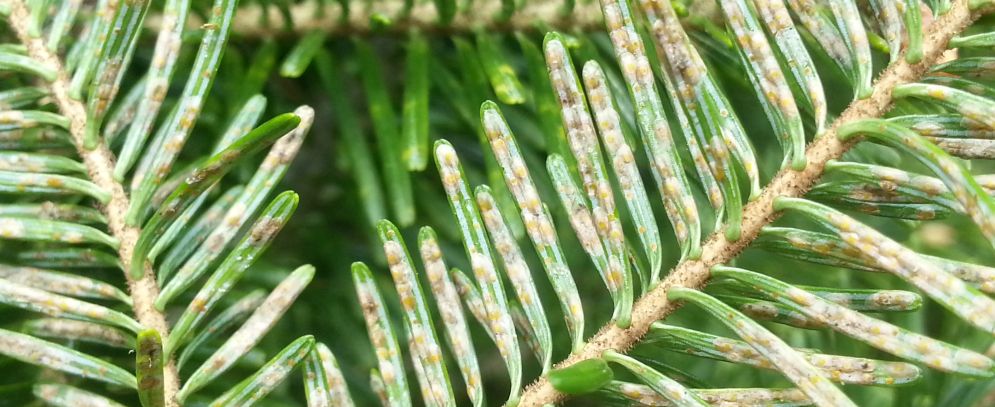
Cryptomeria scale (Aspidiotus cryptomeriae), like elongate hemlock scale (EHS), is another introduced pest from the Orient. It affects many conifers including hemlocks and firs. It causes serious and striking yellow mottling of the foliage and premature needle drop. On the trees we examined today, most of the damage was on the south side of the tree. A few trees were heavily damaged all over with scales even on the needles of the terminal. This is one scale you really don't have to hunt for to find. If it's there, you should see it.

Damage from Cryptomeria scale.
The scale has a very different appearance to EHS. The scales, especially the small immature ones, are round, and they line up in two rows along the backside of the needle on either side of the midrib. They look like fried eggs with a yellow center. The 'white of the egg' is actually where the scale has pushed up the waxy covering of the needle. Older scales are more indistinct.

These younger scales look like they might have been killed, perhaps from a fall
insecticide treatment.
Crawlers will start to appear in another month or so.
The life cycle of CS is similar to EHS. It has two generations per year and is most active in the summer months. It seems to spread very quickly and cause damage very quickly. However, it is much easier to control than EHS.

The scale is spread through crawlers and on infested plant material. This scale was found in three adjacent fields owned by different growers. Next week, we hope to scout other farms in the area to see how far the scale has spread.

Typically when I've found CS, I've also seen the twice-stabbed lady beetle. We didn't find any today. Perhaps it's still too early in the year for this helpful predator.

The grower in 2010 treated in early September and got excellent control. We didn't see any crawlers today, and so it's probably a bit too early to treat -- especially since we are having such a cold, wet spring that's keeping everything from getting active. But we'll definitely be following control from any grower treatments and pass results on.

Tuesday, April 16, 2013

Twig Aphid Hatch -- Spring Pests

Twig aphids. Looked at twig aphid hatch again today. I found just over 90% of the eggs hatched (it worked out to 93%) and there were a couple of aphids that had molted. However, when Jerry Moody and I were doing beats on trees, we were still finding that they were hard to find. So if you do start scouting for twig aphids in the next few days, if you find any at all, you should probably treat in go-to-market trees.

Aphids should all be hatched out in the next few days.

Woollies. Last week we found that only a few balsam woolly adelgid eggs have been lain. This week there were whole lot more. The adults still haven't produced much wool.

Spider mites. I found my first spider mites crawling around today. Many are encysted. That means that they are molting from an immature to more mature state. When they do this, they look like they are dead. They don't move, but they are in fact alive. They are just molting and it takes awhile.

The next couple of days are supposed to be wet, but after that, start scouting trees that were treated last fall to determine if you need to treat this spring for twig aphids or for mites.


Thursday, April 11, 2013

Twig Aphid Hatch

I collected shoots yesterday and examined them today. Hatch in the field I'm monitoring was at around 30%. I only saw first instar aphids -- these are the ones that have first hatched out of the egg and have not yet molted. It will be probably the last full week of April before all the twig aphids have hatched out. My advice would be to wait until late next week before scouting for twig aphids to access whether or not to treat this spring. However if you know you have to spray this spring, insecticide sprays will work any time.

Tuesday, April 9, 2013

Issues with Bees

The Jefferson Post printed the following article today, "Beekeepers report unprecedented losses." It just so happened that I spent today with Brad Edwards and Travis Birdsell working in our beehive at Omni farms! We've had the hive set up there since June of last year. All three of us were impressed with how strong that hive is. The following photos were taken today (April 8, 2013).
The bees bringing in pollen from maples. Photo: Travis Birdsell
We had to put up a mouse guard. Mice damaged about 5 of the frames which we
will probably have to replace.
Lots of bees when we opened the box. Photo: Travis Birdsell
It's all about making babies. The capped cells have bees that will soon emerge.
Photo: Travis Birdsell.
In many ways, Fraser fir Christmas tree production in western North Carolina helps both honey bees and native bees. Growers leave ground covers that bloom. This provides forage for pollinators as well as bringing in predators which help reduce Christmas tree pests. But this also brings an added responsibility to the grower to protect honey bees if they are actively visiting ground covers when an insecticide treatment is necessary. For ways to protect honey bees see Fraser Fir Pest Control Portal: Tips for Keeping Bees Safe.

The causes of beehive losses are complex. A good website which reviews the multiple causes is the USDA website called Honey Bees and Colony Collapse Disorder.

Keep looking for more information on this project as we are putting bees out in tree fields in Alleghany and Avery.

There's a lot of people to thank with this project including Wiley Gimlin and Omni farm for hosting our bees; Shelley Felder with the Honey Hole in West Jefferson for her technical advice about beekeeping; the NCCTA for grant support; all the extension folks -- Brad Edwards, Travis Birdsell, Jerry Moody, Meghan Baker, Jeff Owen and Jeff Vance for their assistance with this project; and Logan Williams who was key in identifying native bees collected last year. Information about the pollinator study can be found at The Pollinator Study.