The Value of Christmas Trees

"...there is no reason why the joy associated with the Christmas evergreen may not be a means of arousing in the minds of children an appreciation of the beauty and usefulness of trees; and keen appreciation of the beauty and usefulness of trees is a long stop toward the will to plant and care for them (Arthur Sowder, US Forest Service, 1949)."
Showing posts with label scales. Show all posts

Monday, March 23, 2015

2015 Scouting Project & Early Pest Observations

Brad Edwards looking for twig aphid eggs
Because of the issues that people had in 2014 with twig aphids (BTA), and the continued issues with elongate hemlock scale (EHS), this year I'm doing an intensive scouting project. I plan on visiting 2-4 farms in the main Christmas tree counties every two weeks through the spring and summer to observe how well natural predators are working at pest control. I've been visiting potential sites the last couple of weeks to set up the project and there are a few things I've already noticed.

Twig Aphids:  I'm finding that most fields have high numbers of BTA eggs in them. Actually the fields with the lowest eggs counts are the ones that have the least amounts of pesticides last spring -- such as organically grown trees or abandoned fields. That's because the natural predators ate the aphids before they could lay any eggs. That's one thing I hope to observe this year -- what predators are most important and how early in the spring they show up.

Another thing we've observed already is that BTA eggs started to hatch the 2nd week in March which is actually earlier than normal. Typically it takes about 3 weeks for all the eggs to hatch. This may well mean that we have an early overall hatch this year. (I'll keep you posted).

For scouting, that means that by around April 10, you should be able to go out into the field and beat the foliage over a plate to see if aphids are present or not. If you sprayed last fall with a synthetic pyrethroid, this would be the time to check to see if you can get away without treating this spring. Don't look before that time as all the eggs haven't hatched yet. And also evaluate other pests such as rust mites, which leads me to the next observation.

Rust Mites: There are already a few fields with active rust mites in them. It might be a good idea to go ahead and check fields where rust mites have been a problem in the past, or fields treated last spring with a pyrethroid, to see if they are making an appearance. If rust mites are a problem, you might need to treat this spring even if twig aphids have been controlled. Also keep an eye on the weather. Rust mites love long springs. I have a feeling that this year there will be good weather for them to be a factor in many fields.

Keep Posted and Thanks! In any case, thanks to the growers who are letting me work in their fields and to the county extension agents who are helping me to make these evaluations. I plan on posting observations here so stay tuned! This work is funded in part by the North Carolina Christmas Tree Association.

Friday, February 13, 2015

Changes to Safari Label

Honey bee in white clover

Many of you are no doubt following the news about bee decline in the US and worldwide. Due to concerns about neonicotinoids in particular, the US EPA is making changes to the labels of these products.

Many growers are using Safari (dinotefuran), a neonicotinoid, for the control of elongate hemlock scale in Fraser fir Christmas trees. This product has proven to be the most effective at controlling scale in western North Carolina. Safari can be sprayed on the foliage or it can be applied as a trunk application. Both have proven effective.

The previous label of Safari indicated that plants shouldn't be sprayed if bees are visiting the treated area. This allowed the product to be applied of an evening or at night when bees weren't active.

The new Safari label which came out in 2014, is far more restrictive. The label now states that this product is "toxic to bees exposed to residue for more than 38 hours following treatment. Do not apply this product to blooming, pollen-shedding or nectar-producing parts of plants if bees may forage on the plants during this time period." The label also indicates it can't be applied "while bees are foraging" or "to plants that are flowering. Only apply after all flower petals have fallen off."

In other words -- no flowers period.

So what's a grower to do? Ground covers in Christmas trees are an integral part of integrated pest management. Besides controlling erosion and making the soil cooler so tree roots are closer to the surface, ground covers keep problem weeds from coming into a field and they are habitat for natural predators such as lady beetles, hover flies and lacewings.

In 2013, Jeff Owen conducted several demonstrations to find ways to keep good ground covers while getting rid of flowers and therefore bees. What he found was that our typical chemical mowing with Roundup will burn back flowers in ground covers including white clover within one to two weeks depending on the weather. Therefore, it's important when applying Safari, to time applications after a herbicide treatment. It's also important to scout before making an application to see if bees are visiting the area any further.

Protecting bees from pesticides is important, but flowering ground covers are also important to provide forage for bees as well for natural predators as well. With a little forethought, Fraser fir Christmas tree growers can create a win-win situation for themselves and pollinators.


Friday, May 3, 2013

Cryptomeria Scale Resurfaces in Ashe County

On September 1, 2010, I make the following post: Cryptomeria Scale Found in Ashe County. If you went to any of the meetings where I spoke at the following winter, you probably heard about this new scale problem. I've not really talked much about this scale since then and with good reason -- I've not seen it again.

After making this post in 2010, the grower cut down many trees and treated the rest. I couldn't find any live scale after treatment. Since then I've been back to that field several times and scouted in close-by field and never found any more Cryptomeria scale (CS) until today.

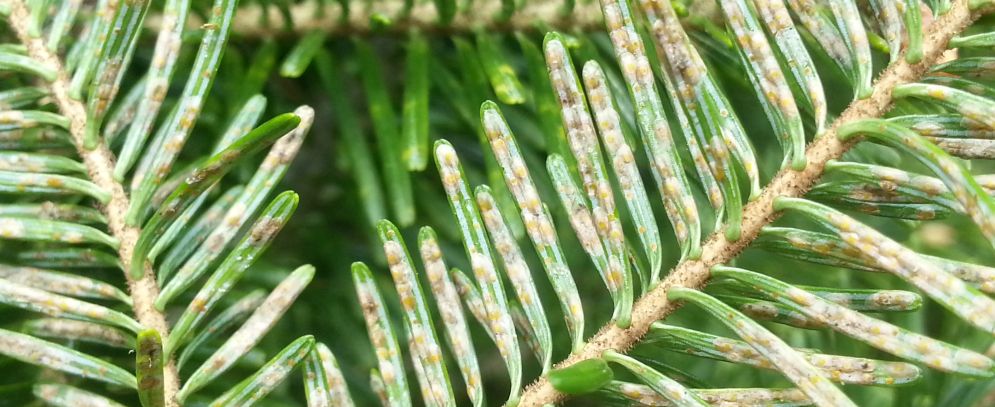
Cryptomeria scale (Aspidiotus cryptomeriae), like elongate hemlock scale (EHS), is another introduced pest from the Orient. It affects many conifers including hemlocks and firs. It causes serious and striking yellow mottling of the foliage and premature needle drop. On the trees we examined today, most of the damage was on the south side of the tree. A few trees were heavily damaged all over with scales even on the needles of the terminal. This is one scale you really don't have to hunt for to find. If it's there, you should see it.

Damage from Cryptomeria scale.
The scale has a very different appearance to EHS. The scales, especially the small immature ones, are round, and they line up in two rows along the backside of the needle on either side of the midrib. They look like fried eggs with a yellow center. The 'white of the egg' is actually where the scale has pushed up the waxy covering of the needle. Older scales are more indistinct.

These younger scales look like they might have been killed, perhaps from a fall
insecticide treatment.
Crawlers will start to appear in another month or so.
The life cycle of CS is similar to EHS. It has two generations per year and is most active in the summer months. It seems to spread very quickly and cause damage very quickly. However, it is much easier to control than EHS.

The scale is spread through crawlers and on infested plant material. This scale was found in three adjacent fields owned by different growers. Next week, we hope to scout other farms in the area to see how far the scale has spread.

Typically when I've found CS, I've also seen the twice-stabbed lady beetle. We didn't find any today. Perhaps it's still too early in the year for this helpful predator.

The grower in 2010 treated in early September and got excellent control. We didn't see any crawlers today, and so it's probably a bit too early to treat -- especially since we are having such a cold, wet spring that's keeping everything from getting active. But we'll definitely be following control from any grower treatments and pass results on.

Tuesday, February 12, 2013

Bees Already?!?

Brad Edwards and I were looking in a field treated with Safari last July to look at scale control. Long story short, the Safari worked well. I'd estimate 99% control. But what really caught our attention was what was going on under the trees. There was an almost continuous carpet of purple deadnettle that was starting to bloom. And it was full of bees! Most had pollen sacs full of red pollen.


This field was at just under 3,000 feet in elevation and southern exposure. The high was only 51 oF in Jefferson today. They say bees don't get out and start working until it's 55 oF. Obviously the bees don't read too well.

In any case, if you need to apply an insecticide, it's important to look and see if bees are in your trees. Pick a warm day at mid-day and look for bees. If you can spray at night, you should be OK. But if you have to spray in the day, clean up the field of flowers by using Roundup at suppression rates a week or so before treatment. Know if you have bee hives close by, and if you do, tell the bee keeper what you plan on doing. They may want to shut up the hive while you are spraying so the bees aren't exposed.

For more information about how to protect bees in trees see: FRASER FIR PEST CONTROL PORTAL: Tips for Keeping Bees Safe.

Monday, September 3, 2012

Impact on Predatory Wasps

Yellow sticky card placed in a Christmas tree that has EHS.
On January 5 of this year, I posted about the parasitic wasps I was finding on cut Christmas trees that were infested with elongate hemlock scales (EHS) (see Parasitic Wasps on Scale Infested Trees). If you will remember, Jerry Moody and I placed yellow sticky cards in cut trees to determine if scale crawlers were coming off of them. Yellow sticky cards are about 3 X 5 inches and coated with a sticky clear substance that traps insects once they step onto it. The yellow is particularly attractive to many insects. During our little study, there were only a few wasps per sticky card coming out once the trees were displayed in water in a warm room just like they would in someone's house.

These parasitic wasps are very important to control of the EHS. They are very, very small -- the size of a single scale. You'd never see them flying around, and in fact you have to use a microscope to see them on the yellow sticky cards. These wasps, Encarsia citrina, are available commercially and are often used for whitefly control in greenhouses. But they also love scales. Whenever you see a scale that has a round hole in it, you know that one of these wasps has developed inside it and killed it.(Think ALIEN with Sigourney Weaver!) I especially enjoy probing into scales this time of year and finding the immature wasp inside one. Sometimes the tiny little wasps even move their heads! (Nature is so cool!)

This scale has been parasitized. The arrow points to the exit hole the wasp made to get out
once it had fully formed.
The arrow points to a wasp that is still forming inside this scale. The eyes are to the left.
Over the last week, I've put out some yellow sticky cards in trees infested with scales in an Ashe County Christmas tree field (pictured up top). Travis Birdsell, the new county agent in Ashe County and I looked at these cards on Thursday after leaving them for 48 hours. I was amazed at how many wasps there were! We put two cards in one tree and there were 56 wasps on one of them and 34 on the other. In a second tree we had one card and it had 15 wasps. This was in a field where there were some scales, but they had never become really bad as they are in some fields.

I was surprised that there were so many wasps out now. So I became curious. Could I see a difference in the number of parasitic wasps in fields that had been treated with a synthetic pyrethroid compared to those that hadn't? I've thought for a long time that the increased use of the bifenthrin products in particular might be causing a lot of the increase problems in scales.

It just so happened that Jerry Moody and I had created the perfect place to test out this theory. We were working in a small field of trees in Avery County where few insecticides had been used and scales had become a problem. I already knew there were lots of parasitic wasps as I had seen them inside the scales. We had sprayed a block of these trees two weeks ago with Safari and a bifenthrin product, in this case, OnyxPro. We are treating a different block of trees every two weeks to see how late in the season we can get good scale control.

So on Friday, when we were making another treatment, I put a yellow sticky card in three untreated trees and three trees treated two weeks ago with Safari + OnyxPro. The two sets of trees were probably only about 75 feet apart. Today I looked at the cards (after 72 hours) and was amazed at the results.

There was an average of 45 wasps on the cards placed in untreated trees (79, 35, and 22) and an average of 5 on the trees that had been treated (10, 3, and 1). That is a 90% reduction in the wasps just two weeks after treatment! And though I didn't look at scale control, I am sure there is very little yet as Safari takes a long time to work.

I plan on looking more at this issue, trying to evaluate different chemical combinations put out at different times of year to see what the optimum time is to get control of scale without doing away with the parasitic wasp. But the early take home lesson is that the use of synthetic pyrethroids can have a profound affect on these important natural controls. Hopefully in the coming months we can determine when these materials can be used with the least negative impacts.

Wednesday, March 7, 2012

Safari for Scale Control

This is my 100th post on this blog!!! 
Thanks for all the support with this endeavor!

Elongate hemlock scale (EHS) is on everyone's minds these days. In some Christmas tree counties in western North Carolina, as much as 85% of the fields are infested with scales. EHS is difficult to control, but the good news is, with scale control comes control of many of our other pests of Fraser fir including balsam woolly adelgid (BWA) and balsam twig aphid (BTA).

Safari (active ingredient: dinotefuran) is a new material recently labeled for Christmas trees. You have to have a copy of the supplemental label for use in Christmas trees.
Safari is a systemic and works well against BWA and EHS. The following are some of the lessons learned in 2011 in using Safari for EHS control.

Lesson #1: Trunk applications haven't worked well.

Applying Safari to the trunk
This method of application would be preferable because it is easier and it would result in the least impact on the parasitic wasp, Encarsia citrina, that attacks the scale. The recommendation was to apply Safari to the lower trunk of trees using a backpack sprayer and a rate of about one pound per acre.

Several growers tried this application method. I also put out several trials in Mitchell and Avery Counties. In our trials, we used a backpack sprayer for application, as well as a high pressure sprayer -- in some instances wetting the entire trunk. Unfortunately, despite the application method or timing, trunk treatments haven't worked well for us in NC. In 2012, I want to look at high rates, but for right now, foliar sprays of Safari are best.

Lesson #2: Full rate and good coverage give best results.

To date, the best EHS controls in North Carolina have been with a high pressure sprayer and full foliage coverage using 8 ounces of Safari per 100 gallons. This has ended up with a rate of as much as two pounds per acre. This application method has worked well from mid-May through August. When used in early October, control was poor.

An August application combining Safari with a bifenthrin product such as Sniper would control almost all Fraser fir pests --  EHS, BWA, BTA for the following year, Cinara aphids and spruce spider mites (SSM).

Lesson #3: It takes a while to work.

The "white" from the males
In my February 9, 2012 blog post, "Working with Safari," I described how control of Safari improved over time. In fact, it can take as long as four months.

This has made several people think it would be better to put Safari out earlier so it will have time to work. Of particular concern are the male scales that create the white on the foliage. But though the product takes that long to work fully, it is primarily the female scales which are toughest to kill that require the full four months to die. The male scales and crawlers are typically all dead within a month and even many of the female scales. So don't think you have to spray in April to prevent the male "white" on the trees. Even trees treated in August looked great by harvest a couple of months later.

Lesson #4: Natural enemies are important.

A wasp caught on a yellow sticky card.
It is the size of a gnat.
Probably the most important natural enemy of the EHS is the parasitc wasp, Encarsia citrina. This wasp lays its egg inside the immature female scales and develops there, eventually exiting as a full grown wasp from a round hole it makes in the scale's outer shell.

The following website has information about this scale: Entocare, biological pest control. (Please note that this website is mentioned for educational purposes only. The pictures are really nice. There has been no research in releasing Encarsia into Christmas tree fields).

But other predators are important too including lacewings and the twice-stabbed lady beetle.

How can you protect these natural enemies?:
  • First of all, only use an insecticide when you really need to. Scout to determine the need for control. 
  • Don't worry about BTA and mites in young trees. 
  • Reserve the synthetic pyrethroids such as Wisdom, Sniper, Talstar, Asana and Astro to the fall when they have less impact on predators.
Questions that still remain.

There are several questions about using Safari.
  1. How well would it work with a mistblower application? Many growers are set up to use a mistblower. If you would like to help us evaluate Safari applicaitons for scale control using a mistblower, let me and your county extension agent know. We'd love to work with you and follow up to see what works and what doesn't.
  2. What if you have to control BTA in the spring? Can you use Safari plus another product for BTA control and still get good scale control in April? If you're interested in trying this, again, let us know so we can follow results.
  3. Can you wait until September to treat? A September treatment would fit in better with most people's production schedule than an August treatment. First of all it's usually cooler. Secondly, Cinara aphid control would be better in trees to be harvested. Also, there would be less impacts on predators. This is something I plan on looking at this September.
  4. Would a higher rate of Safari work when applied to the trunk of the tree? Again, this is something I plan on trying -- targeting the highest allowable rate which is 2.7 pounds per acre per year.

Monday, March 5, 2012

Modified Treatment Wheel

I showed this modified color wheel at the North Carolina Christmas Tree Association meeting in Boone on Thursday, March 1.


We use this wheel to show Christmas tree growers when you can treat for the various pests. Based on what we were seeing last year, I modified the timeline for the elongate hemlock scale. We've been seeing good control from mid May through August. Spraying before bud break and later in September probably won't work as well, though it may fit better into your spray schedule -- hence the dotted pink line. If you don't have twig aphid control in market size trees, you might need to treat before bud break. The fall treatment window in September is better for protecting natural predators as well as Cinara aphid control. We'll continue to evaluate control during those treatment windows in 2012, so if you do treat then, let us know so we can follow how well its been working.

Thursday, February 9, 2012

Working with Safari

With the help of Doug Hundley, I've been following a field treated for elongate hemlock scale at the end of the summer. The grower used Safari + Wisdom (bifenthrin) in early August with a high pressure sprayer. He was trying to get rid of the white from the male scales as well as controlling Cinara aphids on the trees he was harvesting. But he was also hoping to get both good scale control and twig aphid control in the trees that he was leaving. The Wisdom should supply both the Cinara aphid and twig aphid control. The Safari would supply the scale control.

Doug and I have followed the field ever since. Doug was particularly interested in seeing if the white from the male scale would weather away and become less of a problem. So we went in just 3 weeks after application. At that time, the white was already less noticeable, but I found only 55% scale mortality which is, needless to say, practically no control at all.

In mid November, about 100 days after application, we went back and  observed 80% scale mortality. The white from the males was hardly noticeable, and there were no problems with harvesting the trees. Definitely we were headed in the right direction, but the scale control was still not good enough.

Just last week, however, we looked again -- close to 6 months after application. Now the control was around 95%. Control is finally good. This illustrates just how long Safari takes to work.

I plan on looking again at the field in mid-April. Hopefully we'll find that there was twig aphid control from the Wisdom that was applied. Then in June we'll assess how many scales are moving out onto the new growth. If not many are, perhaps the grower can skip scale control for 2012.

The following are some of the questions I'd like to try and answer in 2012:

  1. If you get good scale control one year, can you skip treating the next year?
  2. Can Safari control scales when applied with a mistblower?
  3. What is the best timing and pesticide combinations to control all of our Fraser fir pests including scale?
  4. Can you control theses pests and still have little impact on our natural enemies of scales?

So stay tuned as we try to nail down how to use Safari and other materials to the best advantage. I also have more control results I plan on posting over the next several days. Be sure to attend the NCCTA meeting in Boone on Thursday, March 1 when Doug and I will be joined with Brad Edwards and Brian Davis to discuss getting the most bang from your pesticide buck.


Monday, January 9, 2012

How Do You Know When Scale Control Is Working?

It's not always easy knowing if elongate hemlock scale (EHS) controls are working. On Friday, Meghan Baker and I helped a grower evaluate some Safari and Talstar treatments he'd made in July and August. I collected  shoots to look at under the microscope to determine if the scales were alive or dead. That is the only way to know for sure what kind of control you've gotten. Unfortunately, it takes a lot of work, and few people have access to a microscope.

So how can you tell how well your scale controls are working? Here are some things you can look for several months after treatment. Remember, you won't be able to tell within a few weeks. In fact, all of our treatments can take several months to work.
  1. It's a lot harder to find the scales after treatment. The grower we were working with really knews his fields. He went to several trees that he knew had a lot of scale on them, and had a hard timing finding any. That's a good sign that controls are working. One suggestion is to tag trees with lots of scale prior to treating so you know where to go back to!
  2. There isn't white cotton from the males scales. We were looking on a beautiful day in January. Though the weather was warm, you wouldn't expect to see the white cotton from the male scales yet. That's more of a summer thing. But, if you treated in the spring and were scouting in the summer and didn't see white on the trees, that's a good indication that there has been some control. But, I've seen fields where the control was only marginal where the male production was definitely suppressed. So in my opinion, this is not the best indicator of control.
  3. There aren't crawlers. Crawlers and immature scales are yellow. If you scout several months after application and don't see yellow individuals, then it's a good indication that the treatments have worked. 
  4. There aren't scales on the newest growth. If you treated last year or in the spring, and you don't see any scales forming on the new growth in June or July, that's a really good indication that controls are working . The scales will remain on older growth even if they are dead. Of course some do fall off, but some will remain. So always look at the newest growth to see if there are any scales forming. This is one of the best indicators of control, but you have to wait for it!
  5. The scales look dried up and are falling off. When controls are really good, there is a different appearance to the scales. The males all look dried up, and the females do too. You don't see any yellow immatures. And you can sometimes see on the needle that there used to be a scale present, and there isn't any more. This is a little tricky, because the females scales are brown, and might appear dead. But if you've seen enough treatments, you can develop an eye for what is really dead and what isn't. It helps to train your eye by looking at some of these samples under the microscope.
  6. Looking under the microscope. When I evaluate scale control, I pull 2 or 3 needles off of 6 or 7 different shoots. I try to get some older and some younger needles. I take anything sharp like a pin, and gently prick the very top of the scale. The goal is not to stab the scale and the needle, but to pry off the top of the scales's outer covering to find if the scale is still alive inside. Below are some photos of what to look for.
Obviously, this scale is still very active.
A crawler or any small yellow scales indicates controls didn't work.

Is this female alive or dead?
It is dead because it is empty and dried up inside.
This female is alive, and there are eggs present.
The same photo with everything labeled.
Scales on new growth in June show that treatments didn't work.
The Safari and Talstar treatments made in August gave 99% control. What does that mean? That means that out of 100 or more scales that I examined, only one female was still alive. In actuality, the control is probably even greater because there weren't as many scales as there were prior to treatment.

The grower had some other Safari + Talstar treatments where he used the low rate of Safari (4 ounces per 100 gallons vs. 8 ounces/100 gallons). These were giving 94% control. That means I found 2 or 3 live scales. So should he treat again?

I think I would wait until June to see if scales were showing up on the new growth. If they aren't, I would wait until 2013 to treat again. If they are, he would still have a couple of months to make a treatment in 2012.

This grower also had another scale -- pine needle scale. This scale is much easier to control, and all his treatments worked against it. In the photo below, note some of the scales have holes in the middle, indicating that parasitic wasps have attacked them.

These are all pine needle scale and not elongate hemlock scale.
Assessing EHS control isn't easy. If you need help, contact your local county extension agent and I'll be glad to come out and see. Being patient and waiting until June is probably the easiest way to determine control results.

Thursday, January 5, 2012

Safari Labeled for Christmas Trees

Safari is now clearly labeled for use on Christmas trees. The following links have information about this material:

To date, excellent control of both balsam woolly adelgid and elongate hemlock scale have been obtained through foliar sprays of Safari at 8 ounces/100 gallons using a high pressure sprayer. I'm continuing to look at other methods of application.

Parasitic Wasps on Scale Infested Trees


This photo depicts Frasers set up to see how likely elongate hemlock scale crawlers will come off of cut trees. The yellow sticky cards were used to trap the crawlers. But something more interesting was found. Wasps!

These are predatory wasps, probably Encarsia citrina though I didn't have them positively identified. They are very small. The following photo has both a wasp (on the right) and a crawler (bottom left) on it. You can see the wasp is only a bit larger than the crawler. 


The wasps lay an egg in a scale and it develops inside. When the wasp emerges, it leaves a hole in an otherwise empty scale casing. You can see these sometimes when looking at scales on trees.

I put a photo of a wasp that hadn't emerged yet from inside of a scale on my October 6, 2011 post "Last Treatments." In that post, I made the comment that when you don't add Talstar or Asana to Safari, you see a lot more parasitized scales. 

Interestingly, I only found these wasps on cards put in the two untreated trees. The tree that had been treated in the fall had no wasps in it. That made me curious to see how readily wasps are found on trees following different treatments. I plan on setting up some branches inside a warm location over the next few weeks to see how many wasps appear on sticky cards. Perhaps this can shed some light on how we can control scales without creating conditions for a quick rebound by killing off all of our natural enemies.

These wasps are very small. You would never see them flying around in your trees. But they are giving you free pest control. That's why its so important to only use an insecticide when you really have to. 

Another view of one of the wasps. 

Tuesday, November 8, 2011

How Well Do Scale Infested Trees Hold Their Needles?

If a tree is infested with scales, will it cause the needles to shed prematurely? Last year I looked quite a bit at this issue, but without a lot of success. Here are links to the previous posts in case you are interested in following this story: 1. Setting up the study; 2. The results. The big problem with last year's study was that the room where I kept the shoots got way too hot, and there were many branches where the needles shattered. This isn't how Fraser fir normally behaves when cut.

So this year I'm trying again. Yesterday Jeff Vance helped me  collect some scale infested branches. I will be comparing needle shed on these to branches from uninfested trees in the same field. We also collected some heavily infested branches from a second field just to see if they fared worse.

I will be monitoring needle shed on this year and last year's growth. Each branch is in its own water container, with the 3-year-old wood in the water. The study is set up at my house so I can keep an eye on them better. I noticed this morning that they are already taking up water!

Small studies like this allow us to look at this issue with a great deal of detail under controlled conditions. But I'm also very interested in hearing your observations. Are you finding that needles shed worse in scale infested trees? If you have any observations, please let me know. Some questions I would like to ask are these:

  • Were the trees heavily or lightly infested? 
  • Are you selling trees in northern or southern markets?
  • Do you see a difference in performance between foliage in wreaths and trees?
Send me an email at: jill_sidebottom@ncsu.edu

As always, let's learn together as we try to live with this new pest.

Thursday, October 6, 2011

Last Treatments

I haven't posted anything on my blog for quite awhile. Not because I haven't been busy, I just wanted to get all my results together before doing so. I've been evaluating multiple spring applications of Safari and other materials for elongate hemlock scale control. Since I feel like I should wait 4 months before making evaluations, it has taken quite awhile. I should finish with the spring applied stuff this week, and then I'll compile the results. Maybe I'll even have them by Friday!

However, I did want to let everyone know that I put out my last EHS treatment yesterday. Well, Jeff Vance did actually. We treated trees with Sniper, the new bifenthrin product and a dinotefuran product (active ingredient of Safari). We mixed the products to give the same as 10 oz Talstar per 100 gallons and 8 oz of Safari. Two rows of trees Jeff treated like a woolly spray, and two rows like a twig aphid spray. We used about 1/2 the water the second go round. Those results, I won't have until February!

If this fall treatment controls scales, it would fit in very nicely with production of Fraser fir. With it you would be controlling woollies, twigs, scales, spiders, and Cinaras in go-to-market trees. You have lovely fall weather which is usually drier and cooler (it seemed rather hot to me in that spray suit though!) to do it in. AND, you wouldn't be affecting the predators at all. So that means you won't be creating problems with rust mites come spring, or a resurgence of scales the following year.

What predators are most important for the control of scales? Lady bugs will feed on them, especially the twice-stabbed lady beetle, but also smaller ones. We've also seen lacewing larvae feeding on scales. There are also parasitic wasps that develop inside the scale itself.

I will share one observation I've been making. When people are using just Safari in the spring or summer and not adding a synthetic pyrethroid (esfenvalerate (Asana) or bifenthrin (Talstar, Wisdom, Sniper)) you see a lot more parasitized scales.

In fact, one day I poked open a scale that had a wasp still inside the scale, and when I gently teased it out, it moved it's head around.

Bugs are so cool!

Predatory wasp developing inside female EHS.
This is usually all you see with a scale that has been parasitized. An exit hole!

Thursday, June 23, 2011

Elongate Hemlock Scale Lifecycle

In talking with folks, I find that people are confused about the lifecycle of the elongate hemlock scale.

It is a bit confusing. The same insect can be white (for the males), brown (for the females) and yellow (for the immatures). It's hard to know if they are alive or dead. So here's a bit on the lifecycle that will hopefully make things clearer.

Life for an elongate hemlock scale starts out as an egg which is found under the protective scale of the mother. Here is a photo of the mother flipped over and broken into to show the eggs and the same photo labeled.


These eggs will hatch and the crawler will move out from under the mother scale and find a place to settle down. I actually got by accident a photo of a crawler leaving the mother. It is below. See the crawler at the bottom of the picture? Once again, everything is labeled in the second shot.


The crawler moves around until it finds a place to settle down and start moving. There it will molt, and start creating the scale covering for itself. If it is male, eventually it will fly away  so it can mate. That only happens when it is mature. If it is female, it will never move again.

The crawler is the small yellow thing.
The nymphs settle down, and then they produce the adult scale behind them. Here is a photo of one female scale. The yellow portion is the nymph part of the female, and then the brown part is produced.There aren't two scales, just one. It is all white around it because the scale has grown under the waxy cuticle of the needle. It is also almost impossible to tell if it is dead or alive. Under a microscope you can poke it with a pin and it will be moist. This one was alive when I took the photo.


The males are white. They develop into a winged insect that flies off to mate with the stationary females. You can almost think of the white scales as ultimately being a cocoon in which the male is developing. So often when you see the white scales, they are empty because the adult male has already flown off. The adult male is pictured below. This isn't my photo, but it's all I've got of the males.


Now let's put time into the picture. When does all this happen? The following are observations made by Paris Lambdin, a researcher in Tennessee.


          “EHS has two complete overlapping generations per year at sites within the southern Appalachians.”  My comment -- That means that you can find all life stages virtually any time through the year.
          “The spring peak for crawler emergence occurred in June while the fall peak occurred in late October into November.”  
          “Fall peak emergence for males occurred in August, coincident to the highest number of adult females.”  My comment -- That's why we see a second "wave" of white coming onto the trees in August. That's the second generation of males being produced.
          “Gravid adult females were most numerous in late May and October—November.”  My comment -- Gravid means they have eggs.
          “Females have three stages of development while males have additional prepupal and pupal stages.”  My comment -- That refers to the number of molts each sex goes through before maturity. For females, they are mature when they can lay eggs. For males they are mature when they emerge and fly away.
          “Each female produced 12-16 eggs which hatched over time.”
          “Males do not feed and live only 24 to 72 hours upon emergence. Although capable of flight, males tend to walk across the needles seeking out females for mating.”  My comment -- These are the adult males with wings that have emerged from the "cocoon." Some folks were finding the adult males when they were beating the foliage in the spring looking for twig aphids.

Other observations from scientific literature include:

          All life stages found any time of year (Davidson and McComb 1958) – eggs laid throughout growing season
          Mature females may often live for more than one year. My comment -- Isn't that great!
          After a month, the eggs hatch and the first instar nymphs ("crawlers") emerge and migrate to the underside of new needles. 

No wonder people were having a hard time figuring out the life cycle. It's complicated! If anyone has any questions, please let me know.

Ways to Put Out Safari: Part II

On Tuesday Jeff Vance, the County Extension Director in Mitchell County, and I applied some Safari to trees in Little Switzerland. Hopefully this will be on the 2012 Summer NCCTA tour.

We applied Safari 3 different ways:

  1. With a backpack sprayer to the lower 10 inches of the trunk.
  2. With a high pressure sprayer to the lower 10 inches of the trunk.
  3. A full trunk application with a high pressure sprayer.
Sadly our study site received a great deal of rain just an hour after application so the chemical was probably all washed away. But we plan on repeating this in another couple of weeks, and making more applications like this later in the year. We already made a similar application on May 20.

Here is a video of Jeff applying the Safari to the entire trunk. Hope it doesn't make you seasick!


I think that the full trunk spray will be the better way to apply Safari to Frasers in North Carolina. As you can see, these are large, dense, beautiful trees. It is hard to target just the base of the trunk. We didn't even attempt it with a backpack sprayer -- those trees on other side of the road, pictured to the right of the sprayer.
Field where Safari was applied to the base of the trunk with a backpack sprayer.
Even though the trees were smaller, it was still hard with just a backpack sprayer to make sure I was coating the base of the trunk. I used a hollow cone nozzle which I've been using to apply Safari to the trunk of large hemlocks or Frasers. I ended up using about 2 ounces of water per tree to make a thorough application. That's twice as much water as Dr. Cowles was recommending, but I feel like it was necessary to get good coverage. Even with a high pressure sprayer, sometimes there was full coverage all the way around the base of the trunk and sometimes there wasn't.

Though the full trunk spray will take more water, and it will require a high pressure sprayer, it is certainly much faster, easier and cheaper than a normal balsam woolly adelgid treatment that folks have been doing for years. It will just require calibration to apply the targeted 1 pound per acre application rate.

Now is all of this effective at controlling scales and woollies? We still don't know. However, the full foliar application with a high pressure sprayer has been shown to be effective against both pests this time of year. This is with a lighter spray than typically used for woollies -- more of a twig aphid spray. We asked the grower to do this in another portion of the field to make that comparison. 

Stay tuned for more results!

Wednesday, June 1, 2011

Some Results on Pest Control

We're seeing more twig aphid damage than I anticipated. After all, it wasn't easy to find twig aphids in April. Plus we had lots of rain and cooler temperatures which tend to reduce the survival of the aphids. But they are well adapted to western NC, and they have ended up causing some damage.

BUT... with all the rain, a lot of the damage is disappearing. I spoke with Bryan Davis who told me that he is seeing less needle curl in fields this week even than last week. Thanks to the rain, the majority of this curl will go away.

This leads me to some data to report from my current studies.

FALL TWIG APHID CONTROL: Last fall, Jerry Moody and I treated some trees October 18, 2010. Really we were trying to see how late you could treat in the fall and still control elongate hemlock scale. But I also wanted to see if the treatments would control twig aphids the following spring. We tried Safari (applied to the foliage with a high pressure sprayer at 8 oz/100 gallons), Lorsban, and the standard Dimethoate + Asana.

I did evaluate scale control this spring, and none of the products worked well. This wasn't surprising as mid October is probably too late to get much scale control. However, I also evaluated BTA control this spring with these fall treatments and those results are pictured here.

Remember that I evaluate twig aphid damage by either walking around the entire tree (which makes me dizzy!) or working with a partner. For these observations, I worked with Jerry Moody. We walked on either side of the tree and estimated the percentage of 2011 new shoots with needle curl each on our respective side -- then we come to an average figure for that tree. These result in the numbers in the first column (% shoots with curl) -- averaged for all 20 trees. The next column has the percentage of the 20 trees with at least SOME needle curl. The third column has the percentage of 20 trees with 10 % or more of the needles curled. This is the point where most growers tell me the damage is bad enough to affect the value of the tree. Of course remember that the needle curl will decline over the next several weeks, so all of these numbers will go down. Still, the comparison now when the damage is at its greatest tells us how well the products are working.

Obviously, neither the Lorsban nor the Safari are giving us any twig aphid control when applied in the fall. The Asana + Dimethoate worked well, though not perfectly. In fact, Brad Edward's observation this spring has been that the Asana in the fall isn't working quite as well as the Talstar applied in the fall. It works, but a bit of curl gets through. These results bear this observation out, and in fact the first year I did this type of work at Omni Farms, that was our observation. Still, the Asana + Dimethoate gives good enough control and it would be more effective against scales.

SPRING CONTROL WITH SYSTEMICS: So how well does Safari and Movento work in the spring? Jerry and I applied these products at two farms, treating on April 18, 2011. In this instance we applied the Safari to the base of the tree trunk and not the foliage, using a rate of 1 pound per acre. At two farms we did this with a high pressure sprayer, and at one farm just with a backpack sprayer. The Movento and bifenthrin are applied with a high pressure sprayer to the foliage.

The results again demonstrate that Safari isn't giving us twig aphid control. Practically all the trees had some needle curl when treated with Safari. The Movento gives fair control. A lot of trees have some curl, but hardly enough to worry about. The bifenthrin is of course the best.

At these two farms there was also scale and woolly adelgid. We will be looking at the control of these pests later on in the summer, so stay tuned!

OTHER OBSERVATIONS THIS SPRING: Once again, several people I've spoken with this week are commenting on spider mite activity. The rain is reducing mites to some extent -- probably by increasing predator mite activity, but it is still important to scout for spider mites and make sure they don't damage new growth. The good news? All of this hot weather should be taking care of any rust mite issues!

Monday, April 18, 2011

Putting Out Systemics

Today Jerry Moody and I put out Movento and Safari, both systemic materials, at two different farms.

Movento is a systemic that is supposed to be quite mobile in the plant. It requires the use of an adjuvant to help it be taken up. We used a product called Liberate. The last couple of years that we've worked with Movento it provided great control of balsam woolly adelgid, decent control of twig aphids, but hardly any control of elongate hemlock scale. In one tree last year, it also looked like it control rosette bud mites so we were interested in that too.

This year we applied Movento in two fields that had it all -- twig aphids, scales, rosette buds and woollies. We used a rate of 10 ounces per acre of Movento and 2 pints per 100 gallons of Liberate. Both of these are the highest rates. At the one field the trees were small and we sprayed about 200 GPA. The other field had denser, larger trees so we used double that.

The Safari applications were the new trunk sprays. These may control both woollies and scales but we don't anticipate them having any activity against twig aphids or rosette bud mites. We used a rate of one pound per acre.

Dr. Richard Cowles from Connecticut has been doing this technique for several years. He talked about it at the NCCTA in Boone this spring. He has been recommending an application with a backpack sprayer, wetting the trunk of the tree from about 10 inches to the ground. The rate he uses is 3 1/2 ounces Safari in 3 gallons of water. You use 1 ounce of this solution on each tree, treating the tree from both sides. That is because the Safari will move up the tree, but not from one side to the other.

His recommendations are based on lighter density trees that are also butt pruned. That's not the type of tree we grow here in North Carolina. So we only used this backpack application at one farm. We decided to also apply Safari to the trunk of the tree North Carolina style! We treated the trees with a high pressure sprayer. Again we aimed for about one pound per acre, treating each tree from opposite directions. But since we are putting out more water per tree (about 50 gallons per acre) we mixed the Safari differently. We ended up using 6 ounces of Safari in 20 gallons of water. This should treat 4/10ths of an acre. This type of application went very quickly.

A short video of Jerry applying the Safari this was is seen below. The respirator is not required on the label. On a couple of trees he sprayed twice -- that's because he missed the trunk the first time! He said you could tell when you hit the ground and not the trunk by how it sounded.


At the one farm we also used an Onyx knock-off called Sniper. This is a bifenthrin product (same active ingredient as Talstar) but it is mixed differently. It uses a different carrier, and it has 2 pounds active ingredient per gallon instead of 0.67 pounds. That means you don't need as much. We tried using the same amount of chemical as the full 40 ounces per acre of Talstar -- that ends up being almost 13 ounces of Sniper. We haven't seen that bifenthrin gives much control of scale in NC, but Cowles has said that the Onyx works well, so we'll see.

Unfortunately, it may take several months before we know how well any of these treatments work. I'll keep you posted.

Monday, January 31, 2011

Visiting Scientist Richard Cowles

On Friday March 4, Dr. Richard Cowles with the Connecticut Agricultural Experiment Station will be speaking about scale control in Christmas trees.He is an expert on scale control, working with both elongate hemlock scale and Cryptomeria scale. He also has worked with the systemic insecticides such as Merit and Safari for hemlock woolly adelgid control. Attending the NCCTA meeting would be a great opportunity to learn from and talk to this expert.

The following are two references by Dr. Cowles that you might want to look at before the meeting.
  1. 2008 Scale Efficacy Trial: In this paper is information about Judo, Onyx, Botaniguard and Safari for elongate scale control
  2. Connecticut Weekly Agricultural Report, April 7, 2010: A New Method for Managing Armored Scales in Christmas Tree Plantations: This report has information about trunk applications of Safari for scale control in Christmas trees

Thursday, December 9, 2010

Needle Drop in Scale Infested Trees

This week I finished taking data on the needle drop in cut branches from scale infested trees. I reported on the experiment on November 10th when I set it up. The experiment worked worked well in that there was needle drop, but since there was too much needle drop, I guess it worked a little too well!

Many of the needles shattered as depicted in the photograph to the left. On some branches, almost all the needles fell off. That is definitely not something we're used to seeing with Fraser fir. If you look closely at this photo, you can see that this was from a scale infested tree, but the uninfested trees were just as likely to shatter -- just not as badly.

The room that the branches were stored in was very hot. It's an unused room at the Mountain Horticultural Crops Research Station office, and both Jeff Owen and I had shoots stored there. They kept the door shut and the room, which faces the sun, would often be too hot to be comfortable in. The shoots in the buckets faired the worse, dropping many needles. The shoots that were were kept dry kept almost all of their needles to the end of the study, but they dried out and became very brittle.

So did scale infested trees drop their needles more than uninfested trees? The quick answer is, "Yes." The results are summarized in the following table which lists the average percentage needle drop for all 15 trees in each group (infested and uninfested) for both the trees stored with water (wet) and without (dry). On average, 43.1% of the needles on scale infested branches had shed their needles while only 27.8% of needles on uninfested branches had shed. Also note in the table that there was more needle drop in the field on scale infested trees (first column labeled "From Field"). I had reported this back in November.

If you look at individual trees, by the end the experiment 47% of the infested branches in water had shattered a third or more of their needles (much like the photo above) while only 27% of the uninfested branches had more than 1/3 needle drop. Of course, that is much more needle drop than would be expected from cut Fraser fir. Remember that these branches spent less than 24 hours without water. Needle shed should have been at a minimum, and was through the first couple of weeks. Only one tree shattered its needles in week 2, and that was a scale infested tree. But by week 4, there were needles everywhere.

If you are a very perceptive observer, you will also note in the table that I only report on 1st and 2nd year needle drop and not 3rd as I said I would do back in November. That is because some of the 3rd year needles were under water in the bucket, and I didn't trust the results from them. In this photo, taken in week 2, the discolored needles had been underwater. These were more likely to fall off.

Generally results were along the lines I anticipated -- more needle shed in scale infested trees -- but the data were far from pretty. After all, there were uninfested branches that totally shattered their needles, and there were scale infested branches with very little needle shed. There were trees where one branch placed in water shed their needles, and the other branch from the same tree also in water hardly did at all. On about half of the scale infested trees, of the two branches taken, the one with more scale had less needle drop. So, I am not real happy with the results. I think I'll repeat this experiment next year either in January or next harvest season to see if I can get some clearer results.

I do think I can safely say the following: there appears to be slightly more needle drop in infested trees. However, needle drop occurs for a variety of reasons, and scale infestation is definitely not the over-riding factor. Still scale infested trees are messy. The scales themselves drop off as the tree dries out. There also appeared to be some fungi growing on older scales as my last picture shows.

This quick little study just confirms what many people had been telling me, that scale infestation doesn't help the quality of cut trees.

Thursday, November 18, 2010

Updated Results on Scale Control

I reported in July on some control results of scale treatments I had made on June 20. To recap, I used a backpack mistblower at Dale Cornett's in Watauga County. I used either Asana + Dimethoate, Lorsban, Movento or Safari. In July I went back and the Safari and Asana + Dimethate both gave control, but only about 85% control. This was a bit disappointing. The other two didn't work, but then Movento is a systemic and slow acting, so I vowed to return and see if time would improve the results.

I went back today and now the Dimethoate + Asana and the Safari both had 100% control. I did not see any live scales at all. It was hard to find shoots that had scales on them, and they all looked dried up just by looking at the shoots. There was no white cotton at all.

The Lorsban and Movento treatments were still similar to the untreated check trees. They still hadn't worked.

So not only did control improve with the Safari, it did with the Dimethoate + Asana as well. Maybe we go back too quickly to evaluate control. These materials apparently keep on working.

Remember that currently Safari does not have a Christmas tree label -- only a nursery label. So if you aren't digging your Fraser fir, you're not supposed to use it. Hopefully that will change next year. These results are certainly encouraging.

Research out of Connecticut has indicated that Safari will controls scales with a trunk application, at a reduced rate per acre. These treatments can be made in April through June. I plan on trying this next year.