The Value of Christmas Trees

"...there is no reason why the joy associated with the Christmas evergreen may not be a means of arousing in the minds of children an appreciation of the beauty and usefulness of trees; and keen appreciation of the beauty and usefulness of trees is a long stop toward the will to plant and care for them (Arthur Sowder, US Forest Service, 1949)."
Showing posts with label organic. Show all posts

Sunday, April 22, 2012

Celebrate Earth Day with a Christmas Tree


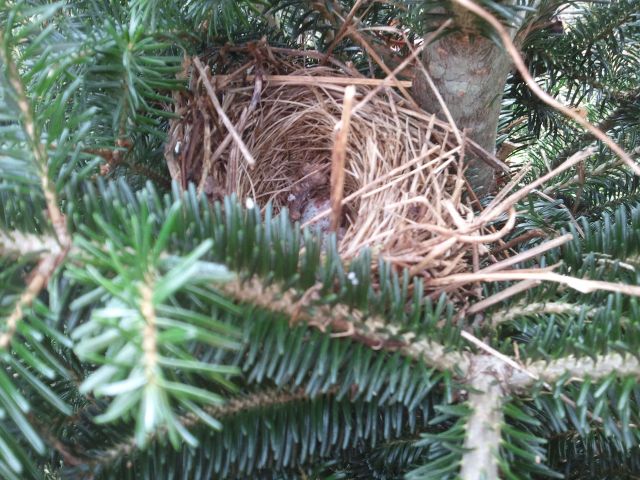
This week while scouting a field for twig aphids and mites, I came across this little nest full of eggs. It reminded me of how Christmas tree fields are home to many creatures -- a perfect reminder of Earth Day.

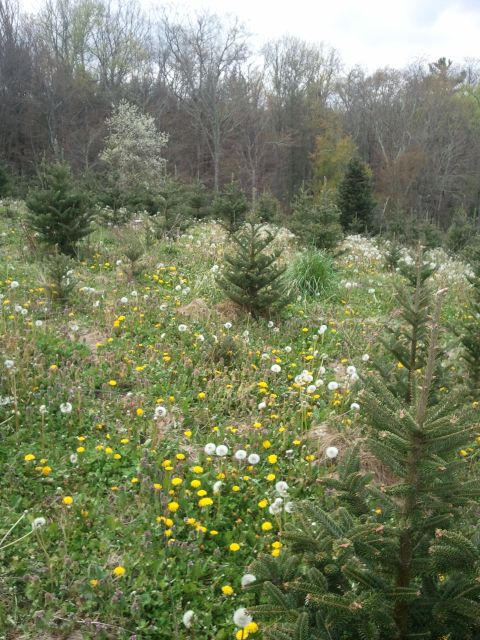
The most important creatures that tree growers invite into their tree fields are natural predators, brought in when ground covers are managed rather than killed. The next photo is from a field I was also in last week, showing a diversity of flowering ground covers.

That means that tree growers don't have to purchase natural predators like the lady beetles sold here for home gardens. Predators are attracted to the diversity of flowers and insect activity in the ground covers and will feed on any aphids or mites found in the Christmas trees themselves. It's free pest control.

One of the lessons from the Extension organic field in Alleghany County has been that the ground covers that come in when low rates of Roundup are used are far superior to all the grass that grows in the organic trees. After all, we grow grass in our lawns because grass tolerates mowing. Mowing ground covers in the organic trees has promoted grass and actually decreased biodiversity in the ground covers as compared to the lower portion of the field where conventional practices have been used up until this year. In this photo, you can clearly see the line where the clover stops and the grass starts. That's the line between the trees that have been grown organically since 2008 and those that are switching to organic production this year. Mowing promotes grass and it has certainly taken over to the detriment of the trees and the natural predators as well. (For those wanting to grow Fraser fir organically, it will be important to plant clover and other beneficial ground covers in a field the year before the Christmas trees are set -- something that wasn't done on this site. But that's for another blog entry!)

These ground covers, however, are also forage for bees. Clover, wild mustard, and purple deadnettle especially bring the bees in. Protecting bees can be as simple as choosing the time of day when you spray with an insecticide. Spraying trees in the late afternoon or at night for mistblower operators, is a good way to avoid problems with bees. Switching pest control to the fall is also a good way to avoid problems with bees. Be aware if someone has a commercial or even a hobby hive near your tree field. For fields close to bee hives, a mid-March application of horticultural oil will control most Fraser fir pests without causing a problem with bees at all.

April 22 -- Earth Day -- might seem like an odd time to think about Christmas trees. But those involved in the Christmas tree industry in western North Carolina know that every day is Earth Day in a Christmas tree farm!


Thursday, August 11, 2011

Organic Project Update

Last month I visited the Extension Organic demonstration and once again rated the trees based on their terminal growth and overall appearance. I made a similar ratings last year and posted them on my blog on August 24, 2010


I rated the tree appearance the same way I did last year. Trees were given a rating of "1" if they were barely growing. A "2" rating was given to a tree that was growing better, but still had poor color and bud set. A "3" rating was given to a tree that was growing acceptably. A "4" rating was given to an exception tree both in color, bud set, needle length and fullness. Of course these ratings were completely subjective and sometimes I had trouble deciding between a "2" and a "3" or a "3" and a "4."


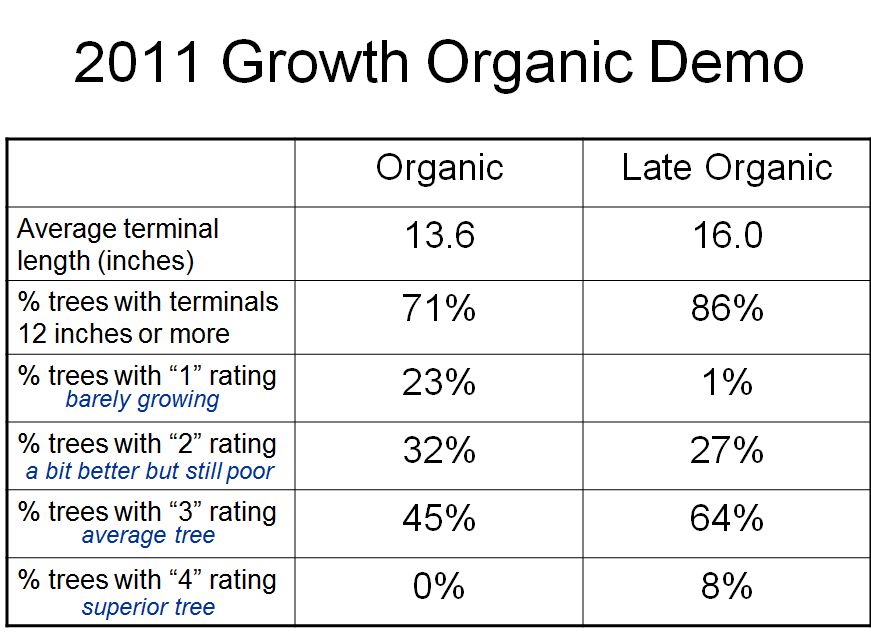
Here are the results:


The results were very similar to last year. Some trees looked worse than they did last year and some looked better. Overall the organic trees appeared to have improved a bit, but there were still many more trees growing poorly than the "late" organic trees. (Remember that the "late" organic trees will switch to complete organic practices next year, but so far have been treated conventionally with Round-up and synthetic fertilizers). 


But as they say, pictures are worth a thousand words. Here are two shots in July of the organic and late organic trees:


Organic trees -- there are a few good trees but not many.
These trees have been grown conventionally and will switch to organic production next year.
It will be interesting to see switching to organic fertilizers will affect the "late" organic trees. I'll let you know same time next year!

Thursday, June 30, 2011

Organic Christmas Tree Powerpoint

Fertilizer for the Extension Organic Demonstration
I was scheduled to give a talk at a Southern Christmas Tree Conference at the end of May in Atlanta. The conference was canceled, but I had already put together the powerpoint. It was a short talk on the possibility of growing organic Christmas trees. Thought some folks might enjoy looking at it. It's in a pdf format.

Organic Christmas Trees

Any thoughts? Questions? Anyone interested in starting organic Christmas trees?

Thursday, May 5, 2011

MITES!!!

I'm surprised how many spruce spider mites I'm seeing this spring, considering how wet it's been. I have been in several fields where individual trees were absolutely cover in mites.


This terminal is covered up in spider mites and their eggs. There is even some webbing between the needles which is where spider mites got their name.


This shot shows my fingers after handling the mite covered terminal. This is the color of squished mites!

These trees were at the site of our organic study. I think I will treat them all sometime in the next few weeks. What's complicating this is that the new growth is out. I'm afraid I'll burn them which is why I'm going to hold off a few weeks.

The final shot I'm posting today shows the difference in the ground covers between the organically grown trees, which are full of grass, and the "late" organic trees that are still being grown conventionally with Roundup use. We will switch to organic production the last three years before sale.

The organic is in the background, and that's where Brad's mowing. In the foreground are the "late" organic, which haven't been treated yet with Roundup. There were areas of the field where the clover was keeping out any weed problems. There appears to be much more biodiversity with the use of Roundup. Hopefully this summer I can get some data along these lines. But for right now, a picture is worth a thousand words!

Tuesday, August 24, 2010

2010 Growth in Organic Demonstration.

Today I measured the terminal growth on the 183 trees I've been evaluating at the organic demonstration in Alleghany County. Thanks again to Della and all the Deals and Tuckers for all their help with this study.

A big thanks also goes to Bryan Davis who has been keeping the site going. For the 3rd NCTA farm tour on August 14, Bryan dug up three trees from this demonstration so that folks could see how the trees were doing. One was a typical "late organic." Remember that these are the trees that are being grown conventionally until the last 3 years before harvest when they will go totally organic -- that is, they are "going organic" late in the rotation with just enough time to be certified as organic. He also brought 2 trees from the organic portion -- one that was growing poorly and one that was growing well.

Those trees were strikingly different. The poor organic tree was just barely alive. The good growing organic tree was growing well, until you compared it to the typical "late organic" tree which was taller and fuller.

The numbers I collected today with the help of my daughter (in the rain no less) bare this out. I measured the terminal of the trees and also gave the trees a rating based on how well they were growing. Trees were given a rating of "1" if they were barely growing at all. A "2" rating was given to a tree that was growing better, but still had poor color and bud set. A "3" rating was given to a tree that was growing acceptably. A "4" rating was given to an exception tree both in color, bud set, needle length and fullness. Of course these ratings were completely subjective and sometimes I had trouble deciding between a "2" and a "3" or a "3" and a "4."

Here is a summary of the data. The "late organic" trees are more likely to have a rating of 3 or 4. Their terminal growth is on average 4.6 inches longer, and there is a higher percentage of trees with at least 12 inch terminals.

There are some very nice looking organic trees. There just aren't as many as in the other section. Still, all the trees are growing better than they did last year. Last year the average terminal growth for the entire study was 6.1 inches. This year it was 14.0 inches -- more than twice as much. The trees that suffered severe drought when they were planted in 2008 with a southern exposure are finally growing strong.

Friday, May 28, 2010

Update on Organic

On February 1, I gave an update on the organic demonstration in Alleghany County. Since then, I've evaluated tree mortality over the past year. In all, only a handful of trees have died -- the same amount in both the organic and "late organic" sections. (Remember that the "late organic" trees are being grown with conventional use of fertilizers and Roundup, then switching to organic practices in 2011).

The trees are all growing now, and Bryan and I made some additional observations just last week. The following are some of our observations.

This photo was taken last week. Bryan had weed eat (is that a verb?) about half of the organic section. The organic trees vary quite a bit in quality. Some trees look great -- growing just as well as those in the "late organic" which is very encouraging. Others look, well, rather puny. Some of these are clear in this picture. The "late organic" trees are at the bottom of the field (top of the photo) and are much more uniform -- except where the deer got them!

By and large the major ground cover around the organic trees is grass. That's what Bryan is chopping down, and it took him more than 2 hour to finish just 1/4 acre. We figure it will need to be mowed again in mid-summer with a clean-up in the fall. We might also have to come in when problem weeds such as spotted knapweed are flowering to keep them from going to seed. We're also considering going back in and removing the chopped weeds from the ground cloth around each seedlings so it won't decompose and provide a site for weeds to germinate. All in all, an acre of organic trees will end up costing quite a bit in labor for weed control.

The other issue with using a weed eater? Injury. To the right is one of the trees that bit the dust. Bryan is afraid that every time someone does this, as least 1 or 2 trees will be injured. Over the years, that will add up.

In the "late organic" there isn't nearly as much grass. There's lots of clover, and also lots of mustard blooming a bit earlier. However, there are also a lot of thistles which they tried to hit with the Roundup. Both areas still have quite a bit of poison ivy which a problem for me especially! So neither section is perfect when it comes to weed control, but that's farming!

Monday, February 1, 2010

Organic Christmas Tree Project

Photo caption: The Extension organic site in June, 2009, a little more than a year after planting.

SUMMARY: In 2008, an extension organic Christmas tree project was started in Alleghany County. Growth has not been as good as normally produced trees at the same site, and costs are higher. It cost $1.50 per tree in materials and labor to put ground cloth around these trees at planting to reduce weed competition. It takes about 8 times as long each year for weed control (weed eater vs. applying low rates of Roundup). The tree terminals in the organic site are about 1/2 as long.

There has been interest in growing Fraser fir for Christmas trees organically for many years in western North Carolina. To my knowledge, there are 2 or 3 certified organic Christmas tree growers in NC that harvest a few hundred to a few thousand every year.

Back in the mid-1990's, several of us in extension did surveys of customers to determine if there was a market for organic Christmas trees. I went to a couple of choose and cut farms (Doug Hundley helped me at the one in Avery County), and Jeff Owen, the area extension specialist with Christmas trees went to an organic grocery store in the Asheville area.

What we found at that time didn't indicate a great demand for organic Christmas trees. Many of the people that Jeff interviewed that were buying organic food either didn't celebrate Christmas or they didn't use Christmas trees. People that I interviewed were interested in integrated pest management as a way of reducing pesticide use, but they were primarily wanted to have a pretty tree at a reasonable price. They didn't indicate that they would pay more for an organic Christmas tree.

However, in the past 15 years, this may have changed as more people are buying organic products. "Green" is definitely in and many people are convinced that organic production is the most environmentally friendly way of producing any crop. I myself prefer organic bananas, carrots and tomatoes because they haven't been loaded down with nitrogen, and therefore, in my opinion, they taste better.

Fraser fir, being a somewhat slow growing and finicky plant, doesn't lend itself to easy organic production. Pest control is really no problem. Even though there are several introduced pests that aren't easy to control (namely the balsam woolly adelgid and elongate hemlock scale) practically all pests can be kept at bay with horticultural oil. And now that there is Saf-T-Side oil without the issues of oil separating out and burning foliage, pest control shouldn't be a problem.

The big problem is weed control. Historically, this has always been the biggest issue with Christmas tree production. Weeds, and especially grasses, will always outgrow conifers. After all, that's why Fraser fir is found at the highest elevations -- because they can grow there and other plants don't. In fact, the top of Mount Mitchell was never logged -- not because Govenor Craig made it a state park and therefore saved it, but because the very top of the mountain was almost entirely Fraser fir. The economically important red spruce was found at slightly lower elevations.

Using low rates of Roundup not only stunts weeds to allow trees to grow, it shifts the ground covers away from grasses to clovers and other low-growing perennials. These living ground covers then become weed control, so that harder to control weeds like poke and ragweed can't get a foothold. That is impossible to reproduce organically without disturbing the soil.

In 2008, several of us started an extension organic project at the farm of one of our county agents, Della Deal. She had a small farm that had just been set in Fraser fir, that she was willing to donate for the project. Also involved were myself, Jeff Owen, Bryan Davis, and Richard Boylan, the alternative agriculture agent in Ashe and Watauga Counties. My goal was to see how much it would cost us to grow a pretty organic Fraser fir Christmas tree. I wasn't interested in an experiment looking at different options for fertility and ground cover management. I wanted to use our best guess as to what would work.

To control weeds, we used an 18 inch square piece of ground cloth that was placed around each tree and secured to the soil with staples, keeping the weeds from growing right up against the tree. Della's field was about 1 acre in size, and we initially had every intention of doing the whole acre organically. But 89 man-hours later, when we were only 1/2 through, we realized that we wouldn't be able to complete the whole project. Necessity being the mother of invention, we decided that the lower half of the field we would call "late organic."

To get organic certification, you can't use unlabeled products for three years. Fraser fir is more than a three year crop. So we decided to handle the trees like a commercial Christmas tree grower would for the first three years, and then switch to organic production for the last three years. We figured between the time in cutting the fabric (it's cheaper to buy it in rolls), putting it around the seedlings, the cost of the fabric and staples, and our labor (we "paid" ourselves $10 per hour), it cost $1.50 per seedling to use the fabric.

Of course we had set up the whole field all wrong. If we had known we were going to be doing this, we would have blocked the field off with a plot of "organic" next to a plot of "late organic" replicated through the entire acre. That isn't what happened. The organic section is at the top of the hill where it is rockier, and has no doubt lead to more issues with seedling mortality.

Our second stumbling block was the weather in 2008. It was DRY. In fact, I'm surprised we lost as few seedlings as we did. There were 6.4% mortality in the organic trees and 3.3% in the "late organic" trees from May to October, 2008. These numbers are not outrageous for newly set trees. Really considering how little water fell that season, the survival was remarkable. I was really worried that the ground cloth would make the soil too hot and cook the little seedlings, but that didn't happen. And if you look at the pattern of mortality in the field, you can see that most of the seedlings died in the organic section where it was rockiest. In the upper-most area where it isn't rocky, we lost almost no seedlings.

Of course, the lack of rain helped with weed control. I was surprised how little it took to control the weeds in the organic section. Bryan used a weed-eater twice in 2008. We have some problem weeds in this field including lots of fescue, spotted knapweed, and poison ivy. Because of the PI, Bryan won't let me help him weed-eat as I am quite allergic to it. (He is probably more worried about me cutting down little trees). .

Spring of 2009, we fertilized the trees with organic fertilizer which we scattered on top of the ground cloth. We were kind of late knocking down all the weeds that spring. Bryan went through with a weed-eater in May, but the trees had already started to grow and they were shaded too much, causing the growth to be stunted and off color. By the way, it typically takes Bryan 4 hours to weed-eat the entire organic plot which is about 1/2 acre. He applies the Roundup (8 ounces per acre) on the "late organic" which is also about 1/2 acre in about 1/2 hour.

On July 21st after the trees had hardened off, Byran and I went through and measured the terminal growth of a random selection of seedlings in both parts of the field. There was tremendous variation, as you always see with Fraser fir. But the seedlings in the "organic" section grew an average of 4.1 inches and the "late organic" an average of 7.4 inches. That's a big difference.

What I've learned so far is the following. First of all, we really didn't set up the field correctly for organic. It probably isn't even the best field to grow organic trees. It faces southwest, which will mean it will be hotter and there will be more problems with spider mites. There was a lot of fescue in the field prior to planting. We didn't put down any organic matter prior to planting. If I had my druthers, I would have incorporated as much organic matter as possible, and tried to kill out the grasses before the trees were ever set. It would have been best to start a year before setting the trees to get the site ready. But when we started, the seedlings were newly planted. You don't look a gift horse in the mouth, so we went with what we had available.

Secondly, we need to be quicker knocking down the weeds in the spring so the young seedlings can grow better. Thirdly, we need to find a better source of fertilizer and think of other ways of putting it out.

I am speaking at the Organic School in Asheville on March 6 & 7. I don't know if anyone will come or not, but I certainly enjoyed pulling together the talk and all the information. I keep posting on this site how things are looking with this project.
Tuesday, January 19, 2010

Horticultural Oil for Spring Pest Control

SUMMARY: Horticultural oil sprayed in mid March gives good control of twig aphids and rust mites, and will reduce problems with spider mites and balsam woolly adelgid.

For the past couple of years, Bryan Davis, IPM technician in Ashe, Alleghany and Watauga Counties, and I have been playing around with using horticultural oil for twig aphid control. Bryan first heard of this technique when he gave a talk in Maine. Tree growers up there regularly use this method for twig aphid control. But their weather, pests and trees are different than ours. Would this same technique work here?

The answer has been an overwhelming -- YES. Spraying trees in mid-March with a 2% oil solution has resulted in excellent twig aphid control without causing burn. That is, if the agitation is sufficient. And what do I mean by excellent control? In one test plot conducted in Avery County last year with the help of Jerry Moody, there were no curled needles at all. In Bryan Davis' own trees where he was getting good enough aggitation, there was again, virtually no twig aphid curl.

So how is oil controlling twig aphids? This is a twig aphid egg that has been sprayed with oil. It is the black thing in the middle that kind of looks like a raisin. It looks a lot different from a healthy egg which is plump and has white, waxy rods scattered across it. This egg will not hatch in the spring.
A 2% oil solution is also quite effective at controlling hemlock rust mites. In fact, oil is every bit as good as some of our other miticides such as Sanmite and Envidor. Oil will also reduce problems with spider mites, and control balsam woolly adelgid.
The trick is to apply the oil before the twig aphids have started to hatch, as it is not as effective against the aphids as their eggs. Early to mid March is a safe time to apply. By the end of March, some aphids will be present. I haven't gone as early as February with a treatment, but may if the weather cooperates.
There are 2 down sides to using oil. One is that you have to use a high pressure sprayer. Though I haven't tried it personally, I don't think that there will be good enough coverage to get control of pests with oil applied with a mistblower.
The other down side is potential for burn. Frasers are very sensitive to burn by oils and pesticides. If there isn't good enough agitation, even dormant trees will be burned. After all, oil and water don't mix. However, there may now be a solution.
Even if you don't get burn, there is a distinct change in the color of the trees. It's not that the trees look bad, but on a sunny day you can definitely tell that the trees have been sprayed with oil.
Saf-T-Side oil is an encapsulated oil that mixes readily with water. It is more expensive than regular oil, but it appears to be much safer. I tried it last summer on a hot day in July for elongate hemlock scale control, and though several other products burned the trees, this oil did not. I haven't tried it for twig aphid control in the spring yet, but I plan to this spring. I don't see why it wouldn't work. After all the July spray with oil gave the same results you would expect with a regular oil -- about 65% control. I'll let you know how it works.
This method of pest control will work well with organic Christmas trees. If you try it, be sure and scout from mid to late April to make sure twig aphids aren't showing up.