The Value of Christmas Trees

"...there is no reason why the joy associated with the Christmas evergreen may not be a means of arousing in the minds of children an appreciation of the beauty and usefulness of trees; and keen appreciation of the beauty and usefulness of trees is a long stop toward the will to plant and care for them (Arthur Sowder, US Forest Service, 1949)."
Showing posts with label bees. Show all posts

Tuesday, April 14, 2015

Time to Scout -- Time to Treat

Twig aphid numbers. If you have twig aphids in your Fraser fir Christmas trees in western NC, you should be able to find them now. They are still quite small, but they have all hatched out. So if you treated your fields last fall for Cinara aphids, you might be able to skip treating for twig aphids this spring. But the only way you'll know for sure is to scout.

The aphids go through several molts before becoming adults. At maturity, this first stage is called the stem mother and she will produce live young aphids which quickly build up the numbers. That's why it's so hard to judge how much damage there will be by the twig aphids. It's a function of how many aphids there are right at bud break, and how quickly the new growth of the tree elongates and becomes resistant to damage. This is all modified by the weather on a daily basis.

To scout, get your plates out and start beating foliage to assess twig aphid numbers. Be sure to use a hand lens as the aphids can be quite small. It's best to wait until the foliage is dry (a challenge for this week!) but if you're good at scouting and don't mind getting wet, you can find them about any time. If you're not sure how to scout, contact your county extension agent.

If you see more than an aphid or two in a block and the trees will be marketed this year, go ahead and plan on treating this spring.

Christy Bredenkamp beating foliage to scout for twig aphids.
Look with a hand lens as the aphids are often quite small.
These tiny aphids will be having babies in just a week or two.

There are at least 6 aphids pictured here along with round balls of honey dew. When scanning a shoot
with a hand lens, you can often spot the aphids by the ball of honey dew.
Rust mites. There are several fields where rust mites are a problem this spring. Mites aren't in every field. The best way to assess rust mites is to pull some of the smaller shoots of growth and scan the back side of the needles for the tiny mites. If you don't need to treat for twig aphids but mites are a problem, you might have to treat anyway. Mark infested trees and go back to them to see if the numbers are building and treatment is necessary.

Choose shoots like this to look for rust mites.
You can also look for twig aphids, spider mites, and scales when scouting shoots.
Flowers & bees. Purple deadnettle must really like the weather we've been having. It is blooming everywhere and on sunny days, it is bringing in the honey bees and bumble bees. Wild mustard is also blooming now in fields and it is even more attractive to bees. So if you have these blooming in your field, either spray at night, or hit the ground covers with a low rate of Roundup or other herbicide to knock back the flowers before spraying.

Purple dead nettle

Bud break. The trees are just starting to move, so we should be 2 to 3 weeks away from bud break.


The Spring Rush. There's a lot to do in the spring. This week looks like it will continue to be wet and not good weather for spraying at all. When it comes to spraying fields before bud break, it's natural to want to just get it done and ignore the weather, but many times insecticide treatments fail because of too much wind during treatment or rain right after treatment. So prioritize your fields, pick your days, and pay attention to changing weather conditions. It's better to leave a field untreated and let the predators clean up twig aphids than to waste your money and pesticides and cause problems with your neighbors by spraying when it's too windy.

Useful links. Here are some links to more information. Remember our main website has changed the web address to christmastrees.ces.ncsu.edu

Wednesday, April 9, 2014

Rust Mites!!!!

I really wouldn't have thought this would be a bad year for rust mites. After all, everyone was hoping that with such a hard winter, there would be fewer pests.

Looks like we were wrong!

Rust mites are cropping up in many fields. They will probably limit the number of fields that can go without an insecticide treatment this spring. But don't just assume you have to treat. Scout first! Twig aphids are now mostly hatched and even spider mites are hatching out. So scout and determine what you need to do.

From my pest management survey, I've learned that a lot of people are depending on either a bifenthrin product such as Sniper and/or dimethoate in the spring for pest control. But with rust mites so bad, neither product is probably the best choice.

Miticides such as Envidor provide a lot longer control of rust mites and spider mites both. Though more expensive, you can treat and pretty much walk away from the situation. So if mites are the only problem and you don't have twig aphids because of a fall treatment, consider just using the Envidor without mixing another product in. That will protect your natural predators.

I also think that bifenthrin is a much better product to use in the fall for Cinara aphid and twig aphid control. Then it should have much less effect on the parasitic wasp that controls the elongate hemlock scale.

The following links will provide help for mite control, twig aphid control and/or scale control.

On other thing... is flowering mustard blooming in your trees? If so, watch out for bees when you spray! Mustard seems to be the plant that brings the most bees in when it is flowering. It is far more attractive to bees than other flowers such as clover. So take special care when mustard is blooming. The following link will help with controlling pests without hurting bees.

If you have any questions, please let me know.

Tuesday, April 9, 2013

Issues with Bees

The Jefferson Post printed the following article today, "Beekeepers report unprecedented losses." It just so happened that I spent today with Brad Edwards and Travis Birdsell working in our beehive at Omni farms! We've had the hive set up there since June of last year. All three of us were impressed with how strong that hive is. The following photos were taken today (April 8, 2013).
The bees bringing in pollen from maples. Photo: Travis Birdsell
We had to put up a mouse guard. Mice damaged about 5 of the frames which we
will probably have to replace.
Lots of bees when we opened the box. Photo: Travis Birdsell
It's all about making babies. The capped cells have bees that will soon emerge.
Photo: Travis Birdsell.
In many ways, Fraser fir Christmas tree production in western North Carolina helps both honey bees and native bees. Growers leave ground covers that bloom. This provides forage for pollinators as well as bringing in predators which help reduce Christmas tree pests. But this also brings an added responsibility to the grower to protect honey bees if they are actively visiting ground covers when an insecticide treatment is necessary. For ways to protect honey bees see Fraser Fir Pest Control Portal: Tips for Keeping Bees Safe.

The causes of beehive losses are complex. A good website which reviews the multiple causes is the USDA website called Honey Bees and Colony Collapse Disorder.

Keep looking for more information on this project as we are putting bees out in tree fields in Alleghany and Avery.

There's a lot of people to thank with this project including Wiley Gimlin and Omni farm for hosting our bees; Shelley Felder with the Honey Hole in West Jefferson for her technical advice about beekeeping; the NCCTA for grant support; all the extension folks -- Brad Edwards, Travis Birdsell, Jerry Moody, Meghan Baker, Jeff Owen and Jeff Vance for their assistance with this project; and Logan Williams who was key in identifying native bees collected last year. Information about the pollinator study can be found at The Pollinator Study.

Wednesday, April 3, 2013

Protecting Pollinators and Groundcovers Continued

On March 20, I posted pictures of a field with lots of purple deadnettle following applications with suppressive rates of either Roundup, Stinger or Goal. The purpose was to stop the deadnettle from blooming so bees wouldn't be attracted to it, but still maintain a healthy living groundcover. At that time -- only 5 days after application -- only the Goal had had much effect. Today it's been 19 days since the applications made on March 15 and things have changed quite a bit.

The Stinger still isn't working at all. The following photo shows the purple deadnettle still growing well.

The Stinger didn't affect the purple deadnettle which is still blooming.
The Goal has worked too well. There are several areas where the ground has been bared. The clover has been hurt pretty bad in some spots, though I suspect it will regrow. Chickweed is filling in some spots.

White clover hit by suppressive rate of Goal.

The suppressive rate of Goal seemed to have worked a bit too well.
The Roundup now looks the best. The purple deadnettle has been stunted and yellowed, and the flowers have been stopped. 
Close-up of purple deadnettle stunted with a suppressive rate of Roundup with no flowers.

If you need a quick knockdown of weeds, Goal will do the job. But if you have more time, Roundup appears to be the better choice at least in this instance.

Wednesday, March 20, 2013

Protecting Pollinators & Groundcovers

Field site in Ashe County
If you follow NCSU Christmas Trees on Facebook, you saw that Jeff Owen, Brad Edwards and I treated some groundcovers -- mainly purple deadnettle -- with either Roundup, Stinger or Goal last Friday.

Why is this important? After all, the groundcovers are just now starting to grow. Typically, growers wait until late April or into May before doing any type of herbicide application. These little purple deadnettles certainly aren't impacting tree growth. When the weather gets warm, they die back naturally.

The goal of these treatments is to burn back the flowers so that bees won't be in the trees.  On warm days, bees have been in this particular field  for the past month. If the grower needed to treat with an insecticide and had to spray during the day with a high pressure sprayer, bees in the area would be at risk.

Early spring is a tough time for bees. The population of a bee hive fluctuates through the year according to the season and resources. The number of worker bees declines at the first of the year, reaching the lowest number in February/March. This is the time of the year the queen is starting to lay eggs when there are fewest bees to feed and take care of the young. A queen may produce 1,500 bees daily. Honey and pollen resources have been depleted and there are few places for bees to forage. They work red maple when it's blooming which provide both pollen and nectar. In tree fields, purple deadnettle and wild mustard bloom early and bees will be foraging in the trees.

The hope is that by using a suppressive rate of a herbicide over the top of the trees the flowers will be burned back, but the good groundcovers -- especially the clover -- won't be killed out. We tried 3 commonly used herbicides at the typical suppressive rates to determine if they would knock back the purple deadnettle and how long flowering would be suppressed.

Of course it's too early to tell completely, but I went back today to see if any materials had made a difference. It's been five days after treatment.

The only treatment that worked so far was the Goal at 13 ounces per acre. The purple deadnettle had been burned back and there were few to no flowers. So this appears to be a quick way to clean up a field of flowers. Of course, Jeff reminded me that this would only work up until the time the trees break bud. After that the Goal will burn the new growth as well.

Purple deadnettle after treatment with Goal.
The Roundup was starting to have some effect, but there were still quite a few flowers. We'll check back next week to see if it's working any better.

Purple deadnettle after suppresive rates of Roundup.
The Stinger hadn't worked at all yet on the purple deadnettle. It looked like the check. It appeared that the deadnettle had grown since Friday in these rows.

Purple deadnettle after suppresive rates of Stinger.
We'll be trying these and other materials on other spring groundcovers and other weather conditions, as well as following how long it takes for the groundcovers at this site to green back up. But it looks like Goal at suppressive rates will burn back some flowers.

Tuesday, February 12, 2013

Bees Already?!?

Brad Edwards and I were looking in a field treated with Safari last July to look at scale control. Long story short, the Safari worked well. I'd estimate 99% control. But what really caught our attention was what was going on under the trees. There was an almost continuous carpet of purple deadnettle that was starting to bloom. And it was full of bees! Most had pollen sacs full of red pollen.


This field was at just under 3,000 feet in elevation and southern exposure. The high was only 51 oF in Jefferson today. They say bees don't get out and start working until it's 55 oF. Obviously the bees don't read too well.

In any case, if you need to apply an insecticide, it's important to look and see if bees are in your trees. Pick a warm day at mid-day and look for bees. If you can spray at night, you should be OK. But if you have to spray in the day, clean up the field of flowers by using Roundup at suppression rates a week or so before treatment. Know if you have bee hives close by, and if you do, tell the bee keeper what you plan on doing. They may want to shut up the hive while you are spraying so the bees aren't exposed.

For more information about how to protect bees in trees see: FRASER FIR PEST CONTROL PORTAL: Tips for Keeping Bees Safe.

Sunday, April 22, 2012

Celebrate Earth Day with a Christmas Tree


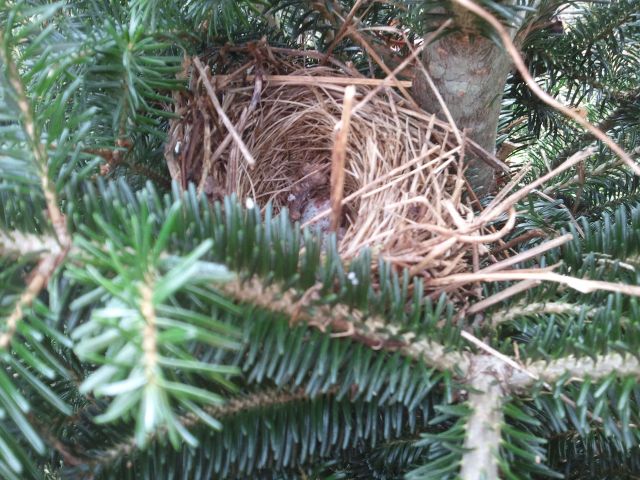
This week while scouting a field for twig aphids and mites, I came across this little nest full of eggs. It reminded me of how Christmas tree fields are home to many creatures -- a perfect reminder of Earth Day.

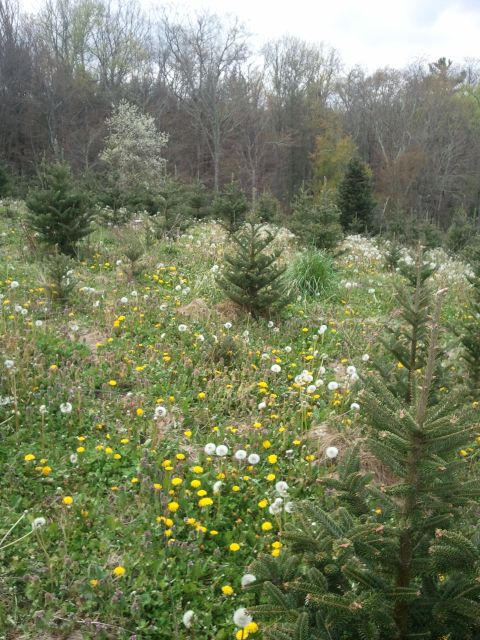
The most important creatures that tree growers invite into their tree fields are natural predators, brought in when ground covers are managed rather than killed. The next photo is from a field I was also in last week, showing a diversity of flowering ground covers.

That means that tree growers don't have to purchase natural predators like the lady beetles sold here for home gardens. Predators are attracted to the diversity of flowers and insect activity in the ground covers and will feed on any aphids or mites found in the Christmas trees themselves. It's free pest control.

One of the lessons from the Extension organic field in Alleghany County has been that the ground covers that come in when low rates of Roundup are used are far superior to all the grass that grows in the organic trees. After all, we grow grass in our lawns because grass tolerates mowing. Mowing ground covers in the organic trees has promoted grass and actually decreased biodiversity in the ground covers as compared to the lower portion of the field where conventional practices have been used up until this year. In this photo, you can clearly see the line where the clover stops and the grass starts. That's the line between the trees that have been grown organically since 2008 and those that are switching to organic production this year. Mowing promotes grass and it has certainly taken over to the detriment of the trees and the natural predators as well. (For those wanting to grow Fraser fir organically, it will be important to plant clover and other beneficial ground covers in a field the year before the Christmas trees are set -- something that wasn't done on this site. But that's for another blog entry!)

These ground covers, however, are also forage for bees. Clover, wild mustard, and purple deadnettle especially bring the bees in. Protecting bees can be as simple as choosing the time of day when you spray with an insecticide. Spraying trees in the late afternoon or at night for mistblower operators, is a good way to avoid problems with bees. Switching pest control to the fall is also a good way to avoid problems with bees. Be aware if someone has a commercial or even a hobby hive near your tree field. For fields close to bee hives, a mid-March application of horticultural oil will control most Fraser fir pests without causing a problem with bees at all.

April 22 -- Earth Day -- might seem like an odd time to think about Christmas trees. But those involved in the Christmas tree industry in western North Carolina know that every day is Earth Day in a Christmas tree farm!


Tuesday, April 3, 2012

Bee Careful!

Though this picture is of a bee in clover, there are many other flowering
plants in Christmas trees that bees may be attracted to.
Christmas tree pests are very active this spring, and growers are finding they need to treat for mites and for twig aphids. Thanks to chemical mowing, Christmas tree fields are full of flowering ground covers, especially wild mustard and purple deadnettle. These are favorites for bees. That's great for wildlife and biodiversity, but it presents a problem when trees need to be treated with an insecticide.

I wrote the following article for LIMBS & NEEDLES in 2008 with the help of Dr. David Tarpy at NCSU. The information is still appropriate. It gives good information on how to protect the bees that are in your Christmas trees. Basically, the best way to do this is to avoid spraying when bees are actively foraging. Target treatments of an evening or night.

There were several products we use today that weren't mentioned in the article because they weren't used at the time this was written.

  • Safari (dinotefuran) is highly toxic to bees.
  •  Movento (spirotetramat) is not toxic to the adult bees, but if it is taken back to the hive, it will affect how the bee larvae develop. 
  • Envidor (spirodiclofen) is slightly toxic to bees and may cause a problem in contaminated pollen and nectar. 
  • None of these products should be sprayed in areas where bees are actively foraging.


Bees and Trees -- LIMBS & NEEDLES article from 2008

By Jill R. Sidebottom, North Carolina State University

We have lots of clover in our Christmas tree fields now. That’s great news. Clover adds nitrogen to the soil and reduces erosion. It also provides forage for bees. That’s a wonderful thing – most of the time. However, when a Christmas tree grower needs to apply an insecticide, having bees actively foraging in the field can present a problem.

Being insects, it is perhaps not surprising that most insecticides are toxic to bees. Even some organic insecticides will kill bees. The wrong pesticide, applied at the wrong time, will not only kill the bees foraging at the site but can be carried back and kill the entire colony. The good news is that pesticide poisoning of honey bees can usually be kept to a minimum if beekeepers and pesticide applicators take certain precautions.

Most pesticide labels have a special warning about bees and other beneficial arthropods. For example, the label from Dimethoate reads as follows:

ENVIRONMENTAL HAZARDS
This pesticide is highly toxic to bees exposed to direct
treatment or residues on blooming crops or weeds. Do
not apply this product or allow it to drift to blooming crops
or weeds if bees are visiting the treatment area.

This language clearly places the responsibility for the safe use of this pesticide squarely on the applicator. Beekeepers can help applicators by making them aware of their hive locations, covering their hives with wet burlap, or even moving the hives during times of pesticide exposure. But the responsibility ultimately falls back on the pesticide applicator to make sure that bees are kept safe.

In the NCSU beekeepers notes, “Reducing the Risk of Pesticide Poisoning to Honey Bees”  contains a table with different pesticides and their relative toxicity to honey bees. I have reproduced the tables, in part, showing the materials that are used in western North Carolina on Christmas trees.

GROUP 1 – HIGHLY TOXIC. Severe bee losses may be expected if the following pesticides are used when bees are present, or if the product is applied near beehives or within a day after application to foraging bees in the pesticide application area.

  • Abamectin
  • Acephate (Orthene)
  • Carbaryl (Sevin)
  • Chlorpyrifos (Lorsban)
  • Dimethoate
  • Imidacloprid (Provado, Merit)
  • Malathion
  • Permethrin (Astro)
  • Spinosad
  • Thimethoxam (Flagship)
 GROUP 2 – MODERATELY TOXIC. These pesticides can be used in the vicinity of bees IF dosage, timing, and method of application are correct; but these products should never be applied directly on bees in the field or at the colony location (apiaries).

  • Bifenazate (Floramite)
  • Disulfoton (Di-Syston)
  • Endosulfan (Thiodan)
  • Fluvalinate (Mavrik)
 GROUP 3 – RELATIVELY NONTOXIC. These pesticides can be used around bees with a minimum of injury if the dosage, timing, and method of application are correct. Never apply pesticide directly to the beehive.

  • Diflubenzuron (Dimilin)
  • Esfenvalerate (Asana)
  • Pymetrozine (Endeavor)
If the pesticide you are interested in is not listed here, you can sometimes find the LD50’s for bees under the MSDS (Material Safety Data Sheets). A material is considered ‘highly toxic’ if the LD50 is less than 2 µg (microgram or 1/1,000.000 of a gram) per bee. It is ‘moderately toxic’ if the LD50 is 2 to 10.99 µg per bee; ‘slightly toxic’ if it is from 11 to 100 µg per bee; and ‘practically non-toxic’ if it is from 50 to 100 µg per bee. For instance, the contact LD50 for bifenthrin (Talstar) is reported as 0.01462 µg/bee, which would make it highly toxic.

The LD50’s for bees can be somewhat misleading, though, because they express the pesticide toxicity to the individual bee. A product that is moderately toxic but that is applied in a form that is similar to pollen and is collected and concentrated along with the pollen can kill the entire colony.

On the other hand, highly toxic materials may cause less of a problem if bees are not actively foraging in the area. Be sure to check fields the day before spraying to determine if bees are actively foraging. For instance this summer, some of the clover flowers are drying up because of the drought, and bees are no longer present. Also, if materials are applied in the late afternoon (after 3 pm) or even at night, the impact on bees will be reduced. Some growers have successfully used Dimethoate, for instance, near hives if the material is applied in the late evening and is dried before the bees start foraging the next day.

Reducing drift is also important in reducing the likelihood that the material contacts beehives. Air-blast sprayers are more dangerous than pressurized-pump sprayers. If a pesticide application is being made by air, then it is the contractor’s responsibility to notify any beekeepers that have “registered” apiaries (one or more hives of bees) within 2 miles of the area to be aerially sprayed. These regulations are defined in the N.C. Pesticide Laws and the person responsible for the notification is the person who contracts for the aerial application.

More information of bees can be found at the apicultureprogram at NCSU. Another important link is to the North Carolina State Beekeeper’s Association. This is a good place to look at see if the county you have Christmas trees in has a beekeepers association that you can contact about the local of hives near your Christmas tree fields. Finally, you can contact the NCDA&CS ApiaryInspection Service for official apiary records and registration.

The NCCTA is currently advertising the environmental benefits of Christmas trees. If bee kills are associated with Christmas tree production, however, it will be hard to defend such a claim.

Special thanks to David Tarpy, Associate Professor and Extension Apicolturist, NCSU, for helping review this article.