The Value of Christmas Trees

"...there is no reason why the joy associated with the Christmas evergreen may not be a means of arousing in the minds of children an appreciation of the beauty and usefulness of trees; and keen appreciation of the beauty and usefulness of trees is a long stop toward the will to plant and care for them (Arthur Sowder, US Forest Service, 1949)."
Showing posts with label miscellaneous. Show all posts

Sunday, April 22, 2012

Celebrate Earth Day with a Christmas Tree


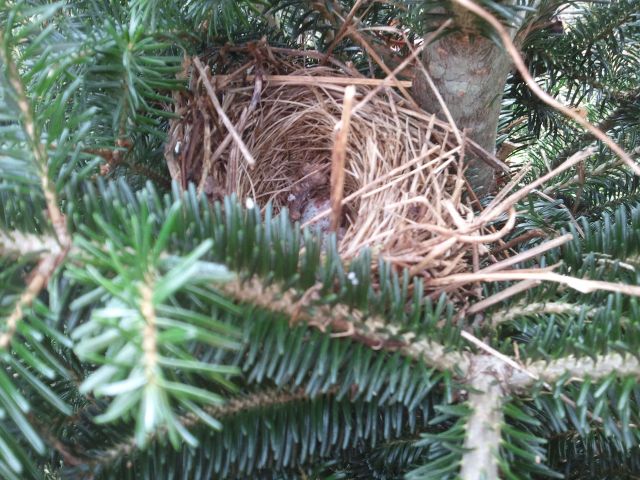
This week while scouting a field for twig aphids and mites, I came across this little nest full of eggs. It reminded me of how Christmas tree fields are home to many creatures -- a perfect reminder of Earth Day.

The most important creatures that tree growers invite into their tree fields are natural predators, brought in when ground covers are managed rather than killed. The next photo is from a field I was also in last week, showing a diversity of flowering ground covers.
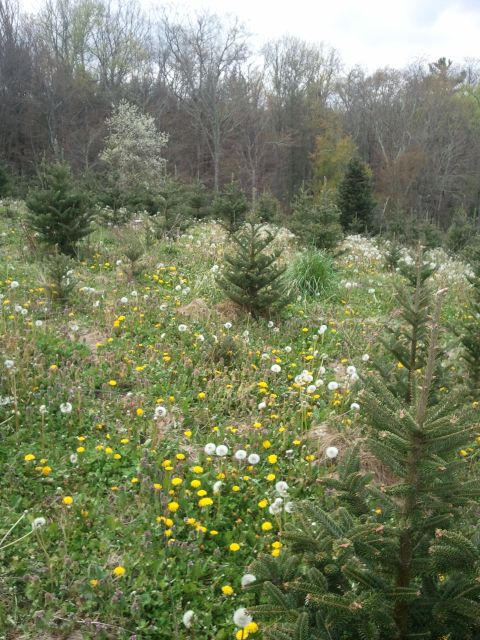
That means that tree growers don't have to purchase natural predators like the lady beetles sold here for home gardens. Predators are attracted to the diversity of flowers and insect activity in the ground covers and will feed on any aphids or mites found in the Christmas trees themselves. It's free pest control.

One of the lessons from the Extension organic field in Alleghany County has been that the ground covers that come in when low rates of Roundup are used are far superior to all the grass that grows in the organic trees. After all, we grow grass in our lawns because grass tolerates mowing. Mowing ground covers in the organic trees has promoted grass and actually decreased biodiversity in the ground covers as compared to the lower portion of the field where conventional practices have been used up until this year. In this photo, you can clearly see the line where the clover stops and the grass starts. That's the line between the trees that have been grown organically since 2008 and those that are switching to organic production this year. Mowing promotes grass and it has certainly taken over to the detriment of the trees and the natural predators as well. (For those wanting to grow Fraser fir organically, it will be important to plant clover and other beneficial ground covers in a field the year before the Christmas trees are set -- something that wasn't done on this site. But that's for another blog entry!)

These ground covers, however, are also forage for bees. Clover, wild mustard, and purple deadnettle especially bring the bees in. Protecting bees can be as simple as choosing the time of day when you spray with an insecticide. Spraying trees in the late afternoon or at night for mistblower operators, is a good way to avoid problems with bees. Switching pest control to the fall is also a good way to avoid problems with bees. Be aware if someone has a commercial or even a hobby hive near your tree field. For fields close to bee hives, a mid-March application of horticultural oil will control most Fraser fir pests without causing a problem with bees at all.

April 22 -- Earth Day -- might seem like an odd time to think about Christmas trees. But those involved in the Christmas tree industry in western North Carolina know that every day is Earth Day in a Christmas tree farm!


Monday, October 31, 2011

White Pine Problems

People still have white pines! And this fall, these have been hammered in the northern mountains by what we think is a needle cast.

People started seeing yellowing and browning needles a few weeks ago. Damage typically occurred in the upper portion of the plant but occasionally was all over. Many growers commented that they had been in the field just a few weeks prior to this and saw no problems, even tagging some trees, only to come back later to find major needle loss.

When you look closely, not every needle in a fascicle is affected. Sometimes there are bands of green and yellow tissue on the needles. Many growers also found that only the sheared white pine was affected. We only found one site where there were some unsheared white pines that also had the same symptoms.

When this occurred in 2007, the problem was diagnosed as Bifusella linearus, a needle cast found on white pines. We have sent samples off to look at a positive identification this year. However, it is often hard to diagnose needle casts. There are several fungi associated with white pine needles. And there is also confusion between needle casts and ozone injury on white pine.

Ozone damages plants by making the stomates sluggish. It is typically the fast growing trees and weeds that are affected most by ozone. The USDA website (click here for site) lists the following plants as good indicators of ozone damage along with the damage seen:

  • Blackberry, secondary canes (Rabus spp.): Red to purple stipple.
  • Black cherry (Prunus serotina): Red to purple stipple, may drop the injured leaves early.
  • Common milkweed (Asclepias syriaca): Purple to black stipple, leaves may be chlorotic (yellow).
  • Yellow-poplar (Liriodendron tulipifera): Brown stipple, may drop the injured leaves early.
  • White ash (Fraxinus americana): Red to brown stipple. Similar injury is also found on green ash
So if you suspect ozone, look at these indicator plants nearby to see if there is also damage. White pines were taken off the indicator list in 1995. If these are not showing symptoms, it is most likely a needle cast.

This is also some question if fertility is playing a role. This time of year calcium deficiency is showing up in Fraser firs and white pines. If you are having extensive problems with needle loss, it might be a good idea to take some soil samples and plant tissue samples to further diagnose the problem.

No matter what is causing this damage, there is probably little a grower can do. One of the main reasons is that the profit margin is so low on white pines that it makes any fungicide treatment unattractive. However, when we get a positive diagnosis, I'll pass along treatment options.

Of course the main question is if the damage will continue to get worse this fall. In falls past it did not, so hopefully what we're seeing right now is the worst of it, and undamaged individuals will remain looking good. The following are some photos I took on Friday.

Banding on the needles

Not every tree is affected and not all the same way.

On this plant, damage only occurs in the upper portion of the plant.

Another shot of banding.

This tree was affected overall.

Wednesday, June 8, 2011

Going Mobile!

The Fraser Fir IPM Blog has gone mobile!

Now when you access this blog from your mobile phone, you will get a slick new look that will allow easy viewing when you are in the field or on the go.
Enjoy!

Wednesday, April 27, 2011

Ready Or Not!

I saw my first Fraser fir with buds breaking yesterday. So ready or not, it's spring!

The weather hasn't cooperated much in getting spring pesticides out. If you got behind and buds are breaking and you need to control twig aphids, an application of Dimethoate should control the aphids even in the broken buds. This will also knock back spider mites and rust mites. This works best when applied with a high pressure sprayer -- not with a lot of pressure, but with good coverage of all the new growth. However, even with a mistblower, it still may help.

So far this spring, though, I haven't seen many fields with enough twig aphids to worry about. With all the rain we're getting, it will greatly lessen the impact of twig aphid damage and spider mites as well.

The key is to not forget the spider mites as the summer progresses and especially if the rains stop. Late season spider mites can sneak up on you. Even if you use a good miticide in the spring, that is no guarantee that spider mites won't become a problem again by late summer or fall. Even a quick job scouting is better than not looking at all.

I guess the point of this post is to not worry if you haven't gotten all the insecticides you intended to before bud break. It is better to not apply a pesticide than to put it out in poor conditions such as too windy or rain on the way. Just keep an eye out for developing problems. Nine times out of ten, pests like twig aphids and mites won't be bad enough to worry about.

Tuesday, April 26, 2011

Honoring John Fraser

Today marks the 200th anniversary of the death of John Fraser, the man for whom the Fraser fir is named.

I hope you were able to read the article I wrote for LIMBS&NEEDLES about John Fraser. He was a remarkable man, exploring this country and its rich plant life when it was nothing but wilderness.

He wasn't the exacting botanist that Michaux and others were. He didn't leave any notes. Some said that he  explored and collected solely for financial gain, and for that reason should be looked down on. But in my opinion, he found a way to make a living doing what he loved. Like the Fraser fir which tenaciously survived on the highest mountains following the last glaciers, John Fraser didn't require anyone's approval. He was self taught, self motivated, and carved out his own name and niche. His legacy is the perfect symbol for the North Carolina Christmas tree growers that followed him scores of years later, who were also self taught, self motivated, and carved out an industry where people said it couldn't be done. Now the Fraser fir is recognized all around the world as one of this planet's best Christmas trees, and it still proudly bears the name of the man who first brought it down off the mountain.

So thank you, John Fraser. Your tree is still well loved and we trust it will be well into the future.

Wednesday, April 20, 2011

Pest Problems Caused by Economics

With problems in selling trees come increased problems with pests. As trees keep getting larger and start growing into each other there is more opportunity for algae and other pest problems. These are related to the lack of air movement around the trees.

In a field I visited today there were actually 3 problems causing discoloration of the foliage -- algae, elongate hemlock scale, and a disease called Rosellinia.The fungus grows in the interior needles, causing them to shed. The fungus grows in mats and produces the fungal spores pictured here.


The remedy for Rosellinia fungus and algae is to improve the air movement by keeping weeds in check, butt pruning trees, and removing trees that are growing into each other.

You can also control algae from developing in the foliage that was produced last year by spraying right at or just after bud break with the copper based fungicide Kocide. For information on algae control check out past entries on algae.

Wednesday, February 9, 2011

Pennsylvania Christmas Tree IPM Manual

The folks in Pennsylvania have put together a new manual on integrated pest management for Christmas trees. Click here for a free pdf of this manual.

Wednesday, October 27, 2010

More Info on Fall Needle Shed

Jeff Owen sent me the following information to further discuss what's happening with fall needle shed:


Stressed Fraser firs will shed interior needles in late September or October. It usually occurs right in line with fall color on hardwood trees. Usually it is a sign of drought stress, but there may also be a fertilizer deficiency or toxicity contributing to the problem. We have not been able to point to a single nutritional problem contributing to interior needleshed. But I have seen internal needle shed in fields that have low phosphorus, or calcium, and/or very high manganeses or sulfur. 

I have observed several fields where the needle shed is widespread on the southwestern aspect and very light as the field shifted to more of a northern aspect. Even a subtle difference in aspect made a big difference in this problem. In a drought stress year, most growers will have 1 to 5% of this problem in their older trees, but I have seen one or two fields with as much as 30% of the trees affected.

Needle loss problems seldom show up before trees are of a marketable age and size.  Trees greatly increase the amount of foliage with each progressive year.  This creates an increasing demand for water and nutrients.  Factors which may have been adequate or marginal for a smaller tree become limiting as the tree grows.  The failure of symptoms to be expressed in younger trees has often lulled growers into complacency only to be surprised by needle loss in trees already tagged for market.

When needles shed out to the new buds in the fall, I think it is a different scenario. In that case I have observed 3 different factors in play: salt, calcium deficiency, and Phytophthora root rot.

Salt injury at some time in the current year can cause needle loss all the way out to the bud typically without killing the branch or bud (although sometimes they die too). I have seen late fall needle loss and grey-black necrosis in the bark and wood of branches that were spring fertilized with "plops" of 10-10-10. Sometimes the whole tree sheds, but sometimes only one side or a coil of branches climbing up the stem from damaged roots will lose needles.

Calcium deficiency will induce fall needle loss in the top or middle of a mature Christmas tree. I have seen white pine and Frasers with similar symptoms in the same field. All the needles on a branch can turn bright yellow, then brown, then drop off. The branch and buds live although growth can be stunted in the following year. I have seldom seen more than 1% or 2% of trees with symptoms of calcium deficiency. Yet these trees may reflect a field-wide deficiency. The concern has been that other trees in the field that showed no symptoms prior to harvest could shed needles after harvest either on the retail lot or in the  home. Dr Hinesley and Dr. Shelton conducted unpublished research that suggested this was the case.

The third root cause of total needle loss that I have seen was Phytophthora root rot (PRR). Usually, Fraser firs that die of PRR hold on to their needles a long time, but sometimes in the fall when the diseased trees have been stressed, green trees will shed out just like they do with a calcium deficiency. Only healthy roots can actively take in calcium, so it makes sense that PRR can contribute to the expression of calcium deficiency.

In all of this there are few proactive steps to take. In terms of the imediate harvest, buy a shaker machine to remove interior needles on trees that are still salable. For the future, take a soil sample and fertilize your farm according to the reports. Don't let market trees go to harvest short on calcium.


Monday, October 25, 2010

Fall Needle Shed

I'm getting out of my comfort zone talking about fall needle shed. I don't think we have a good explanation as to why it is happening. It is certainly associated with stress and is worse in some years (like this one) and in some fields than others.

Of course some needle shed occurs every fall. Usually it's the 4th or 5th year needles. The problem occurs when it's the 3rd, 2nd or even the current year's needles. That's when tags start coming out of trees!

These photos are ones I took with Jerry Moody on Friday at a high elevation farm in Avery County. The site was above 4,000 feet, and it was very windy -- that means a stressful site. Though these pictures were taken in Avery, I've heard of a lot more problems in Ashe County where it has been drier this summer and fall.

This tree had only a few areas that had discolored needles.


This tree had excessive shed throughout the whole canopy. It was a very heavy density tree, so it was hard to see from the outside, but it will still impact if this tree can be sold this year.

In some instances we've seen trees like this with current year needle drop that were due to root injury. Fertilizer burn can be one cause of root injury, but this particular field had not had any fertilizer applied since the spring. The shoots of this tree appeared to be healthy, as did the buds for next year. Root loss can also be caused by drought. Fraser fir, being a seed-run crop, will have individual trees that are more susceptible to drought than others.

I've had some calls from growers that are concerned that scales are causing this discoloration. At this site, there were no scales. If in doubt, look at the shoots of several trees. Turn the foliage over to look for the presence of scales. Most of the fall needle problems have not been associated with scales.

Advice for the grower? Keep on top of your fertility. By fertilizing according to soil sample results, hopefully you can avoid many of these problems. If the problem develops, take soil samples and plant tissue samples of healthy verses trees with shedding needles. And get your County Extension Agent involved.

Wednesday, August 11, 2010

NCTA Meeting

Hope everyone can come to the National Christmas Tree Association annual meeting in Winston this week.

I will be speaking on Friday morning. My talk is called, "Getting Personal With Pests." We have it on-line if you'd like to look at it. It is found at: http://www.ces.ncsu.edu/fletcher/programs/xmas/production-mountains/Sidebottom-Pests_2010-08-13.pdf

It's kind of a big file, so it will take awhile to pull up.

I'll also be on two of the farm tours. I'll be speaking on Saturday morning at Harry Yates' farm on elongate hemlock scale. Then in the afternoon I'll be speaking at Omni farm on scouting, pest control and our organic demonstration.

Friday, July 23, 2010

Japanese Beetles

I may not be moving about too well these days, but thankfully others are out in the trees seeing what's going on.

Jeff Owen has told me that he is seeing Japanese beetles on the terminals feeding. He's seeing this in several tree fields to a greater extent than most years.

Japanese beetles are just one of a number of terminal feeders. They tend to feed toward the top of the tree and terminal, creating irregular patches, though in this picture which I took years ago, they are feeding on older growth. Their feeding is swallow, but will result in discoloration and sap flowing.

Usually by the time you notice the feeding, they have done as much damage as they are going to do. They aren't anything to worry about. However, if you are seeing the insects in your trees, you can spot treat with any good insecticide. A backpack mistbower or backpack sprayer is sufficient. When using a backpack sprayer, I like a hollow cone nozzle for applying insecticides.

Tuesday, July 13, 2010

Some Interesting Pictures

I'm sitting at the extension office with my leg propped up after knee surgery. Walking in all these tree fields sure tears up your knees! It will be awhile before I can tromp around again, so I thought I would post some pictures I've been working on while laid up.

The first is a picture I took at Ewing Harmon's on June 29th. He had treated his trees for scale, and it looked like he got good control. This photo shows what folks need to look for after treatment. There aren't any nymphs on the new growth. I hope you can see in this picture that the needles on the newest growth are scale free.

Scales have moved onto 2010 growth, so if you look at fields and aren't seeing the scales on new growth, that's a good sign. Also, it's easy to see the fuzz from the male scales back in the canopy now. If there aren't many of those, that shows good control as well.

I had commented in my June 30 post about the spread of scale at Dale Cornett's field in Watauga County. I made a colorized scheme to show the increase in scale at Dale's which I have photographed below.

I think this is interesting for a couple of reasons. First of all, the most heavily infested trees in 2010 are scattered everywhere, they aren't just concentrated where the most heavily infested trees were in 2008 which was on the far end of the field.

Something else that was interesting was that two years ago, Dale had some trees with heavy incidence of pine needle scale, not just elongate hemlock scale. We didn't find any of those this year. That's good, because we don't need any other major scale problems.

To date, Dale has only used Di-Syston for pest control in these trees.

The annual Watauga County Christmas Tree Grower's Association meeting will be July 29. I hope to go out before that meeting and look at scale control in the plots that I treated before that meeting, and will report at the meeting and in this blog what I find..

The last schematic I will post today depicts IPM in Christmas trees. I created this for the National Christmas Tree Meeting in Winston Salem in August. This Christmas Tree IPM Pyramid shows the importance of a good IPM foundation to ultimately be successful with pest control.

And this is what so many tree growers in North Carolina do. They work hard to get good fertility and ground cover management, then scout to determine what pests they do have. Through this process, their pesticide controls have been more successful. In fact, I haven't heard of anyone that is too upset that Thionex will be taken off the market. They don't need such a strong material. They can get excellent control with safer products.

Anyway, hope everyone enjoys these schematics. Feel free to use them however you can.

Thursday, July 1, 2010

Doug's Color Wheel

Doug Hundley was telling me the other day that he was explaining to a newer grower all the different times of year you could control the different Fraser fir pests. It's amazing how much our knowledge of pest control has changed even over the past few years. When treating for one pest, you can target others that you have as well, either by your choice of pesticides or how thoroughly you spray.

He told me that he took the white paper plate he and the grower were beating pests on, and he drew different color circles to represent the times of year you could control different pests. I thought it was a great idea. So I put together this color wheel. I haven't talked to Doug or others yet to see if my circles correspond to theirs, so let's talk about it. Email me your comments. I can change it however folks see fit.

Monday, June 28, 2010

Some June Pests

Went out last week and found several June pests that might be of interest to folks.

Elongate hemlock scale. Scales are making their way onto the new growth. If you treated this year in the spring, or sometime last year, and you aren't seeing the scales get on 2010 growth, that means you have pretty good control. This is a photo of scales on 2010 growth.

At this particular field, the grower had treated with Asana + Dimethoate with his mistblower before bud break this spring. Though there was still live scale, it hadn't spread to new trees, so we counted the treatment as a success, since it was far less expensive than spraying with a high pressure sprayer. The grower was going to cut out the worst trees for scale (he'd have a hard time selling them anyway), and will retreat in a few days with his mistblower while the crawler number is at its peak. Hopefully that may also give him twig aphid control next year.

Balsam woolly adelgid. Woolies have also moved onto the 2010 growth. This photo is of nymphs already on the new growth. There is already swelling too. These will molt in place to the adult within the next month and start laying more eggs.

This particular block of trees had been treated with dimethoate in the spring. No control of woollies. The grower will spray with Talstar sometime this fall.


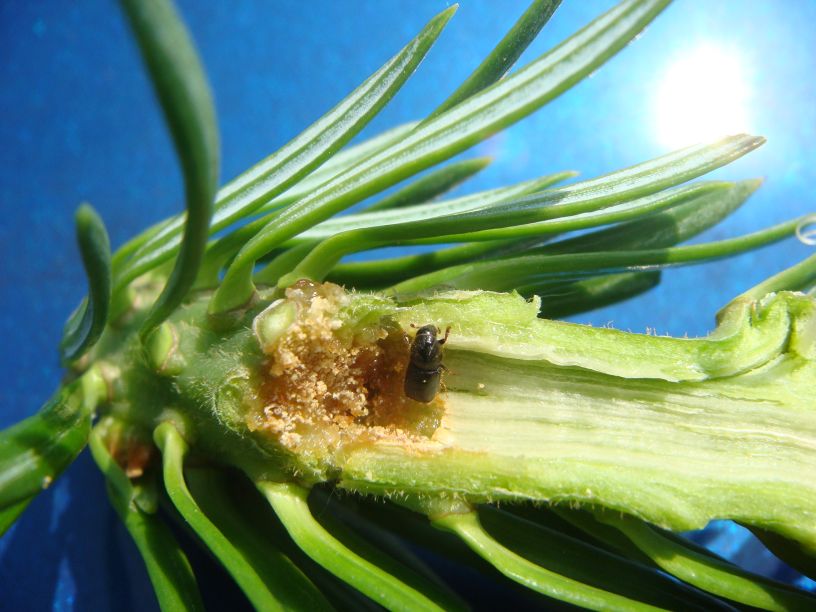
White pine cone beetle. The pine cone beetle is an infrequent pest of Fraser fir, borrowing into usually the first whirl of branches and making a shepherd's crook. Sometimes you can still find the black beetle in the tree. The two photos are of the entrance hole and then of the beetle. These pictures were taken in Ashe County last Friday. I haven't seen any of these pests for several years. They are usually only a problem when there aren't many white pine cones, which are their preferred food. When you find them, they have already caused as much damage as they are going to, so they are only a novelty and nothing to worry about. Shearing will take care of the problem. Bryan found these. Jerry Washington was the first one to find them years ago.

Leaf footed seed bug. The last interesting bug Bryan also found on a Fraser fir cone in some Christmas trees. I think it is a leaf footed seed bug that will feed on Fraser fir cones. You never know what you'll find in a tree field!

Friday, June 11, 2010

Endosulfan (Thionex)

As of June, 2010, EPA has decided that endosulfan, the active ingredient to Thionex, poses too great a risk to workers and wildlife. Therefore EPA is taking action to end all uses of the product. You can read more about it at: http://www.epa.gov/pesticides/reregistration/endosulfan/endosulfan-cancl-fs.html.

According to an EPA news release dated 6/9/2010, "Makhteshim Agan of North America, the manufacturer of endosulfan, is in discussions with EPA to voluntarily terminate all endosulfan uses. EPA is currently working out the details of the decision that will eliminate all endosulfan uses, while incorporating consideration of the needs for growers to timely move to lower-risk pest control practices."

I do not know anything more at this time, but will keep you posted.

Thursday, April 22, 2010

Earth Day

For Christmas tree growers, every day is Earth Day. Since I started working with Christmas trees in 1988, I've seen a complete transformation of the industry in North Carolina. Growers have slashed their pesticide and fertilizer needs through adoption of IPM practices and good ground cover management.

And look at the healthy Frasers on Mount Mitchell. I took this photo last year from the new tower. Given half a chance, nature has a wonderful ability to heal herself.

Getting Rates Right

I don't think there's anything else that causes people more confusion than numbers. And unfortunately, pesticide rates are all about numbers.

Insecticides can be labeled as a per acre rate, or a per 100 gallons rate. Growers like the 100 gallon rates, because they are easy to mix, but often the per acre rates are more accurate.

When spraying with a mistblower, it's pretty easy to calibrate the sprayer. In fact, most growers can tell you exactly how much water they are putting out per acre. The problem comes when putting out sprays with a high pressure sprayer. Yet, when I start to question people, they can usually give me a ball park figure -- say less than 200 gallons per acre or around 300 gallons per acre or 500+ gallons per acre. And that's all you need to know to get an idea of how much chemical to add per 100 gallons.

For instance, if you are trying to apply Envidor at 24 ounces per acre, it you are using 300 gallons of water per acre, mixing the product at 8 ounces per 100 gallons will give you the exact rate. But if you are spraying 500 gallons of water per acre, you will be applying more than 40 ounces per acre which exceeds the rate and will cost way too much money. If you're using less than 200 gallons of water per acre, you'd best mix it at 12 ounces per 100 gallons. So before you mix, think about how much water you're likely to use. *(See below for calibrating a high pressure sprayer).

Using that same Envidor at 24 ounces per acre out of a mistblower? Applying 40 gallons of water per acre? Then you would mix the Envidor at 60 ounces in 100 gallons.

But what about when you are applying a materials with a mistblower that has a per 100 gallon rate? Asana is a good example of this. Labeled at 9.6 ounces per 100 gallons, it can be used in a mistblower to get control of multiple pests including twig aphids, balsam woolly adelgid, and elongate hemlock scale.

Back when I first started working, Bill Huxster and Jim McGraw encouraged people to use 3 times the per 100 gallon rate when spraying with a mistblower. That's because growers are using much less water, but they still need basically the same amount of chemical per acre. It turns out, that's a pretty good rule of thumb. A mix of 30 ounces of Asana per 100 gallons seems like a lot, but Asana is labeled at up to 52 ounces per 100 gallons in ultra-low volume sprays (such as an aircraft) and as much as 37 ounces per acre for certain pests in Christmas trees.

When looking at labels, see if there is a cap for application. Is there an amount you should not exceed when applying materials specified on the label? Use this as your guideline for how much to apply.

Figuring out rates when it comes to insecticides is just common sense. Take a minute to make sure what you're using makes sense.

*CALIBRATING A HIGH PRESSURE SPRAYER:You can always calibrate your high pressure sprayer. First determine how much water you are putting out per second. Spray into a bucket for 10 seconds having set up the gun the way you mean to spray, measure what you spray and divide by 10. (You might need to cover the bucket with a garbage bag to keep it from coming out). That gives you what you are spraying out per second. Then spray a few trees and see approximately how many seconds it takes to cover the tree the way you want to. 

An example -- say you spray 3 ounces per second and approximately 4 seconds per tree on one side. Since you spray from two directions, thats 8 seconds per tree. That's 24 ounces of water per tree. If you have 1,700 trees per acre, you are using about 300 gallons per acre. If you stock at 2,200 trees per acre, you would be using about 400 gallons per acre.

Monday, March 22, 2010

March Madness

Well. Not quite. I thought it might get people's attention. Of course, people do get a bit mad in the spring. "Mad as a March hare," the English used to say. People are just now realizing what all they have to do this spring -- at least I know I am.

Just wanted to share a few observations I and others have been making this spring.

BALSAM TWIG APHIDS: I haven't seen any hatched yet, but the eggs are getting plump like they are ready to hatch. However, I haven't found any fields so far with a high incidence of twig aphid eggs. You might pull off 10 shoots before you find an egg. I guess last spring it stayed so wet that the aphids didn't reproduce well. Remember, though, that even these low numbers can result in damaging levels of twig aphids if the spring is warm and dry, as the aphids reproduce so quickly.

VOLES: Both Bryan Davis and Doug Hundley are seeing greater than normal vole activity. With all the snow cover, it only makes sense.

Bryan sent the following in a March 17 email, "I have seen a tremendous amount of signs of rodent tunneling under the snow. During the winter when the snow melted on some fields signs were visible and as I've been out over the last two weeks I've thought this is the most sign I've ever seen. I recall seeing some signs of rodents last fall where we were spraying deer repellent and as I've returned to these farms there is more signs of rodent activity. The tracks I'm seeing don't seem to bee tunneling in the soil, but on top of the ground. I haven't seen any damage such as girdling or dead trees in these fields yet. I'm going back to one site today that has had a lot of activity and I'll look closer for signs of damage. As far as control, I had a grower asking about this last fall and I checked with Scott Henson about what they carry at CPS and they had rodenticides, but they came in large volumes. Hopefully now the hawks, foxes and cats can work on these pests."


I've only found voles damaging Fraser fir once -- and in that field they completely severed the trunks of small trees. The poor little trees looked like pencils stuck in the ground. Rodent control on that farm involved controlling the thick grass in the field, allowing the hawks to work it. Like Bryan says, the natural predators should take care of things.


RUST MITES: Bryan and I found some rust mites getting started over the last couple of weeks, but numbers were still very low.


OIL TRIAL FACTS AND FIGURES: Bryan sprayed some trees with the new Saf-T-Side oil last Friday. We used a backpack mistblower and a 2% rate. I'll try to get back there next week and see what the eggs look like. He was using about 100 gallons of water per acre to get good coverage. That is probably more than most growers could use, putting it out 3 1/2 gallons at a time. Another grower we talked to figured he was applying about 8 backpacks per acre for around 28 GPA.


That grower burned some trees with oil last year using his high pressure sprayer. All the needles fell off of some trees. The buds for 2009 weren't touched, and so all that's left is 2009 growth. Here is a picture of one of those trees. Hopefully this new oil will be easier for growers to use and won't cause burn.


Oil isn't cheap. If you are using the regular oils which are about $14 a gallon -- a 2% solution and 300 GPA comes out to $84 per acre. When Bryan sprayed last year, he used up almost a case of oil (5 gallons) on 1,000 trees which cost more than $100 per acre. But, Bryan hopes to market these trees as "pesticide-free" this fall which should give him an advantage over conventionally grown trees.


If anyone sees any interesting pest problems, let me know so I can share them with everyone.

Tuesday, March 16, 2010

Our Natural Stands

This picture was taken on Roan Mountain in the last few days. It's still another world up there -- a winter world even though everywhere else is starting to green up. I just wanted to let people see what Fraser fir and the native pests that affect them such as twig aphids, Cinara aphids, mites, and rosette bud mites are adapted too -- harsh conditions! So they can take the cold winter we've had this year.

Monday, January 11, 2010

This Winter's Weather

SUMMARY: The harsh winter weather this year will help decrease problems with Phytophthora root rot and Cinara aphids, but probably not other pests. And even these pests aren't eliminated by the cold.

Doug Hundley sent me this picture of his trees during the Christmas Day ice storm.

I'm sure a lot of folks are wondering what the weather this winter will mean to pests of Fraser fir Christmas trees.

Of course last winter we had even colder temperatures, though they didn't last as long. I have pictures of the creek near my house taken January 2009 with ice over about half of it, but so farthis year, little ice has shown up on the creek .

I was hoping last year that the cold temperatures would reduce elongate hemlock scale, but they didn't seem too. Of course, when you examine the scales under the microscope, there are always a lot of dead indivduals present. Last spring after a cold winter, I think the percentage of dead scales was higher than I usually observe -- sometimes as high as 45%. But the scale still spread successfully. At one farm, there were scales on 32% more trees the summer of 2009 than there had been in 2008. So cold weather may slow scales down some, but not enough to get excited about.

Cinara aphids are one pest that do appear to be less common after a harsh winter. There weren't many fields that had Cinaras in 2009. Those I did see didn't have aphids until fall. Even so, I still had close to 10 calls about Cinaras before Christmas 2009. So though they aren't prevalent, they can still be a problem.

One pest that cold winter weather does help with is root rot. Research has clearly demonstrated that Phytophthora cinnamomi resting spores will slowly die as soil temperatures remain below freezing. The longer soils are frozen, the more spores will die. This can be a big benefit to Christmas tree growers this year. But again, there will always be a few spores that survive, and given the right conditions of warm weather and flooding, those few spores can still cause quite a problem.

Other pests are well adapted to cold mountain temperatures. That includes about everything else -- woollies, twig aphids, spider mites and rust mites. The only time these pests seem to be affected by cold temperatures is if they start to become active in the spring, and then they are caught by a winter storm. For instance, during the blizzard of 1993 which occurred in March, rust mites on hemlocks were killed out and ended up not being much of a problem that year. However on the white pines that caught and held the snow, the mites were insulated and ended up surviving.

The same can happen in the fall -- if it's warm and pests remain active late in the season and then freezing temperatures suddenly occur, they can be killed out. That didn't happen this fall. We'll have to wait and see what the spring brings!

I plan on going out this week to see how elongate hemlock scales are fairing if I can make it to the field I'm monitoring. I'll report on what I find later this week. I'm especially interested to see what stages are surviving this weather, and if any crawlers or many eggs are found.