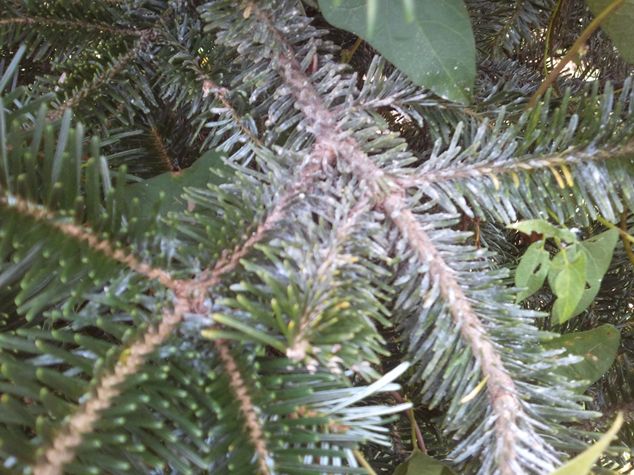
The Value of Christmas Trees

"...there is no reason why the joy associated with the Christmas evergreen may not be a means of arousing in the minds of children an appreciation of the beauty and usefulness of trees; and keen appreciation of the beauty and usefulness of trees is a long stop toward the will to plant and care for them (Arthur Sowder, US Forest Service, 1949)."
Showing posts with label Safari. Show all posts

Friday, February 13, 2015

Changes to Safari Label

Honey bee in white clover

Many of you are no doubt following the news about bee decline in the US and worldwide. Due to concerns about neonicotinoids in particular, the US EPA is making changes to the labels of these products.

Many growers are using Safari (dinotefuran), a neonicotinoid, for the control of elongate hemlock scale in Fraser fir Christmas trees. This product has proven to be the most effective at controlling scale in western North Carolina. Safari can be sprayed on the foliage or it can be applied as a trunk application. Both have proven effective.

The previous label of Safari indicated that plants shouldn't be sprayed if bees are visiting the treated area. This allowed the product to be applied of an evening or at night when bees weren't active.

The new Safari label which came out in 2014, is far more restrictive. The label now states that this product is "toxic to bees exposed to residue for more than 38 hours following treatment. Do not apply this product to blooming, pollen-shedding or nectar-producing parts of plants if bees may forage on the plants during this time period." The label also indicates it can't be applied "while bees are foraging" or "to plants that are flowering. Only apply after all flower petals have fallen off."

In other words -- no flowers period.

So what's a grower to do? Ground covers in Christmas trees are an integral part of integrated pest management. Besides controlling erosion and making the soil cooler so tree roots are closer to the surface, ground covers keep problem weeds from coming into a field and they are habitat for natural predators such as lady beetles, hover flies and lacewings.

In 2013, Jeff Owen conducted several demonstrations to find ways to keep good ground covers while getting rid of flowers and therefore bees. What he found was that our typical chemical mowing with Roundup will burn back flowers in ground covers including white clover within one to two weeks depending on the weather. Therefore, it's important when applying Safari, to time applications after a herbicide treatment. It's also important to scout before making an application to see if bees are visiting the area any further.

Protecting bees from pesticides is important, but flowering ground covers are also important to provide forage for bees as well for natural predators as well. With a little forethought, Fraser fir Christmas tree growers can create a win-win situation for themselves and pollinators.


Tuesday, February 12, 2013

Bees Already?!?

Brad Edwards and I were looking in a field treated with Safari last July to look at scale control. Long story short, the Safari worked well. I'd estimate 99% control. But what really caught our attention was what was going on under the trees. There was an almost continuous carpet of purple deadnettle that was starting to bloom. And it was full of bees! Most had pollen sacs full of red pollen.


This field was at just under 3,000 feet in elevation and southern exposure. The high was only 51 oF in Jefferson today. They say bees don't get out and start working until it's 55 oF. Obviously the bees don't read too well.

In any case, if you need to apply an insecticide, it's important to look and see if bees are in your trees. Pick a warm day at mid-day and look for bees. If you can spray at night, you should be OK. But if you have to spray in the day, clean up the field of flowers by using Roundup at suppression rates a week or so before treatment. Know if you have bee hives close by, and if you do, tell the bee keeper what you plan on doing. They may want to shut up the hive while you are spraying so the bees aren't exposed.

For more information about how to protect bees in trees see: FRASER FIR PEST CONTROL PORTAL: Tips for Keeping Bees Safe.

Monday, September 3, 2012

Impact on Predatory Wasps

Yellow sticky card placed in a Christmas tree that has EHS.
On January 5 of this year, I posted about the parasitic wasps I was finding on cut Christmas trees that were infested with elongate hemlock scales (EHS) (see Parasitic Wasps on Scale Infested Trees). If you will remember, Jerry Moody and I placed yellow sticky cards in cut trees to determine if scale crawlers were coming off of them. Yellow sticky cards are about 3 X 5 inches and coated with a sticky clear substance that traps insects once they step onto it. The yellow is particularly attractive to many insects. During our little study, there were only a few wasps per sticky card coming out once the trees were displayed in water in a warm room just like they would in someone's house.

These parasitic wasps are very important to control of the EHS. They are very, very small -- the size of a single scale. You'd never see them flying around, and in fact you have to use a microscope to see them on the yellow sticky cards. These wasps, Encarsia citrina, are available commercially and are often used for whitefly control in greenhouses. But they also love scales. Whenever you see a scale that has a round hole in it, you know that one of these wasps has developed inside it and killed it.(Think ALIEN with Sigourney Weaver!) I especially enjoy probing into scales this time of year and finding the immature wasp inside one. Sometimes the tiny little wasps even move their heads! (Nature is so cool!)

This scale has been parasitized. The arrow points to the exit hole the wasp made to get out
once it had fully formed.
The arrow points to a wasp that is still forming inside this scale. The eyes are to the left.
Over the last week, I've put out some yellow sticky cards in trees infested with scales in an Ashe County Christmas tree field (pictured up top). Travis Birdsell, the new county agent in Ashe County and I looked at these cards on Thursday after leaving them for 48 hours. I was amazed at how many wasps there were! We put two cards in one tree and there were 56 wasps on one of them and 34 on the other. In a second tree we had one card and it had 15 wasps. This was in a field where there were some scales, but they had never become really bad as they are in some fields.

I was surprised that there were so many wasps out now. So I became curious. Could I see a difference in the number of parasitic wasps in fields that had been treated with a synthetic pyrethroid compared to those that hadn't? I've thought for a long time that the increased use of the bifenthrin products in particular might be causing a lot of the increase problems in scales.

It just so happened that Jerry Moody and I had created the perfect place to test out this theory. We were working in a small field of trees in Avery County where few insecticides had been used and scales had become a problem. I already knew there were lots of parasitic wasps as I had seen them inside the scales. We had sprayed a block of these trees two weeks ago with Safari and a bifenthrin product, in this case, OnyxPro. We are treating a different block of trees every two weeks to see how late in the season we can get good scale control.

So on Friday, when we were making another treatment, I put a yellow sticky card in three untreated trees and three trees treated two weeks ago with Safari + OnyxPro. The two sets of trees were probably only about 75 feet apart. Today I looked at the cards (after 72 hours) and was amazed at the results.

There was an average of 45 wasps on the cards placed in untreated trees (79, 35, and 22) and an average of 5 on the trees that had been treated (10, 3, and 1). That is a 90% reduction in the wasps just two weeks after treatment! And though I didn't look at scale control, I am sure there is very little yet as Safari takes a long time to work.

I plan on looking more at this issue, trying to evaluate different chemical combinations put out at different times of year to see what the optimum time is to get control of scale without doing away with the parasitic wasp. But the early take home lesson is that the use of synthetic pyrethroids can have a profound affect on these important natural controls. Hopefully in the coming months we can determine when these materials can be used with the least negative impacts.

Wednesday, April 11, 2012

Safari Control of HWA

In February 2011 when this photo was taken, these trees had no HWA.
In June of 2010, I made a post on some hemlocks at my office that I had treated for HWA. (See post: HWA Control).

I looked at those trees today and they are covered with HWA and with EHS. The controls worked for 3 years, which wasn't bad.

It seems to me like there is a lot of HWA this spring -- not just on these trees but everywhere. It might be because of the warm winter.

Has anyone else observed how long Safari has controlled HWA? If so, make a comment about your situation.

Thursday, March 22, 2012

Saving the Hunger Games Set!

The same chemical that you may be using on your cat or dog to control fleas is helping to save centuries old hemlocks in the DuPont State Forest in western North Carolina.

Today I helped Brian Heath and Craig Lawing with the NC Forest Service train staff members at the DuPont on how to treat hemlocks for hemlock woolly adelgid (HWA) using a trunk application of Safari (dinotefuran). We just happened to be working at Bridal Veil Falls -- soon to be famous as a filming location for "The Hunger Games" which comes out this weekend.

The DuPont State Forest started controlling HWA several years ago. This has included releasing the predatory beetles, Sasajiscymnus tsugae, and applying the insecticide imidacloprid, often using CoreTect tablets (click here for the label) which are buried in the soil at the base of the tree. Still there are many trees that haven't been protected -- many of which couldn't be treated with a soil application. Sadly, there are still many trees at the DuPont which are in a state of decline.

Safari is more versatile than imidacloprid, as it can be applied as a spray directly to the trunk of the tree. This systemic insecticide is then taken up by the tree, moving to the foliage where the adelgids are killed. It also works well against elongate hemlock scale, another introduced pest that is commonly found in the DuPont. Left unchecked, these pests can kill eastern hemlocks.

Today we worked with two educational rangers with the Forest -- Eric Folk, who worked with the film crew, and Roberta Belcher. We showed them how to calculate the rates for application and how to apply the chemical with a backpack sprayer. Below are some pictures showing the process and the state of some of the trees.

First, the trees are measured to determine the rate. Here Brian
and Craig are determining the tree's diameter while Eric writes down the measurements.
It is important to keep good records as treatments may be several years apart.
Some of the trees are in good condition because of past imidacloprid applications.
This is one of the better looking hemlocks I've seen lately.
 These trees didn't look as good. One of them is already dead.
They had never been treated with imidacloprid as there is hardly any soil for
a soil application. Trunk applications with Safari are the only
hope of saving them.
Eric applies the Safari while Roberta times the application and keeps up with records.
The insecticide is only applied to the trunk of the tree.
You can see where the tree is wet.
The chemical is very safe -- remember it's used in products you can put on your pets.
Roberta has been working at the DuPont for more than 10 years. She said when she first started working, you couldn't even see the falls from the parking area. Now, with so many hemlocks in decline, you can. Hopefully with these and other control methods, these stately and important trees will thrive once more for generations to come.

Wednesday, March 7, 2012

Safari for Scale Control

This is my 100th post on this blog!!! 
Thanks for all the support with this endeavor!

Elongate hemlock scale (EHS) is on everyone's minds these days. In some Christmas tree counties in western North Carolina, as much as 85% of the fields are infested with scales. EHS is difficult to control, but the good news is, with scale control comes control of many of our other pests of Fraser fir including balsam woolly adelgid (BWA) and balsam twig aphid (BTA).

Safari (active ingredient: dinotefuran) is a new material recently labeled for Christmas trees. You have to have a copy of the supplemental label for use in Christmas trees.
Safari is a systemic and works well against BWA and EHS. The following are some of the lessons learned in 2011 in using Safari for EHS control.

Lesson #1: Trunk applications haven't worked well.

Applying Safari to the trunk
This method of application would be preferable because it is easier and it would result in the least impact on the parasitic wasp, Encarsia citrina, that attacks the scale. The recommendation was to apply Safari to the lower trunk of trees using a backpack sprayer and a rate of about one pound per acre.

Several growers tried this application method. I also put out several trials in Mitchell and Avery Counties. In our trials, we used a backpack sprayer for application, as well as a high pressure sprayer -- in some instances wetting the entire trunk. Unfortunately, despite the application method or timing, trunk treatments haven't worked well for us in NC. In 2012, I want to look at high rates, but for right now, foliar sprays of Safari are best.

Lesson #2: Full rate and good coverage give best results.

To date, the best EHS controls in North Carolina have been with a high pressure sprayer and full foliage coverage using 8 ounces of Safari per 100 gallons. This has ended up with a rate of as much as two pounds per acre. This application method has worked well from mid-May through August. When used in early October, control was poor.

An August application combining Safari with a bifenthrin product such as Sniper would control almost all Fraser fir pests --  EHS, BWA, BTA for the following year, Cinara aphids and spruce spider mites (SSM).

Lesson #3: It takes a while to work.

The "white" from the males
In my February 9, 2012 blog post, "Working with Safari," I described how control of Safari improved over time. In fact, it can take as long as four months.

This has made several people think it would be better to put Safari out earlier so it will have time to work. Of particular concern are the male scales that create the white on the foliage. But though the product takes that long to work fully, it is primarily the female scales which are toughest to kill that require the full four months to die. The male scales and crawlers are typically all dead within a month and even many of the female scales. So don't think you have to spray in April to prevent the male "white" on the trees. Even trees treated in August looked great by harvest a couple of months later.

Lesson #4: Natural enemies are important.

A wasp caught on a yellow sticky card.
It is the size of a gnat.
Probably the most important natural enemy of the EHS is the parasitc wasp, Encarsia citrina. This wasp lays its egg inside the immature female scales and develops there, eventually exiting as a full grown wasp from a round hole it makes in the scale's outer shell.

The following website has information about this scale: Entocare, biological pest control. (Please note that this website is mentioned for educational purposes only. The pictures are really nice. There has been no research in releasing Encarsia into Christmas tree fields).

But other predators are important too including lacewings and the twice-stabbed lady beetle.

How can you protect these natural enemies?:
  • First of all, only use an insecticide when you really need to. Scout to determine the need for control. 
  • Don't worry about BTA and mites in young trees. 
  • Reserve the synthetic pyrethroids such as Wisdom, Sniper, Talstar, Asana and Astro to the fall when they have less impact on predators.
Questions that still remain.

There are several questions about using Safari.
  1. How well would it work with a mistblower application? Many growers are set up to use a mistblower. If you would like to help us evaluate Safari applicaitons for scale control using a mistblower, let me and your county extension agent know. We'd love to work with you and follow up to see what works and what doesn't.
  2. What if you have to control BTA in the spring? Can you use Safari plus another product for BTA control and still get good scale control in April? If you're interested in trying this, again, let us know so we can follow results.
  3. Can you wait until September to treat? A September treatment would fit in better with most people's production schedule than an August treatment. First of all it's usually cooler. Secondly, Cinara aphid control would be better in trees to be harvested. Also, there would be less impacts on predators. This is something I plan on looking at this September.
  4. Would a higher rate of Safari work when applied to the trunk of the tree? Again, this is something I plan on trying -- targeting the highest allowable rate which is 2.7 pounds per acre per year.

Thursday, February 9, 2012

Working with Safari

With the help of Doug Hundley, I've been following a field treated for elongate hemlock scale at the end of the summer. The grower used Safari + Wisdom (bifenthrin) in early August with a high pressure sprayer. He was trying to get rid of the white from the male scales as well as controlling Cinara aphids on the trees he was harvesting. But he was also hoping to get both good scale control and twig aphid control in the trees that he was leaving. The Wisdom should supply both the Cinara aphid and twig aphid control. The Safari would supply the scale control.

Doug and I have followed the field ever since. Doug was particularly interested in seeing if the white from the male scale would weather away and become less of a problem. So we went in just 3 weeks after application. At that time, the white was already less noticeable, but I found only 55% scale mortality which is, needless to say, practically no control at all.

In mid November, about 100 days after application, we went back and  observed 80% scale mortality. The white from the males was hardly noticeable, and there were no problems with harvesting the trees. Definitely we were headed in the right direction, but the scale control was still not good enough.

Just last week, however, we looked again -- close to 6 months after application. Now the control was around 95%. Control is finally good. This illustrates just how long Safari takes to work.

I plan on looking again at the field in mid-April. Hopefully we'll find that there was twig aphid control from the Wisdom that was applied. Then in June we'll assess how many scales are moving out onto the new growth. If not many are, perhaps the grower can skip scale control for 2012.

The following are some of the questions I'd like to try and answer in 2012:

  1. If you get good scale control one year, can you skip treating the next year?
  2. Can Safari control scales when applied with a mistblower?
  3. What is the best timing and pesticide combinations to control all of our Fraser fir pests including scale?
  4. Can you control theses pests and still have little impact on our natural enemies of scales?

So stay tuned as we try to nail down how to use Safari and other materials to the best advantage. I also have more control results I plan on posting over the next several days. Be sure to attend the NCCTA meeting in Boone on Thursday, March 1 when Doug and I will be joined with Brad Edwards and Brian Davis to discuss getting the most bang from your pesticide buck.


Thursday, January 5, 2012

Safari Labeled for Christmas Trees

Safari is now clearly labeled for use on Christmas trees. The following links have information about this material:

To date, excellent control of both balsam woolly adelgid and elongate hemlock scale have been obtained through foliar sprays of Safari at 8 ounces/100 gallons using a high pressure sprayer. I'm continuing to look at other methods of application.

Thursday, June 23, 2011

Ways to Put Out Safari: Part II

On Tuesday Jeff Vance, the County Extension Director in Mitchell County, and I applied some Safari to trees in Little Switzerland. Hopefully this will be on the 2012 Summer NCCTA tour.

We applied Safari 3 different ways:

  1. With a backpack sprayer to the lower 10 inches of the trunk.
  2. With a high pressure sprayer to the lower 10 inches of the trunk.
  3. A full trunk application with a high pressure sprayer.
Sadly our study site received a great deal of rain just an hour after application so the chemical was probably all washed away. But we plan on repeating this in another couple of weeks, and making more applications like this later in the year. We already made a similar application on May 20.

Here is a video of Jeff applying the Safari to the entire trunk. Hope it doesn't make you seasick!


I think that the full trunk spray will be the better way to apply Safari to Frasers in North Carolina. As you can see, these are large, dense, beautiful trees. It is hard to target just the base of the trunk. We didn't even attempt it with a backpack sprayer -- those trees on other side of the road, pictured to the right of the sprayer.
Field where Safari was applied to the base of the trunk with a backpack sprayer.
Even though the trees were smaller, it was still hard with just a backpack sprayer to make sure I was coating the base of the trunk. I used a hollow cone nozzle which I've been using to apply Safari to the trunk of large hemlocks or Frasers. I ended up using about 2 ounces of water per tree to make a thorough application. That's twice as much water as Dr. Cowles was recommending, but I feel like it was necessary to get good coverage. Even with a high pressure sprayer, sometimes there was full coverage all the way around the base of the trunk and sometimes there wasn't.

Though the full trunk spray will take more water, and it will require a high pressure sprayer, it is certainly much faster, easier and cheaper than a normal balsam woolly adelgid treatment that folks have been doing for years. It will just require calibration to apply the targeted 1 pound per acre application rate.

Now is all of this effective at controlling scales and woollies? We still don't know. However, the full foliar application with a high pressure sprayer has been shown to be effective against both pests this time of year. This is with a lighter spray than typically used for woollies -- more of a twig aphid spray. We asked the grower to do this in another portion of the field to make that comparison. 

Stay tuned for more results!

Monday, June 20, 2011

Further Results from June 2010 Safari Treatments


So what are all these people doing? Evaluating balsam woolly adelgid (BWA) control of course!

On June 28 of last year, I reported treating some Frasers at the seed orchard near Mount Rogers with Safari using either a soil or trunk application. See post.

Safari (which is still not clearly labeled for Christmas tree application by the way), can be applied with many methods. It can be sprayed on the foliage. It can be applied to the soil. It can be sprayed on the trunk.

We've seen Safari work very well for BWA control spraying the foliage, but these last two methods have been looked at more thoroughly for hemlock woolly adelgid control, though there has been some work conducted in Connecticut by Dr. Richard Cowles looking at elongate hemlock scale control in Fraser fir. To my knowledge, Cowles hasn't looked at BWA control with Safari.

Safari is a really good systemic. But for it to control BWA when it is applied to the soil  it would mean that it was taken up by the roots and moved from the vascular system into the tree bark where the adelgids are feeding. With a trunk application, it has to make one more move -- from the bark into the vascular system and back out to the bark throughout the tree.

Two years ago when Jeff Vance and I tried soil applications of Safari, it seemed to work. But there was also a lot of rainfall at the time.

Last summer it was really dry. When we went back to Virigina in the early fall we didn't see any control with the soil or trunk applications. But I was hoping that control would come later, and last Friday, June 17, I went back to make more observations. Brad Edwards and Teresa Herman came with me and helped me collect samples.

The following pictures are of Teresa climbing up above where the Safari trunk applications were made to get a section of bark, and me looking at the bark samples. (I poke the adelgids with the tip of a pocket knife while looking at it with a magnifying lens).


This time we did see some control with the Safari, but only at the highest rates. We also only saw really good control with a soil drench using the highest rate of Safari, and not with the trunk application (which is of course far easier).

There were a couple of problems with this little study. The first was the lack of rain. There wasn't much after the applications were made, so I would like to repeat the study to see if we can get better results. Also, we might not have used enough water with the trunk applications.

But, even if these work, the rates are rather high. The high rate for the Safari trunk spray is 24 ounces in 1 gallon of water. If you use the recommendations which Valent has for HWA control, you would use only 12 ounces in a gallon, but then apply 1 quart of this spray for a tree that has a 10 inch trunk diameter. That gives a rate of 3 ounces Safari per 10 inch trunk diameter. The rate on the soil drench is 1 to 4.2 ounces per 10 inch trunk diameter. And remember that you can't exceed 2.7 pounds Safari per acre per year -- but then at $115 a pound, who could afford it? With these seed orchard trees, you would quickly exceed the rate.


The foliar sprays are 4 to 8 ounces per 100 gallons -- much more affordable and probably just as easy to do. Perhaps we can get by with a bit less coverage and still get control.

In any case, keep looking at this blog for more updates on how Safari is working with different application methods and timing.

We had a visit from some Mount Rogers ponies on Friday!

Wednesday, June 1, 2011

Some Results on Pest Control

We're seeing more twig aphid damage than I anticipated. After all, it wasn't easy to find twig aphids in April. Plus we had lots of rain and cooler temperatures which tend to reduce the survival of the aphids. But they are well adapted to western NC, and they have ended up causing some damage.

BUT... with all the rain, a lot of the damage is disappearing. I spoke with Bryan Davis who told me that he is seeing less needle curl in fields this week even than last week. Thanks to the rain, the majority of this curl will go away.

This leads me to some data to report from my current studies.

FALL TWIG APHID CONTROL: Last fall, Jerry Moody and I treated some trees October 18, 2010. Really we were trying to see how late you could treat in the fall and still control elongate hemlock scale. But I also wanted to see if the treatments would control twig aphids the following spring. We tried Safari (applied to the foliage with a high pressure sprayer at 8 oz/100 gallons), Lorsban, and the standard Dimethoate + Asana.

I did evaluate scale control this spring, and none of the products worked well. This wasn't surprising as mid October is probably too late to get much scale control. However, I also evaluated BTA control this spring with these fall treatments and those results are pictured here.

Remember that I evaluate twig aphid damage by either walking around the entire tree (which makes me dizzy!) or working with a partner. For these observations, I worked with Jerry Moody. We walked on either side of the tree and estimated the percentage of 2011 new shoots with needle curl each on our respective side -- then we come to an average figure for that tree. These result in the numbers in the first column (% shoots with curl) -- averaged for all 20 trees. The next column has the percentage of the 20 trees with at least SOME needle curl. The third column has the percentage of 20 trees with 10 % or more of the needles curled. This is the point where most growers tell me the damage is bad enough to affect the value of the tree. Of course remember that the needle curl will decline over the next several weeks, so all of these numbers will go down. Still, the comparison now when the damage is at its greatest tells us how well the products are working.

Obviously, neither the Lorsban nor the Safari are giving us any twig aphid control when applied in the fall. The Asana + Dimethoate worked well, though not perfectly. In fact, Brad Edward's observation this spring has been that the Asana in the fall isn't working quite as well as the Talstar applied in the fall. It works, but a bit of curl gets through. These results bear this observation out, and in fact the first year I did this type of work at Omni Farms, that was our observation. Still, the Asana + Dimethoate gives good enough control and it would be more effective against scales.

SPRING CONTROL WITH SYSTEMICS: So how well does Safari and Movento work in the spring? Jerry and I applied these products at two farms, treating on April 18, 2011. In this instance we applied the Safari to the base of the tree trunk and not the foliage, using a rate of 1 pound per acre. At two farms we did this with a high pressure sprayer, and at one farm just with a backpack sprayer. The Movento and bifenthrin are applied with a high pressure sprayer to the foliage.

The results again demonstrate that Safari isn't giving us twig aphid control. Practically all the trees had some needle curl when treated with Safari. The Movento gives fair control. A lot of trees have some curl, but hardly enough to worry about. The bifenthrin is of course the best.

At these two farms there was also scale and woolly adelgid. We will be looking at the control of these pests later on in the summer, so stay tuned!

OTHER OBSERVATIONS THIS SPRING: Once again, several people I've spoken with this week are commenting on spider mite activity. The rain is reducing mites to some extent -- probably by increasing predator mite activity, but it is still important to scout for spider mites and make sure they don't damage new growth. The good news? All of this hot weather should be taking care of any rust mite issues!

Monday, May 23, 2011

Ways to Put Out Safari

On Friday, Jeff Vance and I tried putting out Safari in some Christmas trees. We used either a backpack sprayer with a hollow cone nozzle, or a high pressure sprayer. With either sprayer, we were targeting the lower 10 inches of the trunk.

Unfortunately, I think the application was uneven. On some trees, there was good coverage all around the trunk. This is important because only when the entire trunk is encircled with spray will the entire tree get a dose of the chemical. But on other trees, the entire trunk was not completely covered.

Jerry Moody also tried applying Safari to his trees. In his case, he targeted the entire trunk of the tree, treating from both sides, and not just the base. He ended up using more water but he made a more dilute spray to target 1 pound of Safari per acre. And he thought he was getting excellent coverage, as well as moving quickly through the trees.

Next month when Jeff and I spray, I think we will compare different application methods of Safari using a high pressure sprayer -- treating just the bottom 10 inches, treating the entire trunk, and treating all the foliage lightly -- like a balsam twig aphid spray. That way we can find the quickest, easiest method of application. We hope to have this field on the NCCTA summer tour next year in 2012.