Twig aphids. Looked at twig aphid hatch again today. I found just over 90% of the eggs hatched (it worked out to 93%) and there were a couple of aphids that had molted. However, when Jerry Moody and I were doing beats on trees, we were still finding that they were hard to find. So if you do start scouting for twig aphids in the next few days, if you find any at all, you should probably treat in go-to-market trees.
Aphids should all be hatched out in the next few days.
Woollies. Last week we found that only a few balsam woolly adelgid eggs have been lain. This week there were whole lot more. The adults still haven't produced much wool.
Spider mites. I found my first spider mites crawling around today. Many are encysted. That means that they are molting from an immature to more mature state. When they do this, they look like they are dead. They don't move, but they are in fact alive. They are just molting and it takes awhile.
The next couple of days are supposed to be wet, but after that, start scouting trees that were treated last fall to determine if you need to treat this spring for twig aphids or for mites.
Showing posts with label balsam woolly adelgid. Show all posts
Showing posts with label balsam woolly adelgid. Show all posts
Tuesday, April 16, 2013


Monday, March 5, 2012
Abandoned Christmas Tree Program
 |
| An abandoned Fraser fir Christmas tree field which harbors balsam woolly adelgid. |
Purpose:
Removal of abandoned Christmas trees to reduce sedimentation. An abandoned tree field may consist of trees of any size where interest has been lost to continue standard management practices for production.
Policies:
- Trees are to be cut to an appropriate level not to exceed 3 inches. All side branches are to be removed.
- Debris is to be processed onsite by chipping, windrowing, and/or burning as deemed legal by the Division of Air Quality.
- Offsite processing or disposal costs will not be covered under this BMP.
- Re-vegetation with grasses, pines, or hadwoods is required.
- Payments will be based on actual costs per acre not to exceed $500.
- If a cooperator is going to graze livestock on cost-shared fields, then he/she must provide at his or her own cost livestock exclusion, watering facilities, stream crossing, etc.
- The abandoned tree field cannot be replanted into Christmas trees within the maintenance period. The BMP is considered out of compliance if the land use changes (due to the replanted trees or grasses) to another use within the maintenance period.
The following Avery Journal article also has information about this program, "New cost-share program to remove abandoned Fraser fir."
Thursday, January 5, 2012
Safari Labeled for Christmas Trees
Safari is now clearly labeled for use on Christmas trees. The following links have information about this material:
- Pesticides Labeled for Use in Christmas Trees in North Carolina
- Safari label
- Supplemental label for Christmas trees
- Safari MSDS
To date, excellent control of both balsam woolly adelgid and elongate hemlock scale have been obtained through foliar sprays of Safari at 8 ounces/100 gallons using a high pressure sprayer. I'm continuing to look at other methods of application.
Friday, August 19, 2011
Clingman's Dome and Wild Trees
 |
| Ghostly skeletons of Frasers emerge in the fog on Clingman's Dome as young trees grow around. |
 |
| Treating on Clingman's Dome for BWA in early 90s with insecticidal soap. The soap was mixed in the white vat and a powerful pump was used to spray the product on the trees. |
 |
| They would spray the trees with fire hoses using many volunteers. Hard hats were required as the pressure spray might bring down limbs. |
Today it looked different than I remembered. There weren't many tall Frasers, but there was quite a bit of healthy regrowth. Still, it looked like there was a lot more open ground than when I was there last.
 |
| Shot from the visitor center parking lot at Clingman's Dome on 8/17/11. |
The following are photographs from the visit.
 |
| The tower today. |
 |
| Lots of wildflowers are growing in areas left bare from dead trees. |
 |
| The young trees coming on look good, but they are somewhat resistant to BWA as they produce juvabione. This is an insect growth regulator that keeps the insect from becoming mature. |
 |
| Larger trees stop producing juvabione and become infested. Each white spot covers an adult female which will lay a dozen eggs or so. |
 |
| The tree in the previous picture is on the left. It has no top left. Other trees around it still do. The loss of apical dominance is a symptom of BWA infestation. |
 |
| Even with the dying trees, Clingman's Dome is a popular destination. The steep walk to the tower and all the fog doesn't keep people from going to the top, even if you have to stop to catch your breath along the way! |
Wednesday, June 29, 2011
Trip to the Roan
Roan Mountain is one of my favorite places. I hadn't been on the mountain for three years, so thought I would travel up there last week to see how the trees are looking.
The Roan has changed tremendously through the years. I have a bit of information about it in my history of the NC Christmas tree industry at: Chapter 2: Why Fraser Fir? This chapter goes into a lot of the natural history if Fraser fir if your interested. As far as Roan Mountain is concerned, logging had stopped by 1937 and by 1941 the US government had purchased the property. Wikipedia has a pretty interesting summary of Roan Mountain as well. Jennifer Bauer Laughlin also wrote a good book on the Roan in 1999 called "Roan Mountain: A Passage of Time."
Balsam woolly adelgid was first detected on the Roan in 1962. Trees were protected in 1963 to establish a source of seed for the fledgling Fraser fir Christmas tree industry in North Carolina. The following is an excerpt from Chapter 5: Early Days: the 1960s.
"A 25-acre seed production area was established by the US Forest Service and NC Division of Forestry (Johnson, 1980). “Three hundred trees were marked and subsequently included in the protection zone” (Johnson, 1980, p. 16). Those who worked on the project included Dwight Brenneman, Nursery Superintendent of the Edwards State Forest Nursery in Morganton, Bob Kellison who had been hired that year as a forestry faculty member, John Gilliam, Leonard Hampton and others presumably with the Forest Service. Trees had been thinned in the fall of 1963 to increase cone set, but the shallow rooted habit of the Frasers made them prone to blowing over (Green, 1965).
Trees were originally sprayed November of 1963 with BHC, a precursor to Lindane, and more trees sprayed along the 2 ¼ mile Balsam Road in the summer of 1964 (Green 1965). Treating these areas with insecticides and other areas in natural stands cost an estimated $100 per acre (Claridge, 1963). “Spraying was discontinued in the seed production area in 1974 after many trees had been lost to windthrow” (Johnson, 1980, p. 17). "
Roan Mountain had been the industry's most important seed source for many years. In recent years, research conducted at NCSU has determined that Roan Mountain trees were genetically inferior to other seed sources.
The Roan Mountain seedling pull has been discontinued due to lack of interest.
In 2008 when I went up to the Roan to view the rhododendron's blooming, I was struck with how healthy the trees looked on the road back to toll house. Sadly, this year most of those trees were dead. The following video highlights the regeneration of the Frasers, and the larger trees which have finally succumb to the balsam woolly adelgid and other stresses.
Young trees are naturally less susceptible to BWA because they produce juvibione, an insect growth regulator. This is different from hemlock woolly adelgid which attacks all ages of eastern hemlocks. Read more about juvabione on Wikipedia!
So what kinds of pests did we find on the Roan last week? We found balsam woolly adelgid, rosette bud mites, and balsam twig aphid damage. We also found some strange needle problems which I haven't seen before. We didn't see any elongate hemlock scale.
We also didn't see many Fraser fir cones. There were red spruce cones developing. This seems odd because it's been a rather big year for cones in growers' fields. Guess it has to do with the heat and dry weather last year in June at lower elevations. I'll try to find some weather archives from the top of the mountain. At least I got some photos of red spruce cones. I didn't have any.
I also got to see the Gray's lilies starting to bloom. Always a pleasure to visit the natural stands of Fraser fir.
The Roan has changed tremendously through the years. I have a bit of information about it in my history of the NC Christmas tree industry at: Chapter 2: Why Fraser Fir? This chapter goes into a lot of the natural history if Fraser fir if your interested. As far as Roan Mountain is concerned, logging had stopped by 1937 and by 1941 the US government had purchased the property. Wikipedia has a pretty interesting summary of Roan Mountain as well. Jennifer Bauer Laughlin also wrote a good book on the Roan in 1999 called "Roan Mountain: A Passage of Time."
Balsam woolly adelgid was first detected on the Roan in 1962. Trees were protected in 1963 to establish a source of seed for the fledgling Fraser fir Christmas tree industry in North Carolina. The following is an excerpt from Chapter 5: Early Days: the 1960s.
 |
| Spraying trees on the Roan in 1964. |
 |
| From a forest service brochure dated 1964. |
Trees were originally sprayed November of 1963 with BHC, a precursor to Lindane, and more trees sprayed along the 2 ¼ mile Balsam Road in the summer of 1964 (Green 1965). Treating these areas with insecticides and other areas in natural stands cost an estimated $100 per acre (Claridge, 1963). “Spraying was discontinued in the seed production area in 1974 after many trees had been lost to windthrow” (Johnson, 1980, p. 17). "
Roan Mountain had been the industry's most important seed source for many years. In recent years, research conducted at NCSU has determined that Roan Mountain trees were genetically inferior to other seed sources.
 |
| People line up to pull seedlings from Roan Mountain in 1978. |
 |
| Collecting seed from Roan Mountain in 1997. |
In 2008 when I went up to the Roan to view the rhododendron's blooming, I was struck with how healthy the trees looked on the road back to toll house. Sadly, this year most of those trees were dead. The following video highlights the regeneration of the Frasers, and the larger trees which have finally succumb to the balsam woolly adelgid and other stresses.
Young trees are naturally less susceptible to BWA because they produce juvibione, an insect growth regulator. This is different from hemlock woolly adelgid which attacks all ages of eastern hemlocks. Read more about juvabione on Wikipedia!
So what kinds of pests did we find on the Roan last week? We found balsam woolly adelgid, rosette bud mites, and balsam twig aphid damage. We also found some strange needle problems which I haven't seen before. We didn't see any elongate hemlock scale.
 |
| Rosette bud on the Roan. |
 |
| Twig aphid damage on the Roan |
 |
| Unidentified needle damage on the Roan. |
 |
| Red spruce cones |
 |
| Gray's lily |
 |
| The crew that went up on Roan Mountain included Brad Edwards, Jeff Vance, Jerry Moody and my daughter Emma. |
Thursday, June 23, 2011
Ways to Put Out Safari: Part II
On Tuesday Jeff Vance, the County Extension Director in Mitchell County, and I applied some Safari to trees in Little Switzerland. Hopefully this will be on the 2012 Summer NCCTA tour.
We applied Safari 3 different ways:
We applied Safari 3 different ways:
- With a backpack sprayer to the lower 10 inches of the trunk.
- With a high pressure sprayer to the lower 10 inches of the trunk.
- A full trunk application with a high pressure sprayer.
Sadly our study site received a great deal of rain just an hour after application so the chemical was probably all washed away. But we plan on repeating this in another couple of weeks, and making more applications like this later in the year. We already made a similar application on May 20.
Here is a video of Jeff applying the Safari to the entire trunk. Hope it doesn't make you seasick!
I think that the full trunk spray will be the better way to apply Safari to Frasers in North Carolina. As you can see, these are large, dense, beautiful trees. It is hard to target just the base of the trunk. We didn't even attempt it with a backpack sprayer -- those trees on other side of the road, pictured to the right of the sprayer.
 |
| Field where Safari was applied to the base of the trunk with a backpack sprayer. |
Even though the trees were smaller, it was still hard with just a backpack sprayer to make sure I was coating the base of the trunk. I used a hollow cone nozzle which I've been using to apply Safari to the trunk of large hemlocks or Frasers. I ended up using about 2 ounces of water per tree to make a thorough application. That's twice as much water as Dr. Cowles was recommending, but I feel like it was necessary to get good coverage. Even with a high pressure sprayer, sometimes there was full coverage all the way around the base of the trunk and sometimes there wasn't.
Though the full trunk spray will take more water, and it will require a high pressure sprayer, it is certainly much faster, easier and cheaper than a normal balsam woolly adelgid treatment that folks have been doing for years. It will just require calibration to apply the targeted 1 pound per acre application rate.
Now is all of this effective at controlling scales and woollies? We still don't know. However, the full foliar application with a high pressure sprayer has been shown to be effective against both pests this time of year. This is with a lighter spray than typically used for woollies -- more of a twig aphid spray. We asked the grower to do this in another portion of the field to make that comparison.
Stay tuned for more results!
Monday, June 20, 2011
Further Results from June 2010 Safari Treatments

So what are all these people doing? Evaluating balsam woolly adelgid (BWA) control of course!
On June 28 of last year, I reported treating some Frasers at the seed orchard near Mount Rogers with Safari using either a soil or trunk application. See post.
Safari (which is still not clearly labeled for Christmas tree application by the way), can be applied with many methods. It can be sprayed on the foliage. It can be applied to the soil. It can be sprayed on the trunk.
We've seen Safari work very well for BWA control spraying the foliage, but these last two methods have been looked at more thoroughly for hemlock woolly adelgid control, though there has been some work conducted in Connecticut by Dr. Richard Cowles looking at elongate hemlock scale control in Fraser fir. To my knowledge, Cowles hasn't looked at BWA control with Safari.
Safari is a really good systemic. But for it to control BWA when it is applied to the soil it would mean that it was taken up by the roots and moved from the vascular system into the tree bark where the adelgids are feeding. With a trunk application, it has to make one more move -- from the bark into the vascular system and back out to the bark throughout the tree.
Two years ago when Jeff Vance and I tried soil applications of Safari, it seemed to work. But there was also a lot of rainfall at the time.
Last summer it was really dry. When we went back to Virigina in the early fall we didn't see any control with the soil or trunk applications. But I was hoping that control would come later, and last Friday, June 17, I went back to make more observations. Brad Edwards and Teresa Herman came with me and helped me collect samples.
The following pictures are of Teresa climbing up above where the Safari trunk applications were made to get a section of bark, and me looking at the bark samples. (I poke the adelgids with the tip of a pocket knife while looking at it with a magnifying lens).


This time we did see some control with the Safari, but only at the highest rates. We also only saw really good control with a soil drench using the highest rate of Safari, and not with the trunk application (which is of course far easier).
There were a couple of problems with this little study. The first was the lack of rain. There wasn't much after the applications were made, so I would like to repeat the study to see if we can get better results. Also, we might not have used enough water with the trunk applications.
But, even if these work, the rates are rather high. The high rate for the Safari trunk spray is 24 ounces in 1 gallon of water. If you use the recommendations which Valent has for HWA control, you would use only 12 ounces in a gallon, but then apply 1 quart of this spray for a tree that has a 10 inch trunk diameter. That gives a rate of 3 ounces Safari per 10 inch trunk diameter. The rate on the soil drench is 1 to 4.2 ounces per 10 inch trunk diameter. And remember that you can't exceed 2.7 pounds Safari per acre per year -- but then at $115 a pound, who could afford it? With these seed orchard trees, you would quickly exceed the rate.

The foliar sprays are 4 to 8 ounces per 100 gallons -- much more affordable and probably just as easy to do. Perhaps we can get by with a bit less coverage and still get control.
In any case, keep looking at this blog for more updates on how Safari is working with different application methods and timing.
 |
| We had a visit from some Mount Rogers ponies on Friday! |
Monday, April 18, 2011
Putting Out Systemics
Today Jerry Moody and I put out Movento and Safari, both systemic materials, at two different farms.
Movento is a systemic that is supposed to be quite mobile in the plant. It requires the use of an adjuvant to help it be taken up. We used a product called Liberate. The last couple of years that we've worked with Movento it provided great control of balsam woolly adelgid, decent control of twig aphids, but hardly any control of elongate hemlock scale. In one tree last year, it also looked like it control rosette bud mites so we were interested in that too.
This year we applied Movento in two fields that had it all -- twig aphids, scales, rosette buds and woollies. We used a rate of 10 ounces per acre of Movento and 2 pints per 100 gallons of Liberate. Both of these are the highest rates. At the one field the trees were small and we sprayed about 200 GPA. The other field had denser, larger trees so we used double that.
The Safari applications were the new trunk sprays. These may control both woollies and scales but we don't anticipate them having any activity against twig aphids or rosette bud mites. We used a rate of one pound per acre.
Dr. Richard Cowles from Connecticut has been doing this technique for several years. He talked about it at the NCCTA in Boone this spring. He has been recommending an application with a backpack sprayer, wetting the trunk of the tree from about 10 inches to the ground. The rate he uses is 3 1/2 ounces Safari in 3 gallons of water. You use 1 ounce of this solution on each tree, treating the tree from both sides. That is because the Safari will move up the tree, but not from one side to the other.
His recommendations are based on lighter density trees that are also butt pruned. That's not the type of tree we grow here in North Carolina. So we only used this backpack application at one farm. We decided to also apply Safari to the trunk of the tree North Carolina style! We treated the trees with a high pressure sprayer. Again we aimed for about one pound per acre, treating each tree from opposite directions. But since we are putting out more water per tree (about 50 gallons per acre) we mixed the Safari differently. We ended up using 6 ounces of Safari in 20 gallons of water. This should treat 4/10ths of an acre. This type of application went very quickly.
A short video of Jerry applying the Safari this was is seen below. The respirator is not required on the label. On a couple of trees he sprayed twice -- that's because he missed the trunk the first time! He said you could tell when you hit the ground and not the trunk by how it sounded.
At the one farm we also used an Onyx knock-off called Sniper. This is a bifenthrin product (same active ingredient as Talstar) but it is mixed differently. It uses a different carrier, and it has 2 pounds active ingredient per gallon instead of 0.67 pounds. That means you don't need as much. We tried using the same amount of chemical as the full 40 ounces per acre of Talstar -- that ends up being almost 13 ounces of Sniper. We haven't seen that bifenthrin gives much control of scale in NC, but Cowles has said that the Onyx works well, so we'll see.
Unfortunately, it may take several months before we know how well any of these treatments work. I'll keep you posted.
Movento is a systemic that is supposed to be quite mobile in the plant. It requires the use of an adjuvant to help it be taken up. We used a product called Liberate. The last couple of years that we've worked with Movento it provided great control of balsam woolly adelgid, decent control of twig aphids, but hardly any control of elongate hemlock scale. In one tree last year, it also looked like it control rosette bud mites so we were interested in that too.
This year we applied Movento in two fields that had it all -- twig aphids, scales, rosette buds and woollies. We used a rate of 10 ounces per acre of Movento and 2 pints per 100 gallons of Liberate. Both of these are the highest rates. At the one field the trees were small and we sprayed about 200 GPA. The other field had denser, larger trees so we used double that.
The Safari applications were the new trunk sprays. These may control both woollies and scales but we don't anticipate them having any activity against twig aphids or rosette bud mites. We used a rate of one pound per acre.
Dr. Richard Cowles from Connecticut has been doing this technique for several years. He talked about it at the NCCTA in Boone this spring. He has been recommending an application with a backpack sprayer, wetting the trunk of the tree from about 10 inches to the ground. The rate he uses is 3 1/2 ounces Safari in 3 gallons of water. You use 1 ounce of this solution on each tree, treating the tree from both sides. That is because the Safari will move up the tree, but not from one side to the other.
His recommendations are based on lighter density trees that are also butt pruned. That's not the type of tree we grow here in North Carolina. So we only used this backpack application at one farm. We decided to also apply Safari to the trunk of the tree North Carolina style! We treated the trees with a high pressure sprayer. Again we aimed for about one pound per acre, treating each tree from opposite directions. But since we are putting out more water per tree (about 50 gallons per acre) we mixed the Safari differently. We ended up using 6 ounces of Safari in 20 gallons of water. This should treat 4/10ths of an acre. This type of application went very quickly.
A short video of Jerry applying the Safari this was is seen below. The respirator is not required on the label. On a couple of trees he sprayed twice -- that's because he missed the trunk the first time! He said you could tell when you hit the ground and not the trunk by how it sounded.
At the one farm we also used an Onyx knock-off called Sniper. This is a bifenthrin product (same active ingredient as Talstar) but it is mixed differently. It uses a different carrier, and it has 2 pounds active ingredient per gallon instead of 0.67 pounds. That means you don't need as much. We tried using the same amount of chemical as the full 40 ounces per acre of Talstar -- that ends up being almost 13 ounces of Sniper. We haven't seen that bifenthrin gives much control of scale in NC, but Cowles has said that the Onyx works well, so we'll see.
Unfortunately, it may take several months before we know how well any of these treatments work. I'll keep you posted.
Monday, June 28, 2010
Some Success with Safari

Spring treatment. This spring, Buddy Deal sprayed some trees with Safari + Dimethoate. Remember that Safari doesn't control twig aphids or mites, so the Dimethoate was for twig control. They used a high pressure sprayer, but put out the materials with a light spray intended for twig control and not for woolly control. They didn't soak the trees or the trunks. The rate was the high rate of 8 ounces per 100 gallons which is the high rate. The field is pictured here.
We went back about a month later, on May 20, and the woollies were still alive. But it had been rather dry, and we decided to go back in another month.
On Friday June 25, Bryan and I went back again. This time the woollies were all dead -- both on the trunk of the tree and on the buds and branches. We didn't find any live adelgids at all.
I'll keep an eye on these trees over the next 12 to 18 months to see if the woollies come back quickly or if the control is long lasting.
Seed orchard treatments. We've been putting out Safari for BWA control in seed orchard trees as well. On June 17, we treated trees at the Mount Rogers seed orchard at Grayson Highlands State Park in Virginia. This will be on one of the summer tours for the NCTA/NCCTA meeting in August.
We treated 3 trees with one of 5 treatments:
- Safari soil drench at the high rate of 4.2 oz/10 inches trunk diameter
- Safari soil drench at the low rate of 1.0 oz/10 inches trunk diameter
- Safari trunk spray at the high rate of 24 oz/gallon
- Safari trunk spray at the low rate of 12 oz/gallon
- Merit soil drench at the highish rate.
The trunk sprays are interesting. The material soaks up through the bark and travels through the tree. I sprayed with a backpack sprayer using a hollow cone nozzle. I sprayed from 5 foot high on the trunk down to the root flairs, wetting the entire trunk, but not to runoff. If the low rate works (the high rate would be way too expensive), it would be a quick easy way to control woollies in seed orchards or very large trees (greater than 12 foot). I will check the control before the NCTA meeting.
HWA treatments with Safari. Jerry Moody and I also treated hemlocks with these trunk sprays using either Safari or Merit. In this case we also added Pentrabark to increase penetration through the bark.
Elongate hemlock scale control. I also plan on treating some trees for elongate hemlock scale later this week. I'll compare the Safari to Dimethoate + Asana, Lorsban, and Movento.
I'll keep everyone posted of how well things work.
Some June Pests
Went out last week and found several June pests that might be of interest to folks.
 Elongate hemlock scale. Scales are making their way onto the new growth. If you treated this year in the spring, or sometime last year, and you aren't seeing the scales get on 2010 growth, that means you have pretty good control. This is a photo of scales on 2010 growth.
At this particular field, the grower had treated with Asana + Dimethoate with his mistblower before bud break this spring. Though there was still live scale, it hadn't spread to new trees, so we counted the treatment as a success, since it was far less expensive than spraying with a high pressure sprayer. The grower was going to cut out the worst trees for scale (he'd have a hard time selling them anyway), and will retreat in a few days with his mistblower while the crawler number is at its peak. Hopefully that may also give him twig aphid control next year.
 Balsam woolly adelgid. Woolies have also moved onto the 2010 growth. This photo is of nymphs already on the new growth. There is already swelling too. These will molt in place to the adult within the next month and start laying more eggs.
This particular block of trees had been treated with dimethoate in the spring. No control of woollies. The grower will spray with Talstar sometime this fall.

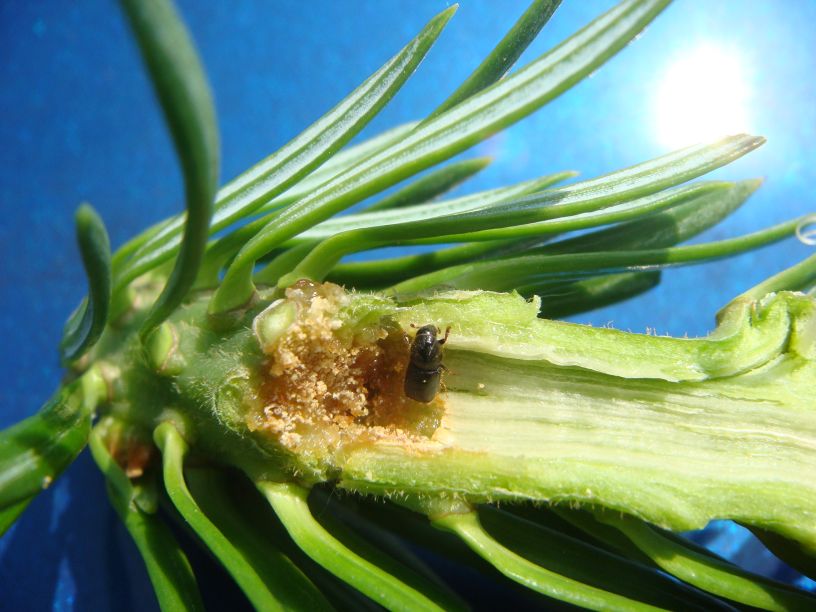
 White pine cone beetle. The pine cone beetle is an infrequent pest of Fraser fir, borrowing into usually the first whirl of branches and making a shepherd's crook. Sometimes you can still find the black beetle in the tree. The two photos are of the entrance hole and then of the beetle. These pictures were taken in Ashe County last Friday. I haven't seen any of these pests for several years. They are usually only a problem when there aren't many white pine cones, which are their preferred food. When you find them, they have already caused as much damage as they are going to, so they are only a novelty and nothing to worry about. Shearing will take care of the problem. Bryan found these. Jerry Washington was the first one to find them years ago.
 Leaf footed seed bug. The last interesting bug Bryan also found on a Fraser fir cone in some Christmas trees. I think it is a leaf footed seed bug that will feed on Fraser fir cones. You never know what you'll find in a tree field!

At this particular field, the grower had treated with Asana + Dimethoate with his mistblower before bud break this spring. Though there was still live scale, it hadn't spread to new trees, so we counted the treatment as a success, since it was far less expensive than spraying with a high pressure sprayer. The grower was going to cut out the worst trees for scale (he'd have a hard time selling them anyway), and will retreat in a few days with his mistblower while the crawler number is at its peak. Hopefully that may also give him twig aphid control next year.

This particular block of trees had been treated with dimethoate in the spring. No control of woollies. The grower will spray with Talstar sometime this fall.


Tuesday, June 15, 2010
Update on Endosulfan
Wayne Buhler, the pesticide coordinator for NCSU sent the following message out this morning. It is from Lee Davis with NCDA&CS about the fate of endosulfan. Nothing has been decided yet about how the product will be phased out, but Lee describes what usually happens. Again, when things have been decided, I'll let you know.
"Yes. The way I understand it is that the EPA and the registrant are currently working out the details of how to cancel the product. Usually, the EPA will post to the Federal Register a notice to cancel the product and give a date upon which the product is cancelled. Usually, the EPA will allow product already in the channels of trade or in the hands of the end user to be used up according to label directions. This is what usually happens, but each cancellation notice is unique. So, it is not possible to say exactly what instructions might be in the cancellation notice.
Thanks,
Lee"
Thursday, April 1, 2010
End of March Assessments
I've had the opportunity to walk through several Christmas tree fields the last couple of weeks. Here are some of my observations.
BALSAM TWIG APHIDS: I'm still not seeing many fields that have high twig aphid numbers. I finally found a couple that did, but mostly there aren't many aphid eggs. Bryan and I found our first live twig aphid on March 30! It was tiny -- just a fist instar. The weather during April will determine how bad twig aphids end up being. Now we're having warm, dry weather which will allow the aphids to quickly hatch, mature, and start to reproduce -- laying live young. If this kind of weather keeps up, those few aphid eggs will turn into plenty of aphids to curl needles by bud break.
We were in one field that had been treated with Talstar in the fall, that actually had a dead aphid sticking out of the aphid egg. But it's still a bit early to be evaluating how these fall aphid treatments are working. Wait until April 15, and then it should be easy to beat aphids out of trees if they are present.
However, if you didn't treat in the fall, and you need to control twig aphids, don't wait until the 15th unless you are using either Di-Syston or Thionex. All other materials including Asana, Talstar (Wisdom), and Dimethoate can be applied now.
BALSAM WOOLLY ADELGID: I visited another field yesterday where several trees were showing symptoms of woollies (flat tops, swollen buds, stiff trunks), but it was extremely hard to find any live woolly on the trees. What we did find were on the buds, and we had to look at lots of buds before we found them. These trees had been completely untreated in 2009. Therefore, I think we're seeing quite a bit of winter kill of BWA, but don't assume they are all killed out. Fields with symptoms of woollies should still be treated for them.
SPRUCE SPIDER MITES: I have yet to find a field with more than just a few spider mite eggs this spring. I'm sure they are out there, but for now, I don't think there are many growers that will have to worry about this pest.
HEMLOCK RUST MITES: Rust mites are really active this spring -- much more so than in the last couple of years. We walked through several fields last week that had been treated in July or August with Dimethoate + Asana to control elongate hemlock scale. This is a combination that should create rust mite problems the following spring, but of the four fields we visited, only one had rust mites. The other fields had virtually no mites.
We walked through another farm this week that had been treated with Talstar in October. It was a very large farm that rambled up and over a ridge, dropping down to the river. On the ridge top, the rust mites were nearing treatment threshold. In other areas of the farm, there weren't any.
So what's a grower to do??? SCOUT!!!! You can find the blocks that need rust mite controls and target only those for treatment. It doesn't take a lot of time to scout. A field of several acres can be evaluated in just 30 minutes. That's worth knowing where you need and don't need rust mite control.
Envidor will provide longer lasting control than just dimethoate. After all, it's a long time until summer. Spring's barely started.
BALSAM TWIG APHIDS: I'm still not seeing many fields that have high twig aphid numbers. I finally found a couple that did, but mostly there aren't many aphid eggs. Bryan and I found our first live twig aphid on March 30! It was tiny -- just a fist instar. The weather during April will determine how bad twig aphids end up being. Now we're having warm, dry weather which will allow the aphids to quickly hatch, mature, and start to reproduce -- laying live young. If this kind of weather keeps up, those few aphid eggs will turn into plenty of aphids to curl needles by bud break.
We were in one field that had been treated with Talstar in the fall, that actually had a dead aphid sticking out of the aphid egg. But it's still a bit early to be evaluating how these fall aphid treatments are working. Wait until April 15, and then it should be easy to beat aphids out of trees if they are present.
However, if you didn't treat in the fall, and you need to control twig aphids, don't wait until the 15th unless you are using either Di-Syston or Thionex. All other materials including Asana, Talstar (Wisdom), and Dimethoate can be applied now.
BALSAM WOOLLY ADELGID: I visited another field yesterday where several trees were showing symptoms of woollies (flat tops, swollen buds, stiff trunks), but it was extremely hard to find any live woolly on the trees. What we did find were on the buds, and we had to look at lots of buds before we found them. These trees had been completely untreated in 2009. Therefore, I think we're seeing quite a bit of winter kill of BWA, but don't assume they are all killed out. Fields with symptoms of woollies should still be treated for them.
SPRUCE SPIDER MITES: I have yet to find a field with more than just a few spider mite eggs this spring. I'm sure they are out there, but for now, I don't think there are many growers that will have to worry about this pest.
HEMLOCK RUST MITES: Rust mites are really active this spring -- much more so than in the last couple of years. We walked through several fields last week that had been treated in July or August with Dimethoate + Asana to control elongate hemlock scale. This is a combination that should create rust mite problems the following spring, but of the four fields we visited, only one had rust mites. The other fields had virtually no mites.
We walked through another farm this week that had been treated with Talstar in October. It was a very large farm that rambled up and over a ridge, dropping down to the river. On the ridge top, the rust mites were nearing treatment threshold. In other areas of the farm, there weren't any.
So what's a grower to do??? SCOUT!!!! You can find the blocks that need rust mite controls and target only those for treatment. It doesn't take a lot of time to scout. A field of several acres can be evaluated in just 30 minutes. That's worth knowing where you need and don't need rust mite control.
Envidor will provide longer lasting control than just dimethoate. After all, it's a long time until summer. Spring's barely started.
Wednesday, March 10, 2010
Spring Insecticides for Pest Control

But what options do growers have that didn't treat in the fall? I'll try and list them all below. If anyone has any other's they'd like to share, email me and I'll add them. As I go through different materials, I'll be using abbreviations for pests with BWA=balsam woolly adelgid, BTA=balsam twig aphid, SSM=spruce spider mite, HRM=hemlock rust mite, and EHS=elongate hemlock scale.
The first consideration is do you even need to treat for twig aphids? If you aren't cutting out of the trees this year or next, you don't need to control BTA. You should walk through your trees to make sure mites aren't a problem, but you can probably skip treatments.
A second consider is what have you used in the past for insect control. It's important to rotate materials from different chemical families. In other words, products like Asana and Talstar are both synthetic pyrethroids and so have similar modes of action. Think about what you used in past years, and try to use other products this year. For a complete listing of all the chemical families, go to the IRAC Mode of Action Classification.
Another consideration is that it doesn't all have to be done in the spring. You can get control of pests in the summer and fall when you have more time and can pick better weather conditions. At the end of this post, I have some possibilities for when to treat if you have all the major pests.
And just a few more words of wisdom: Remember that all pesticides are dangerous to something -- whether the bees in your trees, or the stream insects below your field, or the man putting it out -- so read and follow the label. Labels can change every year, so be sure to read them each spring. Also, be considerate of your neighbors. Remember that getting good coverage is just as important as what material(s) you choose to use. Also remember that if the wind is blowing, or if it rains before the spray has dried, you are wasting your time and money. Be sure to scout after using any of these products to make sure they have worked.
Anyway, here is a list of products, their rates, different mixes and what they will control.
- Horticultural oil. Use a highly refined oil -- 92% unsulfonated residues or better -- at the full 2% solution -- that is 2 gallons in 100 gallons of water. When applied in March with a high pressure sprayer, it will control BTA and HRM very well, and will help reduce SSM, BWA, and even EHS. Be sure to get good agitation so the oil and water don't separate. We're going to be looking closer at Saf-T-Side oil which won't separate in water to see how well that works.
- Asana. Can be used anytime from February through bud break to control BTA (5 oz/100 gallons) and BWA (10 oz/100 gallons). Add a miticide if mites are present. Will also knockdown EHS. However, there is also a potential to create problems with HRM and SSM when using Asana -- even the following spring. If BWA control can wait until fall, rust mite problems can be avoided when using this product.
- Dimethoate. Use at full rate of 24 oz/acre. From last week of March through bud break will control BTA and knock-down EHS, HRM and SSM.
- Dimethaote + Savey -- BTA plus SSM control (the Savey controls the mite eggs). Also Apollo can be used in this manner. Still will only knockdown EHS and HRM.
- Di-Syston 15 G -- There might be some folks who are still using this. It will control BTA and SSM and possibly a brief knockdown HRM. Be sure to apply when there is no wind and scout after treatment to make sure it worked.
- Talstar. Use at full rate of 40 oz/acre. Will give BTA and BWA control from February through bud break. Should also give control of SSM. (Though Talstar doesn't have any activity against mite eggs, it should last long enough to kill the mites that hatch from the eggs). Doesn't control HRM or EHS well.
- Talstar + Dimethoate -- BTA, BWA, SSM and knockdown of HRM and EHS.
- Thionex. Use at full rate of 2/3rds of a quart (about 21 ounces) for BWA control. Wait until mid April through bud break to get BTA control as well. (It just seems that BTA control is more reliable with Thionex if you wait until all the aphids have hatched out). Add a miticide if mites are present. Has no activity against EHS.
- Thionex + Dimethoate -- BTA, BWA control and EHS, SSM and HRM knockdown. Some folks have been using this mix without scouting first, thinking that it will control about every pest. But control of mites and scales will only be fair.
- Envidor. Use at 18 oz/acre for HRM and 25 oz/acre for SSM control. Therefore, if you add Envidor to any of these products listed above, you will also control these mites. Will it keep the mites from developing later in the year or next year? Probably not. I would prefer seeing people keep on scouting and apply when needed -- not as a preventative.
- Dimethoate + Asana -- Use dimethoate at rate of 16 oz/100 gallons and Asana at the highest rate of 10 oz/100 gallons. Will control BTA, BWA, EHS and knockdown SSM and HRM. Wait as close to bud break as possible to get the most out of EHS control.This mix would give better control of EHS in summer.
- Dimethoate + Prev-Am Use Prev-Am at 0.4% solution (50 oz/100 gallons). Will control BTA, EHS and knock-down of SSM and HRM. Prev-Am has burned trees at higher rates, so be careful, but this mix sure smells better than straight dimethoate!
- Lorsban -- will control BTA and knockdown SSM and HRM (?). Will also control BWA in March -- but not once woollies start laying eggs. Will control EHS??? We're still looking at this, but it did a great job last October. We've seen some issues with Lorsban burning foliage, so be careful.
So, what would I use if I had everything -- BWA, BTA, SSM, HRM, and EHS? I would probably either use Asana + Dimethoate and continue scouting for the mites to see it they rebound, treating with Envidor if they do, or go ahead and use Asana + Dimethoate + Envidor (which would be rather pricey). Or, I might wait to control my BWA and EHS in the summer with Dimethoate + Asana, and just use dimethoate in the spring -- and scout for mites later on. If you wait until August or September, you should pick up BTA control for the following year. Or I might use oil in March every year to control all these pests.
Monday, January 25, 2010
Interesting Results with Safari for Woolly Adelgid
 Picture caption: Field site where Safari was applied in July, 2009 was heavily infested.
SUMMARY: Safari controls balsam woolly adelgid well, and may work well even with incomplete coverage. However, more research is needed.
Safari (dinotefuran) is one of the neonicotinoid insecticides. Their mode of action is similar to the natural insecticide, nicotine. The most commonly used neonicotinoid is Merit (imidacloprid) which many people have used for hemlock woolly adelgid (HWA). Safari, however, is far more water insoluble than Merit, and control of HWA has proven to take weeks instead of months as it does with Merit.
In fact, researchers are now applying Safari in a spray form just to the trunk of the hemlock and getting good control. Now that's quite a systemic if the chemical is moving through the bark and up to the needles.
Jerry Moody, the CEA in Avery County and I tried Safari against balsam woolly adelgid (BWA) 2 years ago, with very good results. Oddly, this material will not control twig aphids. How something is so good against adelgids and won't control aphids, I don't understand. It is also labeled for scale control, though control of elongate hemlock scale has been variable. (I will talk about that more in a future post).
In any case, Jeff VAnce, the CEA in Mitchell County and I decided to try Safari against BWA in a field trial this summer. We mixed Safari at 8 oz/100 gallons and then applied it one of three ways -- with a thorough spray, only hitting the trunks (and using about 1/2 the water and moving twice as fast), or not spraying the tree at all but just hitting the ground. The treatments were made July 1 with a high pressure sprayer.
I never thought it would work. After all, systemics don't work as well against BWA as they do against HWA because BWA is feeding in the bark and not the needles. However, it did work well.
Before anyone gets too excited, remember that we had an awful lot of rain last summer. This may have allowed the chemical to get into the tree better than it would in a normal year. The results are exciting, and we will try it again this year.
Subscribe to:
Posts (Atom)