On June 20th I posted about a spray trial I had applied that day with 4 different materials for control of scale. Meghan Baker helped me collect samples from that study on July 27 and I looked at the results.
The following numbers are the percentage of dead scales based on observing at least 100 scales:
Check -- 53% dead
Movento + Liberate -- 69% dead
Lorsban -- 75% dead
Safari -- 83% dead
Dimethoate + Asana -- 84% dead.
Remember that these were applied with a backpack mistblower which never does give as good results as with a high pressure sprayer. Hopefully with a bit more forceful coverage you would be getting closer to 95% control with the Dimethoate +Asana.
The Lorsban results were a bit disappointing. I was hoping control would be better. Safari worked well. I've seen situations when it hasn't worked as well, but there has been plenty of rainfall in that area which probably helped it get in the plant better.
I will re-evaluate control in these trees in the fall to see if any clearer differences emerge. I will also apply these same materials to other trees in September to look further at fall scale control as well as twig aphid control the following spring.
Wednesday, July 28, 2010


Friday, July 23, 2010
Japanese Beetles
I may not be moving about too well these days, but thankfully others are out in the trees seeing what's going on.
Jeff Owen has told me that he is seeing Japanese beetles on the terminals feeding. He's seeing this in several tree fields to a greater extent than most years.
 Japanese beetles are just one of a number of terminal feeders. They tend to feed toward the top of the tree and terminal, creating irregular patches, though in this picture which I took years ago, they are feeding on older growth. Their feeding is swallow, but will result in discoloration and sap flowing.
Usually by the time you notice the feeding, they have done as much damage as they are going to do. They aren't anything to worry about. However, if you are seeing the insects in your trees, you can spot treat with any good insecticide. A backpack mistbower or backpack sprayer is sufficient. When using a backpack sprayer, I like a hollow cone nozzle for applying insecticides.
Jeff Owen has told me that he is seeing Japanese beetles on the terminals feeding. He's seeing this in several tree fields to a greater extent than most years.

Usually by the time you notice the feeding, they have done as much damage as they are going to do. They aren't anything to worry about. However, if you are seeing the insects in your trees, you can spot treat with any good insecticide. A backpack mistbower or backpack sprayer is sufficient. When using a backpack sprayer, I like a hollow cone nozzle for applying insecticides.
Tuesday, July 13, 2010
Some Interesting Pictures
I'm sitting at the extension office with my leg propped up after knee surgery. Walking in all these tree fields sure tears up your knees! It will be awhile before I can tromp around again, so I thought I would post some pictures I've been working on while laid up.
 The first is a picture I took at Ewing Harmon's on June 29th. He had treated his trees for scale, and it looked like he got good control. This photo shows what folks need to look for after treatment. There aren't any nymphs on the new growth. I hope you can see in this picture that the needles on the newest growth are scale free.
Scales have moved onto 2010 growth, so if you look at fields and aren't seeing the scales on new growth, that's a good sign. Also, it's easy to see the fuzz from the male scales back in the canopy now. If there aren't many of those, that shows good control as well.
I had commented in my June 30 post about the spread of scale at Dale Cornett's field in Watauga County. I made a colorized scheme to show the increase in scale at Dale's which I have photographed below.
 I think this is interesting for a couple of reasons. First of all, the most heavily infested trees in 2010 are scattered everywhere, they aren't just concentrated where the most heavily infested trees were in 2008 which was on the far end of the field.
Something else that was interesting was that two years ago, Dale had some trees with heavy incidence of pine needle scale, not just elongate hemlock scale. We didn't find any of those this year. That's good, because we don't need any other major scale problems.
To date, Dale has only used Di-Syston for pest control in these trees.
The annual Watauga County Christmas Tree Grower's Association meeting will be July 29. I hope to go out before that meeting and look at scale control in the plots that I treated before that meeting, and will report at the meeting and in this blog what I find..
 The last schematic I will post today depicts IPM in Christmas trees. I created this for the National Christmas Tree Meeting in Winston Salem in August. This Christmas Tree IPM Pyramid shows the importance of a good IPM foundation to ultimately be successful with pest control.
And this is what so many tree growers in North Carolina do. They work hard to get good fertility and ground cover management, then scout to determine what pests they do have. Through this process, their pesticide controls have been more successful. In fact, I haven't heard of anyone that is too upset that Thionex will be taken off the market. They don't need such a strong material. They can get excellent control with safer products.
Anyway, hope everyone enjoys these schematics. Feel free to use them however you can.

Scales have moved onto 2010 growth, so if you look at fields and aren't seeing the scales on new growth, that's a good sign. Also, it's easy to see the fuzz from the male scales back in the canopy now. If there aren't many of those, that shows good control as well.
I had commented in my June 30 post about the spread of scale at Dale Cornett's field in Watauga County. I made a colorized scheme to show the increase in scale at Dale's which I have photographed below.

Something else that was interesting was that two years ago, Dale had some trees with heavy incidence of pine needle scale, not just elongate hemlock scale. We didn't find any of those this year. That's good, because we don't need any other major scale problems.
To date, Dale has only used Di-Syston for pest control in these trees.
The annual Watauga County Christmas Tree Grower's Association meeting will be July 29. I hope to go out before that meeting and look at scale control in the plots that I treated before that meeting, and will report at the meeting and in this blog what I find..

And this is what so many tree growers in North Carolina do. They work hard to get good fertility and ground cover management, then scout to determine what pests they do have. Through this process, their pesticide controls have been more successful. In fact, I haven't heard of anyone that is too upset that Thionex will be taken off the market. They don't need such a strong material. They can get excellent control with safer products.
Anyway, hope everyone enjoys these schematics. Feel free to use them however you can.
Thursday, July 1, 2010
Doug's Color Wheel
Doug Hundley was telling me the other day that he was explaining to a newer grower all the different times of year you could control the different Fraser fir pests. It's amazing how much our knowledge of pest control has changed even over the past few years. When treating for one pest, you can target others that you have as well, either by your choice of pesticides or how thoroughly you spray.
He told me that he took the white paper plate he and the grower were beating pests on, and he drew different color circles to represent the times of year you could control different pests. I thought it was a great idea. So I put together this color wheel. I haven't talked to Doug or others yet to see if my circles correspond to theirs, so let's talk about it. Email me your comments. I can change it however folks see fit.

He told me that he took the white paper plate he and the grower were beating pests on, and he drew different color circles to represent the times of year you could control different pests. I thought it was a great idea. So I put together this color wheel. I haven't talked to Doug or others yet to see if my circles correspond to theirs, so let's talk about it. Email me your comments. I can change it however folks see fit.

Wednesday, June 30, 2010
A Good Day for Scales to Die!
At least I hope so!
Today I sprayed 4 different materials for EHS control. I applied the materials with a backpack mistblower, using about 100 gallons to the acre. I treated 40 trees each with either:


Today I sprayed 4 different materials for EHS control. I applied the materials with a backpack mistblower, using about 100 gallons to the acre. I treated 40 trees each with either:
- Safari @ 8 oz/100 gallons
- Movento @ 10 oz/acre + Liberate (an adjuvant) @ 2 pts/100 gallons
- Lorsban @ 1 qt/acre
- Dimethoate @ 16 oz/100 gallons + Asana @ 10 oz/100 gallons
The population was ready for control. I collected a sample and looked at the percentage of individuals that were either males (the easiest to kill), nymphs, or females (the hardest to kill). Only 14% of the population were females with 24% as males and 62% as nymphs. I'll come back in a month or so to see what kind of controls I got.
The field I treated was part of a study to see how quickly the scales spread. On July 14, 2008, Bryan Davis and I evaluated 361 trees to see which ones had scales. We flagged infested trees and made a map. At that time, about 1/2 of the trees had scale, though most of it was only a shoot. Only 4% of the trees had moderately heavy scale.
We couldn't go back last year because the grower had put lime on the trees, and it was too hard to tell what was lime and what was scale. But I went back yesterday before treating today.
Now 95% of the trees have scale and 40% have it pretty bad. But even on trees that have had scale heavy for two years or more, they don't look that bad (one is pictured at the end of this blog along with a photo of the field). I do think the trees that have had scale heavy have weaker bottoms, but they are still growing well.
So how much does EHS really damage trees? The jury is still out. I think we can keep the scale "beat back" though never eliminating it completely. For most growers who aren't shipping to California or another country, that will probably be good enough.


Monday, June 28, 2010
Some Success with Safari

Spring treatment. This spring, Buddy Deal sprayed some trees with Safari + Dimethoate. Remember that Safari doesn't control twig aphids or mites, so the Dimethoate was for twig control. They used a high pressure sprayer, but put out the materials with a light spray intended for twig control and not for woolly control. They didn't soak the trees or the trunks. The rate was the high rate of 8 ounces per 100 gallons which is the high rate. The field is pictured here.
We went back about a month later, on May 20, and the woollies were still alive. But it had been rather dry, and we decided to go back in another month.
On Friday June 25, Bryan and I went back again. This time the woollies were all dead -- both on the trunk of the tree and on the buds and branches. We didn't find any live adelgids at all.
I'll keep an eye on these trees over the next 12 to 18 months to see if the woollies come back quickly or if the control is long lasting.
Seed orchard treatments. We've been putting out Safari for BWA control in seed orchard trees as well. On June 17, we treated trees at the Mount Rogers seed orchard at Grayson Highlands State Park in Virginia. This will be on one of the summer tours for the NCTA/NCCTA meeting in August.
We treated 3 trees with one of 5 treatments:
- Safari soil drench at the high rate of 4.2 oz/10 inches trunk diameter
- Safari soil drench at the low rate of 1.0 oz/10 inches trunk diameter
- Safari trunk spray at the high rate of 24 oz/gallon
- Safari trunk spray at the low rate of 12 oz/gallon
- Merit soil drench at the highish rate.
The trunk sprays are interesting. The material soaks up through the bark and travels through the tree. I sprayed with a backpack sprayer using a hollow cone nozzle. I sprayed from 5 foot high on the trunk down to the root flairs, wetting the entire trunk, but not to runoff. If the low rate works (the high rate would be way too expensive), it would be a quick easy way to control woollies in seed orchards or very large trees (greater than 12 foot). I will check the control before the NCTA meeting.
HWA treatments with Safari. Jerry Moody and I also treated hemlocks with these trunk sprays using either Safari or Merit. In this case we also added Pentrabark to increase penetration through the bark.
Elongate hemlock scale control. I also plan on treating some trees for elongate hemlock scale later this week. I'll compare the Safari to Dimethoate + Asana, Lorsban, and Movento.
I'll keep everyone posted of how well things work.
Some June Pests
Went out last week and found several June pests that might be of interest to folks.
 Elongate hemlock scale. Scales are making their way onto the new growth. If you treated this year in the spring, or sometime last year, and you aren't seeing the scales get on 2010 growth, that means you have pretty good control. This is a photo of scales on 2010 growth.
At this particular field, the grower had treated with Asana + Dimethoate with his mistblower before bud break this spring. Though there was still live scale, it hadn't spread to new trees, so we counted the treatment as a success, since it was far less expensive than spraying with a high pressure sprayer. The grower was going to cut out the worst trees for scale (he'd have a hard time selling them anyway), and will retreat in a few days with his mistblower while the crawler number is at its peak. Hopefully that may also give him twig aphid control next year.
 Balsam woolly adelgid. Woolies have also moved onto the 2010 growth. This photo is of nymphs already on the new growth. There is already swelling too. These will molt in place to the adult within the next month and start laying more eggs.
This particular block of trees had been treated with dimethoate in the spring. No control of woollies. The grower will spray with Talstar sometime this fall.

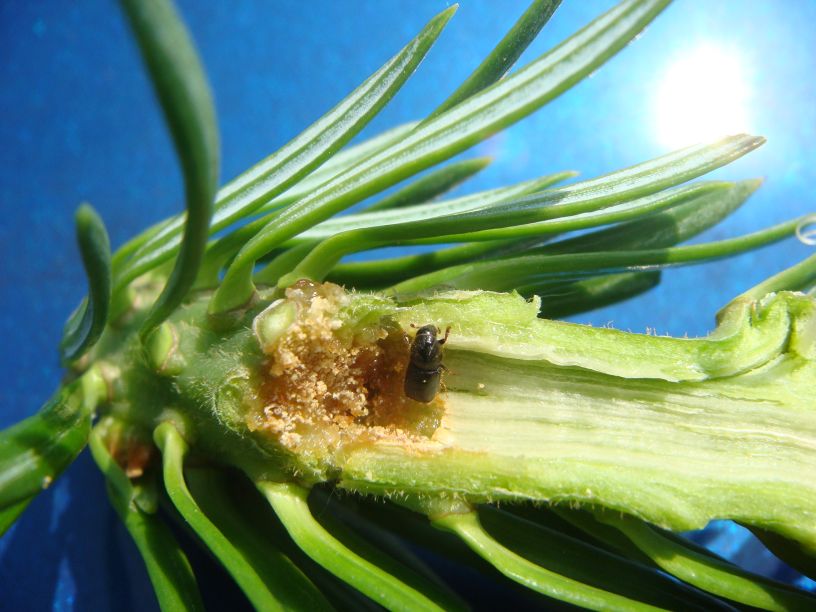
 White pine cone beetle. The pine cone beetle is an infrequent pest of Fraser fir, borrowing into usually the first whirl of branches and making a shepherd's crook. Sometimes you can still find the black beetle in the tree. The two photos are of the entrance hole and then of the beetle. These pictures were taken in Ashe County last Friday. I haven't seen any of these pests for several years. They are usually only a problem when there aren't many white pine cones, which are their preferred food. When you find them, they have already caused as much damage as they are going to, so they are only a novelty and nothing to worry about. Shearing will take care of the problem. Bryan found these. Jerry Washington was the first one to find them years ago.
 Leaf footed seed bug. The last interesting bug Bryan also found on a Fraser fir cone in some Christmas trees. I think it is a leaf footed seed bug that will feed on Fraser fir cones. You never know what you'll find in a tree field!

At this particular field, the grower had treated with Asana + Dimethoate with his mistblower before bud break this spring. Though there was still live scale, it hadn't spread to new trees, so we counted the treatment as a success, since it was far less expensive than spraying with a high pressure sprayer. The grower was going to cut out the worst trees for scale (he'd have a hard time selling them anyway), and will retreat in a few days with his mistblower while the crawler number is at its peak. Hopefully that may also give him twig aphid control next year.

This particular block of trees had been treated with dimethoate in the spring. No control of woollies. The grower will spray with Talstar sometime this fall.


Subscribe to:
Posts (Atom)