The Value of Christmas Trees

"...there is no reason why the joy associated with the Christmas evergreen may not be a means of arousing in the minds of children an appreciation of the beauty and usefulness of trees; and keen appreciation of the beauty and usefulness of trees is a long stop toward the will to plant and care for them (Arthur Sowder, US Forest Service, 1949)."

Tuesday, April 14, 2015

Time to Scout -- Time to Treat

Twig aphid numbers. If you have twig aphids in your Fraser fir Christmas trees in western NC, you should be able to find them now. They are still quite small, but they have all hatched out. So if you treated your fields last fall for Cinara aphids, you might be able to skip treating for twig aphids this spring. But the only way you'll know for sure is to scout.

The aphids go through several molts before becoming adults. At maturity, this first stage is called the stem mother and she will produce live young aphids which quickly build up the numbers. That's why it's so hard to judge how much damage there will be by the twig aphids. It's a function of how many aphids there are right at bud break, and how quickly the new growth of the tree elongates and becomes resistant to damage. This is all modified by the weather on a daily basis.

To scout, get your plates out and start beating foliage to assess twig aphid numbers. Be sure to use a hand lens as the aphids can be quite small. It's best to wait until the foliage is dry (a challenge for this week!) but if you're good at scouting and don't mind getting wet, you can find them about any time. If you're not sure how to scout, contact your county extension agent.

If you see more than an aphid or two in a block and the trees will be marketed this year, go ahead and plan on treating this spring.

Christy Bredenkamp beating foliage to scout for twig aphids.
Look with a hand lens as the aphids are often quite small.
These tiny aphids will be having babies in just a week or two.

There are at least 6 aphids pictured here along with round balls of honey dew. When scanning a shoot
with a hand lens, you can often spot the aphids by the ball of honey dew.
Rust mites. There are several fields where rust mites are a problem this spring. Mites aren't in every field. The best way to assess rust mites is to pull some of the smaller shoots of growth and scan the back side of the needles for the tiny mites. If you don't need to treat for twig aphids but mites are a problem, you might have to treat anyway. Mark infested trees and go back to them to see if the numbers are building and treatment is necessary.

Choose shoots like this to look for rust mites.
You can also look for twig aphids, spider mites, and scales when scouting shoots.
Flowers & bees. Purple deadnettle must really like the weather we've been having. It is blooming everywhere and on sunny days, it is bringing in the honey bees and bumble bees. Wild mustard is also blooming now in fields and it is even more attractive to bees. So if you have these blooming in your field, either spray at night, or hit the ground covers with a low rate of Roundup or other herbicide to knock back the flowers before spraying.

Purple dead nettle

Bud break. The trees are just starting to move, so we should be 2 to 3 weeks away from bud break.


The Spring Rush. There's a lot to do in the spring. This week looks like it will continue to be wet and not good weather for spraying at all. When it comes to spraying fields before bud break, it's natural to want to just get it done and ignore the weather, but many times insecticide treatments fail because of too much wind during treatment or rain right after treatment. So prioritize your fields, pick your days, and pay attention to changing weather conditions. It's better to leave a field untreated and let the predators clean up twig aphids than to waste your money and pesticides and cause problems with your neighbors by spraying when it's too windy.

Useful links. Here are some links to more information. Remember our main website has changed the web address to christmastrees.ces.ncsu.edu

Monday, March 23, 2015

2015 Scouting Project & Early Pest Observations

Brad Edwards looking for twig aphid eggs
Because of the issues that people had in 2014 with twig aphids (BTA), and the continued issues with elongate hemlock scale (EHS), this year I'm doing an intensive scouting project. I plan on visiting 2-4 farms in the main Christmas tree counties every two weeks through the spring and summer to observe how well natural predators are working at pest control. I've been visiting potential sites the last couple of weeks to set up the project and there are a few things I've already noticed.

Twig Aphids:  I'm finding that most fields have high numbers of BTA eggs in them. Actually the fields with the lowest eggs counts are the ones that have the least amounts of pesticides last spring -- such as organically grown trees or abandoned fields. That's because the natural predators ate the aphids before they could lay any eggs. That's one thing I hope to observe this year -- what predators are most important and how early in the spring they show up.

Another thing we've observed already is that BTA eggs started to hatch the 2nd week in March which is actually earlier than normal. Typically it takes about 3 weeks for all the eggs to hatch. This may well mean that we have an early overall hatch this year. (I'll keep you posted).

For scouting, that means that by around April 10, you should be able to go out into the field and beat the foliage over a plate to see if aphids are present or not. If you sprayed last fall with a synthetic pyrethroid, this would be the time to check to see if you can get away without treating this spring. Don't look before that time as all the eggs haven't hatched yet. And also evaluate other pests such as rust mites, which leads me to the next observation.

Rust Mites: There are already a few fields with active rust mites in them. It might be a good idea to go ahead and check fields where rust mites have been a problem in the past, or fields treated last spring with a pyrethroid, to see if they are making an appearance. If rust mites are a problem, you might need to treat this spring even if twig aphids have been controlled. Also keep an eye on the weather. Rust mites love long springs. I have a feeling that this year there will be good weather for them to be a factor in many fields.

Keep Posted and Thanks! In any case, thanks to the growers who are letting me work in their fields and to the county extension agents who are helping me to make these evaluations. I plan on posting observations here so stay tuned! This work is funded in part by the North Carolina Christmas Tree Association.

Friday, February 13, 2015

Changes to Safari Label

Honey bee in white clover

Many of you are no doubt following the news about bee decline in the US and worldwide. Due to concerns about neonicotinoids in particular, the US EPA is making changes to the labels of these products.

Many growers are using Safari (dinotefuran), a neonicotinoid, for the control of elongate hemlock scale in Fraser fir Christmas trees. This product has proven to be the most effective at controlling scale in western North Carolina. Safari can be sprayed on the foliage or it can be applied as a trunk application. Both have proven effective.

The previous label of Safari indicated that plants shouldn't be sprayed if bees are visiting the treated area. This allowed the product to be applied of an evening or at night when bees weren't active.

The new Safari label which came out in 2014, is far more restrictive. The label now states that this product is "toxic to bees exposed to residue for more than 38 hours following treatment. Do not apply this product to blooming, pollen-shedding or nectar-producing parts of plants if bees may forage on the plants during this time period." The label also indicates it can't be applied "while bees are foraging" or "to plants that are flowering. Only apply after all flower petals have fallen off."

In other words -- no flowers period.

So what's a grower to do? Ground covers in Christmas trees are an integral part of integrated pest management. Besides controlling erosion and making the soil cooler so tree roots are closer to the surface, ground covers keep problem weeds from coming into a field and they are habitat for natural predators such as lady beetles, hover flies and lacewings.

In 2013, Jeff Owen conducted several demonstrations to find ways to keep good ground covers while getting rid of flowers and therefore bees. What he found was that our typical chemical mowing with Roundup will burn back flowers in ground covers including white clover within one to two weeks depending on the weather. Therefore, it's important when applying Safari, to time applications after a herbicide treatment. It's also important to scout before making an application to see if bees are visiting the area any further.

Protecting bees from pesticides is important, but flowering ground covers are also important to provide forage for bees as well for natural predators as well. With a little forethought, Fraser fir Christmas tree growers can create a win-win situation for themselves and pollinators.


Monday, October 20, 2014

White Pines in the Loading Yard

It's not always easy to tell why trees start to decline
THE VALUE OF WHITE PINES IN LOADING YARDS: Many Fraser fir growers in the mountains are fortunate enough to have loading yards shaded by white pines. These trees create a cooler and more humid environment for harvested trees.

White pines are native to western North Carolina so you'd think they'd have fewer pest problems. A fast growing tree, most people view white pines as being a lot 'tougher' than Fraser fir. After all you can plant white pines where Frasers have died from Phytophthora root rot and they will most likely survive, even though they are also susceptible to the disease. But white pines do have pest problems and are sensitive to poor sites which, unfortunately, are often associated with loading yards.

Recently, Brian Heath, Forest Health Specialist with the NC Forest Service, helped me walk through a local loading yard that utilized white pines for shade. We discussed some of the pest issues that face these important trees and what a grower can -- and more often cannot -- do about them.

White pine aphids
Tree with pine bark adelgid
PESTS OF WHITE PINE: According to the US Forest Service, there are 227 insects and 110 disease organisms that can attack the eastern white pine. That's a lot of pests! Sill, they seldom cause problems particularly of mature trees. Some, like the pine bark adelgid, can literally cover the trunk of the tree, turning it white, but seldom harm the tree.

White pines grown for Christmas trees or nursery can suffer from several pests such as pine needle scale, introduced pine sawfly, rust mites, white pine aphids (a species of Cinara aphid), weevils including white pine weevil and Pales weevil, and needle blights including ozone injury, but these problems are primarily cosmetic and will not affect trees being grown for shade.
Introduced pine sawfly

STRESS THE MAJOR ISSUE: When it comes to loading yards, it is stress that is the primary cause for concern. Stressed trees attract pests like bark beetles and are more likely to succumb to other pests that usually aren't a problem. The stress, however, is the underlying factor.

White pines in the mountains typically grow on stream banks in areas that are well drained. They grow well on poorer. sandier soils where they can out-compete hardwoods. They do best when planted in undisturbed forest soils. But most loading yards are on level ground that used to be a field or are near a building site. This past soil disturbance affects white pine growth. They may grow well for 20 years, but then often start to decline for no apparent reason. If planted on forested land, those same trees would live as long as 200 years.

Stress continues in the loading yard. Soils are compacted with equipment movement, and trees may be injured by equipment or deicing salt. If the ground is watered to keep cut Christmas trees moist, the white pine roots may stand in water.

Pitch tubes
Stressed white pines are attractive to bark beetles including southern pine beetle, black turpentine beetle, several species of Ips beetles, and Pityogenes beetles. Signs of beetle attack include small holes in the bark and pitch tubes created as the tree tries to keep the beetle out. The beetle lays eggs under the bark and the larval feeding creates distinctive galleries. Several beetles also carry a blue-stain fungus which disrupts the flow of water to the tree's crown.

Cutting pines adjacent to white pines in a loading yard can also bring in a host of problems such as more bark beetles and weevils. In addition, Annosum root rot will infect cut stumps and grow along the roots into adjacent, living trees -- even Fraser fir.
Bark beetles attacked this tree because
it was under stress.

In the loading yard that Brian and I visited, we found black turpentine, Ips and sawyer beetles, pine bark adelgid, and evidence of injury from road construction and/or salt injury. But many symptoms of decline couldn't be pinned down to a specific problem. Procera root rot is also a common disease found on white pines growing in fields, but was not observed at this particular site.

KEEPING WHITE PINES HAPPY: The best possible set up for a loading yard is to put it to the south of a bank planted in white pines. Setting the white pines on undisturbed soil and allowing no traffic on the roots will greatly reduce stress to these trees.

Tree spacing is another issue. You might want to initially plant trees every 6 feet, but they should be thinned to 12 or more feet apart as they get larger. If you are planting two or more rows on a bank, they should be thinned to around 20 feet apart.

Trees growing too close together will experience more stress
If such a setup isn't possible and you have to plant the white pines in areas where greater stress is likely, be prepared for a much shorter lifespan for your trees. They may only live 20 years or so. That means it will take them 10 years to reach a size where they are creating appreciable shade and they may only provide shade for 10 years.

Setting up two loading areas that you could rotate between every 10 years would be the ideal situation but replanting in an existing loading yard is the only option most people have. Just realize that survival may be low. Plant more trees than necessary to replace declining trees, but thin out trees as they get older to 12 or more feet apart.

And don't become too concerned if trees start to decline. That is to be expected. There really isn't any need to treat the trees for incoming pests, the best thing to do is keep them as stress-free as possible.

READ  MORE ABOUT IT:

US Forest Service -- Eastern White Pine

White Pines for Windbreaks

Procera Root Rot of White Pine

Pine Bark Beetles


Wednesday, April 9, 2014

Rust Mites!!!!

I really wouldn't have thought this would be a bad year for rust mites. After all, everyone was hoping that with such a hard winter, there would be fewer pests.

Looks like we were wrong!

Rust mites are cropping up in many fields. They will probably limit the number of fields that can go without an insecticide treatment this spring. But don't just assume you have to treat. Scout first! Twig aphids are now mostly hatched and even spider mites are hatching out. So scout and determine what you need to do.

From my pest management survey, I've learned that a lot of people are depending on either a bifenthrin product such as Sniper and/or dimethoate in the spring for pest control. But with rust mites so bad, neither product is probably the best choice.

Miticides such as Envidor provide a lot longer control of rust mites and spider mites both. Though more expensive, you can treat and pretty much walk away from the situation. So if mites are the only problem and you don't have twig aphids because of a fall treatment, consider just using the Envidor without mixing another product in. That will protect your natural predators.

I also think that bifenthrin is a much better product to use in the fall for Cinara aphid and twig aphid control. Then it should have much less effect on the parasitic wasp that controls the elongate hemlock scale.

The following links will provide help for mite control, twig aphid control and/or scale control.

On other thing... is flowering mustard blooming in your trees? If so, watch out for bees when you spray! Mustard seems to be the plant that brings the most bees in when it is flowering. It is far more attractive to bees than other flowers such as clover. So take special care when mustard is blooming. The following link will help with controlling pests without hurting bees.

If you have any questions, please let me know.

Friday, May 3, 2013

Cryptomeria Scale Resurfaces in Ashe County

On September 1, 2010, I make the following post: Cryptomeria Scale Found in Ashe County. If you went to any of the meetings where I spoke at the following winter, you probably heard about this new scale problem. I've not really talked much about this scale since then and with good reason -- I've not seen it again.

After making this post in 2010, the grower cut down many trees and treated the rest. I couldn't find any live scale after treatment. Since then I've been back to that field several times and scouted in close-by field and never found any more Cryptomeria scale (CS) until today.

Cryptomeria scale (Aspidiotus cryptomeriae), like elongate hemlock scale (EHS), is another introduced pest from the Orient. It affects many conifers including hemlocks and firs. It causes serious and striking yellow mottling of the foliage and premature needle drop. On the trees we examined today, most of the damage was on the south side of the tree. A few trees were heavily damaged all over with scales even on the needles of the terminal. This is one scale you really don't have to hunt for to find. If it's there, you should see it.

Damage from Cryptomeria scale.
The scale has a very different appearance to EHS. The scales, especially the small immature ones, are round, and they line up in two rows along the backside of the needle on either side of the midrib. They look like fried eggs with a yellow center. The 'white of the egg' is actually where the scale has pushed up the waxy covering of the needle. Older scales are more indistinct.

These younger scales look like they might have been killed, perhaps from a fall
insecticide treatment.
Crawlers will start to appear in another month or so.
The life cycle of CS is similar to EHS. It has two generations per year and is most active in the summer months. It seems to spread very quickly and cause damage very quickly. However, it is much easier to control than EHS.

The scale is spread through crawlers and on infested plant material. This scale was found in three adjacent fields owned by different growers. Next week, we hope to scout other farms in the area to see how far the scale has spread.

Typically when I've found CS, I've also seen the twice-stabbed lady beetle. We didn't find any today. Perhaps it's still too early in the year for this helpful predator.

The grower in 2010 treated in early September and got excellent control. We didn't see any crawlers today, and so it's probably a bit too early to treat -- especially since we are having such a cold, wet spring that's keeping everything from getting active. But we'll definitely be following control from any grower treatments and pass results on.

Tuesday, April 16, 2013

Twig Aphid Hatch -- Spring Pests

Twig aphids. Looked at twig aphid hatch again today. I found just over 90% of the eggs hatched (it worked out to 93%) and there were a couple of aphids that had molted. However, when Jerry Moody and I were doing beats on trees, we were still finding that they were hard to find. So if you do start scouting for twig aphids in the next few days, if you find any at all, you should probably treat in go-to-market trees.

Aphids should all be hatched out in the next few days.

Woollies. Last week we found that only a few balsam woolly adelgid eggs have been lain. This week there were whole lot more. The adults still haven't produced much wool.

Spider mites. I found my first spider mites crawling around today. Many are encysted. That means that they are molting from an immature to more mature state. When they do this, they look like they are dead. They don't move, but they are in fact alive. They are just molting and it takes awhile.

The next couple of days are supposed to be wet, but after that, start scouting trees that were treated last fall to determine if you need to treat this spring for twig aphids or for mites.


Thursday, April 11, 2013

Twig Aphid Hatch

I collected shoots yesterday and examined them today. Hatch in the field I'm monitoring was at around 30%. I only saw first instar aphids -- these are the ones that have first hatched out of the egg and have not yet molted. It will be probably the last full week of April before all the twig aphids have hatched out. My advice would be to wait until late next week before scouting for twig aphids to access whether or not to treat this spring. However if you know you have to spray this spring, insecticide sprays will work any time.

Tuesday, April 9, 2013

Issues with Bees

The Jefferson Post printed the following article today, "Beekeepers report unprecedented losses." It just so happened that I spent today with Brad Edwards and Travis Birdsell working in our beehive at Omni farms! We've had the hive set up there since June of last year. All three of us were impressed with how strong that hive is. The following photos were taken today (April 8, 2013).
The bees bringing in pollen from maples. Photo: Travis Birdsell
We had to put up a mouse guard. Mice damaged about 5 of the frames which we
will probably have to replace.
Lots of bees when we opened the box. Photo: Travis Birdsell
It's all about making babies. The capped cells have bees that will soon emerge.
Photo: Travis Birdsell.
In many ways, Fraser fir Christmas tree production in western North Carolina helps both honey bees and native bees. Growers leave ground covers that bloom. This provides forage for pollinators as well as bringing in predators which help reduce Christmas tree pests. But this also brings an added responsibility to the grower to protect honey bees if they are actively visiting ground covers when an insecticide treatment is necessary. For ways to protect honey bees see Fraser Fir Pest Control Portal: Tips for Keeping Bees Safe.

The causes of beehive losses are complex. A good website which reviews the multiple causes is the USDA website called Honey Bees and Colony Collapse Disorder.

Keep looking for more information on this project as we are putting bees out in tree fields in Alleghany and Avery.

There's a lot of people to thank with this project including Wiley Gimlin and Omni farm for hosting our bees; Shelley Felder with the Honey Hole in West Jefferson for her technical advice about beekeeping; the NCCTA for grant support; all the extension folks -- Brad Edwards, Travis Birdsell, Jerry Moody, Meghan Baker, Jeff Owen and Jeff Vance for their assistance with this project; and Logan Williams who was key in identifying native bees collected last year. Information about the pollinator study can be found at The Pollinator Study.

Monday, April 8, 2013

Spring 2013 Pest Control

Last spring I made several posts about the effects of the warm spring on our Fraser fir pests. This spring, as you well know, is the complete opposite of last spring. Last spring we were 2-3 weeks ahead of normal. This spring we may well be 2-3 weeks behind normal.

I went out on Friday to evaluate twig aphid hatch in some untreated trees in Avery County (thanks Jerry Moody!). These trees had ice on them from the snow/sleet/freezing rain from Thursday, so it was a bit hard to evaluate twig aphids. However, the aphid eggs were very plump and ready to hatch and it appeared that a few of them had already, though I didn't see any live aphids. I estimated that about 16% of them had hatched already. Typically I see that many hatched by late March, so hatch is definitely late this year.

In most years, all twig aphids have hatched by April 15. I doubt that we have 100% twig aphid hatch by that time this year. So what does that mean for you in trying to scout and control twig aphids?

First of all, if you are scouting to determine if your fall insecticide applications have successfully controlled twig aphids this spring, you might want to wait until after the 15th. I doubt if you will see much this week in the way of twig aphids. Remember too that the aphid which hatches from the egg is the stem mother. They are all female and they reproduce without mating. At maturity they produce live young. So if you see one aphid on April 15 and your trees break bud on May 1st, that aphid has 2 weeks to mature and start reproducing. One aphid could easily turn into 15 during those two weeks. Therefore, be very cautious of scouting too early for twig aphids.

If you know you have to treat however, it's not too early to start. Any material used will last long enough to kill the aphids once they are hatched. At least one grower has already seen some rust mite activity so be sure to scout for rust mites and spider mite eggs before deciding what material to use. Also remember to protect honeybees. If the temperatures are above 50 degrees, they will be foraging in flowers.

If you are treating for twig aphids, it's a good idea to do so before cones are produced on the tree. Twig aphids will hide in the cones, protecting them from chemical spray. Once the cones have come out on trees, dimethoate is one of the few materials that will penetrate them to kill the aphids in the cones.

One word about dimethoate -- if you do have to send workers in to remove cones after treating with dimethoate during the 10 day re-entry interval, they have to wear long sleeved shirts and long pants, chemical resistant gloves and chemical resistant footwear. They don't have to wear masks.

I will keep monitoring twig aphid hatch as in years past and will keep you posted on how the spring is progressing. And if you see anything interesting when scouting let me know so I can pass that information on to others.

Wednesday, April 3, 2013

Protecting Pollinators and Groundcovers Continued

On March 20, I posted pictures of a field with lots of purple deadnettle following applications with suppressive rates of either Roundup, Stinger or Goal. The purpose was to stop the deadnettle from blooming so bees wouldn't be attracted to it, but still maintain a healthy living groundcover. At that time -- only 5 days after application -- only the Goal had had much effect. Today it's been 19 days since the applications made on March 15 and things have changed quite a bit.

The Stinger still isn't working at all. The following photo shows the purple deadnettle still growing well.

The Stinger didn't affect the purple deadnettle which is still blooming.
The Goal has worked too well. There are several areas where the ground has been bared. The clover has been hurt pretty bad in some spots, though I suspect it will regrow. Chickweed is filling in some spots.

White clover hit by suppressive rate of Goal.

The suppressive rate of Goal seemed to have worked a bit too well.
The Roundup now looks the best. The purple deadnettle has been stunted and yellowed, and the flowers have been stopped. 
Close-up of purple deadnettle stunted with a suppressive rate of Roundup with no flowers.

If you need a quick knockdown of weeds, Goal will do the job. But if you have more time, Roundup appears to be the better choice at least in this instance.

Wednesday, March 20, 2013

Protecting Pollinators & Groundcovers

Field site in Ashe County
If you follow NCSU Christmas Trees on Facebook, you saw that Jeff Owen, Brad Edwards and I treated some groundcovers -- mainly purple deadnettle -- with either Roundup, Stinger or Goal last Friday.

Why is this important? After all, the groundcovers are just now starting to grow. Typically, growers wait until late April or into May before doing any type of herbicide application. These little purple deadnettles certainly aren't impacting tree growth. When the weather gets warm, they die back naturally.

The goal of these treatments is to burn back the flowers so that bees won't be in the trees.  On warm days, bees have been in this particular field  for the past month. If the grower needed to treat with an insecticide and had to spray during the day with a high pressure sprayer, bees in the area would be at risk.

Early spring is a tough time for bees. The population of a bee hive fluctuates through the year according to the season and resources. The number of worker bees declines at the first of the year, reaching the lowest number in February/March. This is the time of the year the queen is starting to lay eggs when there are fewest bees to feed and take care of the young. A queen may produce 1,500 bees daily. Honey and pollen resources have been depleted and there are few places for bees to forage. They work red maple when it's blooming which provide both pollen and nectar. In tree fields, purple deadnettle and wild mustard bloom early and bees will be foraging in the trees.

The hope is that by using a suppressive rate of a herbicide over the top of the trees the flowers will be burned back, but the good groundcovers -- especially the clover -- won't be killed out. We tried 3 commonly used herbicides at the typical suppressive rates to determine if they would knock back the purple deadnettle and how long flowering would be suppressed.

Of course it's too early to tell completely, but I went back today to see if any materials had made a difference. It's been five days after treatment.

The only treatment that worked so far was the Goal at 13 ounces per acre. The purple deadnettle had been burned back and there were few to no flowers. So this appears to be a quick way to clean up a field of flowers. Of course, Jeff reminded me that this would only work up until the time the trees break bud. After that the Goal will burn the new growth as well.

Purple deadnettle after treatment with Goal.
The Roundup was starting to have some effect, but there were still quite a few flowers. We'll check back next week to see if it's working any better.

Purple deadnettle after suppresive rates of Roundup.
The Stinger hadn't worked at all yet on the purple deadnettle. It looked like the check. It appeared that the deadnettle had grown since Friday in these rows.

Purple deadnettle after suppresive rates of Stinger.
We'll be trying these and other materials on other spring groundcovers and other weather conditions, as well as following how long it takes for the groundcovers at this site to green back up. But it looks like Goal at suppressive rates will burn back some flowers.

Tuesday, February 12, 2013

Bees Already?!?

Brad Edwards and I were looking in a field treated with Safari last July to look at scale control. Long story short, the Safari worked well. I'd estimate 99% control. But what really caught our attention was what was going on under the trees. There was an almost continuous carpet of purple deadnettle that was starting to bloom. And it was full of bees! Most had pollen sacs full of red pollen.


This field was at just under 3,000 feet in elevation and southern exposure. The high was only 51 oF in Jefferson today. They say bees don't get out and start working until it's 55 oF. Obviously the bees don't read too well.

In any case, if you need to apply an insecticide, it's important to look and see if bees are in your trees. Pick a warm day at mid-day and look for bees. If you can spray at night, you should be OK. But if you have to spray in the day, clean up the field of flowers by using Roundup at suppression rates a week or so before treatment. Know if you have bee hives close by, and if you do, tell the bee keeper what you plan on doing. They may want to shut up the hive while you are spraying so the bees aren't exposed.

For more information about how to protect bees in trees see: FRASER FIR PEST CONTROL PORTAL: Tips for Keeping Bees Safe.

Tuesday, November 27, 2012

Post Harvest Pests

Heard about my first post-harvest pests today. Cinara aphids. Anyway, here are links to information about these pests.
  1. Grower information on Cinaras.
  2. Information for the retail lot operator.
  3. Retail lot information in pdf format.
  4. Photos of Cinara aphids.
  5. Consumer education information on post harvest pests including Cinaras, praying mantids, and spider mites.
If you need me to speak with retailers or consumers about this issue, email me at: jill_sidebottom@ncsu.edu

Jeff Vance is holding a bottle of insecticidal soap.
This works well against aphids and is completely safe
around children and pets. It does have a bit of an odor.
You can buy this pre-mixed in high end garden centers.

This is a photo I received from a consumer a few years ago.
Surprisingly it's never hard to ID Cinara aphids from the  strange photos I receive.


Monday, September 3, 2012

Impact on Predatory Wasps

Yellow sticky card placed in a Christmas tree that has EHS.
On January 5 of this year, I posted about the parasitic wasps I was finding on cut Christmas trees that were infested with elongate hemlock scales (EHS) (see Parasitic Wasps on Scale Infested Trees). If you will remember, Jerry Moody and I placed yellow sticky cards in cut trees to determine if scale crawlers were coming off of them. Yellow sticky cards are about 3 X 5 inches and coated with a sticky clear substance that traps insects once they step onto it. The yellow is particularly attractive to many insects. During our little study, there were only a few wasps per sticky card coming out once the trees were displayed in water in a warm room just like they would in someone's house.

These parasitic wasps are very important to control of the EHS. They are very, very small -- the size of a single scale. You'd never see them flying around, and in fact you have to use a microscope to see them on the yellow sticky cards. These wasps, Encarsia citrina, are available commercially and are often used for whitefly control in greenhouses. But they also love scales. Whenever you see a scale that has a round hole in it, you know that one of these wasps has developed inside it and killed it.(Think ALIEN with Sigourney Weaver!) I especially enjoy probing into scales this time of year and finding the immature wasp inside one. Sometimes the tiny little wasps even move their heads! (Nature is so cool!)

This scale has been parasitized. The arrow points to the exit hole the wasp made to get out
once it had fully formed.
The arrow points to a wasp that is still forming inside this scale. The eyes are to the left.
Over the last week, I've put out some yellow sticky cards in trees infested with scales in an Ashe County Christmas tree field (pictured up top). Travis Birdsell, the new county agent in Ashe County and I looked at these cards on Thursday after leaving them for 48 hours. I was amazed at how many wasps there were! We put two cards in one tree and there were 56 wasps on one of them and 34 on the other. In a second tree we had one card and it had 15 wasps. This was in a field where there were some scales, but they had never become really bad as they are in some fields.

I was surprised that there were so many wasps out now. So I became curious. Could I see a difference in the number of parasitic wasps in fields that had been treated with a synthetic pyrethroid compared to those that hadn't? I've thought for a long time that the increased use of the bifenthrin products in particular might be causing a lot of the increase problems in scales.

It just so happened that Jerry Moody and I had created the perfect place to test out this theory. We were working in a small field of trees in Avery County where few insecticides had been used and scales had become a problem. I already knew there were lots of parasitic wasps as I had seen them inside the scales. We had sprayed a block of these trees two weeks ago with Safari and a bifenthrin product, in this case, OnyxPro. We are treating a different block of trees every two weeks to see how late in the season we can get good scale control.

So on Friday, when we were making another treatment, I put a yellow sticky card in three untreated trees and three trees treated two weeks ago with Safari + OnyxPro. The two sets of trees were probably only about 75 feet apart. Today I looked at the cards (after 72 hours) and was amazed at the results.

There was an average of 45 wasps on the cards placed in untreated trees (79, 35, and 22) and an average of 5 on the trees that had been treated (10, 3, and 1). That is a 90% reduction in the wasps just two weeks after treatment! And though I didn't look at scale control, I am sure there is very little yet as Safari takes a long time to work.

I plan on looking more at this issue, trying to evaluate different chemical combinations put out at different times of year to see what the optimum time is to get control of scale without doing away with the parasitic wasp. But the early take home lesson is that the use of synthetic pyrethroids can have a profound affect on these important natural controls. Hopefully in the coming months we can determine when these materials can be used with the least negative impacts.

Monday, July 16, 2012

New Website

I've just completed a new website that will help sort through all the pest control options.

FRASER FIR PEST CONTROL PORTAL

There's lots of information on these pages, so skim through them all. If you see any errors let me know. If you're having trouble navigating, let me know as well. It was hard deciding how to set up the navigation, so I'd be happy to change anything to make it easier.

Sunday, April 22, 2012

Celebrate Earth Day with a Christmas Tree


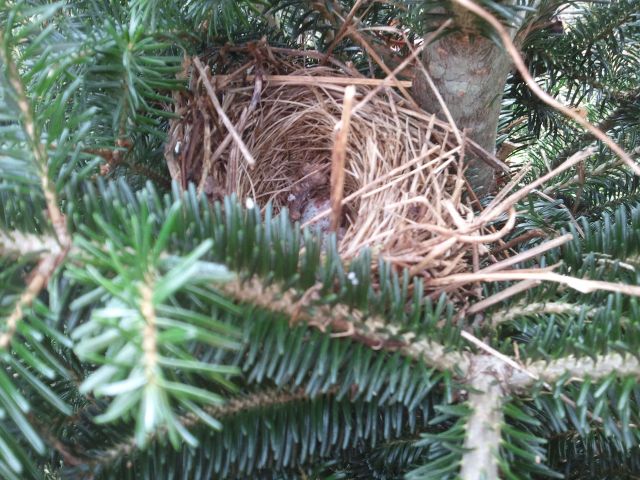
This week while scouting a field for twig aphids and mites, I came across this little nest full of eggs. It reminded me of how Christmas tree fields are home to many creatures -- a perfect reminder of Earth Day.

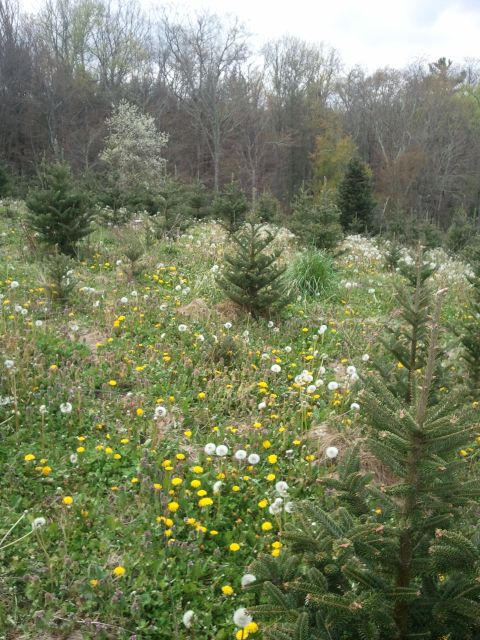
The most important creatures that tree growers invite into their tree fields are natural predators, brought in when ground covers are managed rather than killed. The next photo is from a field I was also in last week, showing a diversity of flowering ground covers.

That means that tree growers don't have to purchase natural predators like the lady beetles sold here for home gardens. Predators are attracted to the diversity of flowers and insect activity in the ground covers and will feed on any aphids or mites found in the Christmas trees themselves. It's free pest control.

One of the lessons from the Extension organic field in Alleghany County has been that the ground covers that come in when low rates of Roundup are used are far superior to all the grass that grows in the organic trees. After all, we grow grass in our lawns because grass tolerates mowing. Mowing ground covers in the organic trees has promoted grass and actually decreased biodiversity in the ground covers as compared to the lower portion of the field where conventional practices have been used up until this year. In this photo, you can clearly see the line where the clover stops and the grass starts. That's the line between the trees that have been grown organically since 2008 and those that are switching to organic production this year. Mowing promotes grass and it has certainly taken over to the detriment of the trees and the natural predators as well. (For those wanting to grow Fraser fir organically, it will be important to plant clover and other beneficial ground covers in a field the year before the Christmas trees are set -- something that wasn't done on this site. But that's for another blog entry!)

These ground covers, however, are also forage for bees. Clover, wild mustard, and purple deadnettle especially bring the bees in. Protecting bees can be as simple as choosing the time of day when you spray with an insecticide. Spraying trees in the late afternoon or at night for mistblower operators, is a good way to avoid problems with bees. Switching pest control to the fall is also a good way to avoid problems with bees. Be aware if someone has a commercial or even a hobby hive near your tree field. For fields close to bee hives, a mid-March application of horticultural oil will control most Fraser fir pests without causing a problem with bees at all.

April 22 -- Earth Day -- might seem like an odd time to think about Christmas trees. But those involved in the Christmas tree industry in western North Carolina know that every day is Earth Day in a Christmas tree farm!


Friday, April 20, 2012

Strange Spring: The Continuing Saga!

This spring continues to be unique. I was in a field in Avery County at a fairly high elevation yesterday, and one in Transylvania County at a low elevation today, and bud break was about the same. Only a few trees had broken a few buds in both fields, but it looks like the trees are ready to pop. I think the cooler weather this week has slowed things down.

But don't expect the cooler weather to slow the bugs down. The twig aphids are reproducing. This typically happens right before bud break, and they are doing the same again this year. The difference is that it appears that bud break and perhaps shoot growth might take longer than normal. That means that the trees will be at their most vulnerable to twig aphid attack for a longer period of time. Also, the warm spring has allowed for good aphid survival and reproduction. It all adds up to a potentially bad year for twig aphids.

That is why I've always warned people that if you are beating the foliage and finding even a few aphids, they will reproduce and end up being a problem. Each female aphid can produce 10 to 15 live young -- making what you saw last week 10 times more this week.

Rust mites are also quite active and will remain so until temperatures really warm up.

The good news is there has also been a lot of rain, which will help the trees grow out of any twig aphid damage. The following aren't very good photos, but they illustrate my point. The first picture is of a tree with twig aphid damage in May. The second is of the same tree in July. Most of the damage has straightened back out.

Shoots actively growing show lots of needle curl...

... but the mature growth has little damage.
So don't get too concerned with twig aphids. Use your judgement. Still, it's a good idea to recheck the trees that you plan on cutting this year that are your best trees, and treat them if necessary. Dimethoate is a good choice at this point as it will penetrate the cones and any broken buds. However, remember that Dimethoate is quite toxic, and is especially a problem when bees are active (which they are now in ground covers). Consider spraying later in the day, or if you are using a mistblower, of an evening.

With as much wind as we've been having this spring, I know how hard its been to get sprays out. Just remember, that poor conditions for spraying will give poor control results. There's little need to waste time, money, and put the environment to risk by forcing a spray job under windy conditions.

Let me know if you have any questions, and good luck!

Monday, April 16, 2012

Who Can Learn to Scout?

ANSWER: Anyone!

Yesterday, Brad Edwards showed a picture of his girls scouting for pests. His 6-year-old was identifying twig aphids and elongate hemlock scale, and showing the grower what to look for and what to do. I love it! Way to go girls!!!


Sunday, April 15, 2012

The Early Spring: A Message From Doug Hundley

Doug Hundley, Avery County IPM Technician, sent out this message to his IPM folks. I thought it was so good, I've copied it here for everyone.

The only other thing I would add to this is the need to be aware of bees in the field when you spray. Don't apply products like Dimethoate when bees are actively foraging. I posted something about this a couple of weeks ago in: Bee Careful, but it bears repeating.

Doug Hundley (left), talking with Brad and Scott about scales.
Good day everyone,

How early the Fraser budbreak will be this year will obviously be a record breaker; like everything else that is happening this spring.  This is hardly news worthy now.  The frost events this last week were, of course,  tough on the fruit and flowers but we lucked out on the Fraser buds in Avery County.  Below 3,000 ft.elevation, light damage may have occurred.

Today I wanted to know if you are seeing what I am seeing out there.  The cones have emerged and have made a good hiding spot for any BTA in the trees.  As you know, from this point on, any BTA treatments need to include Dimethoate and be applied with a high pressure hose sprayer.  The cones should be targeted specifically to get adequate penetration.  Of course if you have the time to remove the cones and carry them out of the field, a mistblower application could work for a few more days.

I said a few more days because it looks to me like the new growth buds will be breaking this week.  Budbreak is already underway below 3,000 ft. ; elevation in locations like Mountain City.  As the buds emerge, hose applications that include Dimethoate will continue to be somewhat effective for about 2 weeks into budbreak.  After that, we have no other options.  I know some of you are adding Safari to your spring BTA treatments.  We really need to know how well Safari works in April and letting us know when and where you are treating with Safari will help very much.  Please respond via email and we'll monitor your results over the summer.  Thanks in advance!

The high winds and early budbreak have made it another tough year to treat for BTA in the springtime.  I know many of you are enjoying the benefits of having made your BTA treatment last summer or fall.  What a great development this has been.  However, if you haven't already heard, that Hemlock Rust Mites are having a very good year.  The rust mites have enjoyed this perpetual spring that began in January.  With temperatures forecasted to top out in the 60's for the next 7-10 days, we don't expect the rust mites to do anything but increase. 

I know that many of you have been treating for BTA in the Fall for several years and have a sense of security that it always works, which it usually does.  However, never forget the Rust Mites, especially if you applied Wisdom or Asana last year between the months of April and July.  I've seen not only 25 mites per needle but damage beginning to show on the foliage. 

Everything is happening early this year.  That may include Rust mite and spider mite damage as well.  Despite our successful spray programs there is always an important need to scout.  Please reply to me with your own observations.  Feedback from you guys has been very helpful and always will be.

Sincerely,  Doug

Again, thanks Doug for your observations and recommendations. And Bee Careful out there! This spring certainly has been challenging, but if we keep getting rain, don't worry too much about twig aphids! I'd worry more about rust mites!